
Spanning Tree Ensembles: Quantifying Social Network Complexity via Node Contraction
Spanning tree based method for a social network analysis
This paper introduces a combinatorial approach based on the node contraction method to enumerate spanning trees in complex social networks. Its core contribution is the derivation of explicit recursive functions for closed chains of both identical and heterogeneous graphs, facilitating the analysis of large-scale interaction topologies.
TL;DR
This research addresses the challenge of calculating "network complexity"—the total number of spanning trees—within large-scale social networks. By leveraging a Node Contraction Method, the authors derive exact recursive formulas for networks structured as closed chains, providing a mathematical shortcut to assess the connectivity and interaction potential of massive social groups.
Background: Why Spanning Trees Matter in Social Science
In Social Network Analysis (SNA), a network isn't just a static map; it is a repository of possible interaction paths. Theoretical complexity, defined here as the number of spanning trees, represents the variety of ways individuals can be connected without cycles.
- High Complexity = Robust interaction opportunities.
- Low Complexity = Limited, fragile social ties.
The problem lies in calculation: as the number of individuals and interactions grows, the computational cost of counting these trees explodes.
Methodology: The Contraction Approach
The authors move away from raw computational brute force, favoring a combinatorial approach. The primary tool is the contraction of adjacent vertices.
1. The Core Principle
For a planar graph with a separation pair , the complexity can be decomposed into the product of the complexities of its subgraphs and their contracted versions:
2. Structural Models
The paper investigates two specialized topologies:
- Closed Chain of Identical Graphs (): A loop of identical subgraphs connected via articulation points.
- Closed Chain of Heterogeneous Graphs (): A generalization where each link in the chain can be a different type of interaction subgraph.
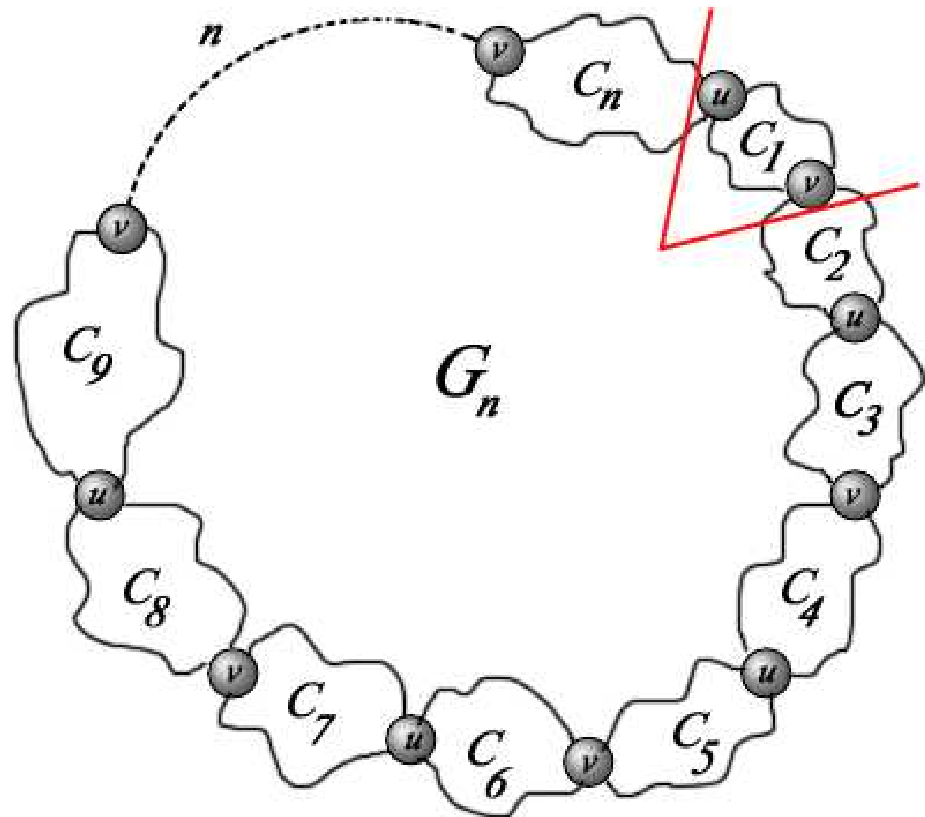 Fig 1: A social network represented by a closed chain of different graph types .
Applications and Numerical Efficiency
The researchers applied their formulas to three specific "real-world" social scenarios:
- Cycle Chains (): Groups connected in circular logic.
- Interaction Multipliers (): Scenarios where the number of distinct edges between two nodes increases linearly.
- Neighbor Multipliers (): Scenarios where intermediate "broker" individuals are added between two main actors.
Performance Highlights
The mathematical formulas allow for the calculation of astronomical numbers that would crash standard graph-traversal algorithms. For instance, in a chain of 12,345 graphs, the number of spanning trees reaches a scale of .
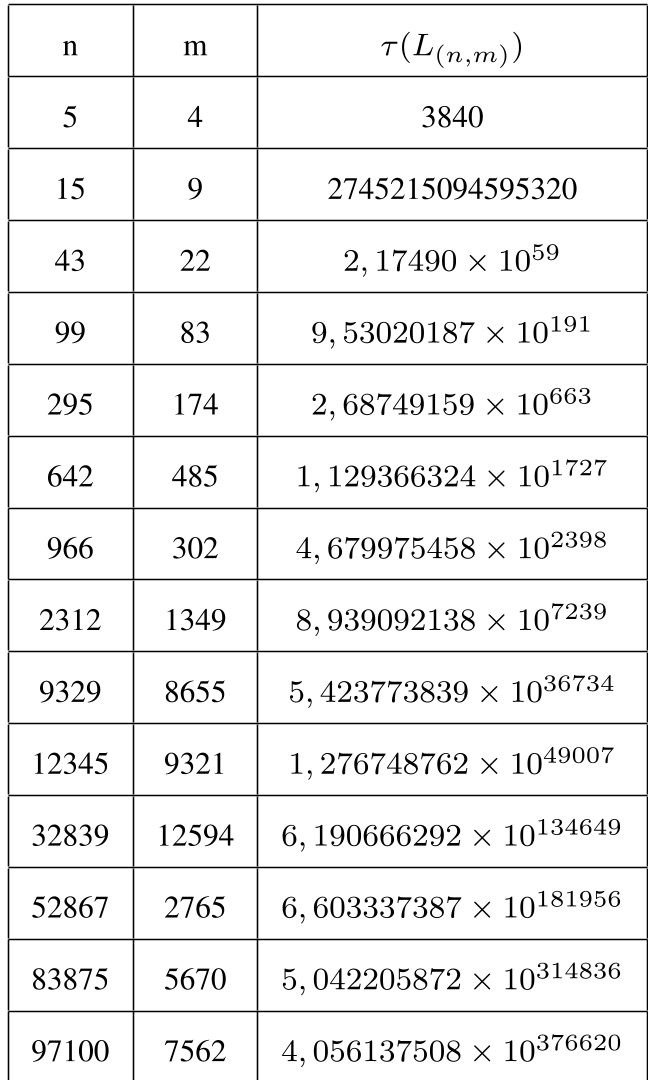 Table 1: Numerical results for illustrating the scalability of the recursive formula approach.
Critical Insight & Conclusion
Why this works
The beauty of this method lies in its recursive nature. Instead of viewing a social network as one giant matrix, the authors treat it as a sequence of operations. By solving the "local" contraction of a single social group, they can propagate that solution across the entire chain.
Limitations
While the approach is highly efficient for planar graphs and chain-like structures, its application to highly dense, non-planar "hairball" networks (like the global internet or random Erdos-Renyi graphs) remains an open challenge. The "closed chain" is a specific Inductive Bias that may not fit every social group.
Takeaway
This work provides a bridge between pure combinatorial graph theory and practical sociology. It demonstrates that the "complexity" of a social structure is not just a qualitative feel, but a quantifiable metric that can be calculated precisely, even for networks involving tens of thousands of actors.