
Scaling Connection Seeds: Why Triangle Counting is the Secret to Social Link Prediction
Spark’s GraphX-based link prediction for social communication using triangle counting
This paper introduces the Clustering Coefficient Index (CCI), a Spark GraphX-based link prediction method designed for large-scale social networks. By leveraging triangle counting and local clustering coefficients, the method significantly enhances prediction accuracy over traditional similarity indices in a distributed computing environment.
Executive Summary
TL;DR: This paper tackles the "future friend" problem in massive social networks by introducing the Clustering Coefficient Index (CCI). Built on Apache Spark's GraphX, it moves beyond simple neighbor-counting to analyze the "compactness" of local communities through triangle counting. The result is a more accurate prediction engine that runs twice as fast as legacy MapReduce implementations.
Positioning: This work serves as a practical bridge between theoretical graph topology and distributed big data engineering, demonstrating how higher-order graph metrics (like clustering coefficients) can be computed at scale to solve real-world recommendation problems.
The "Missing Link" Problem
Social networks are inherently dynamic and incomplete. Platforms like Twitter or Facebook only capture snapshots of human interaction. Predicting the next "edge" (link) is computationally expensive because the number of potential pairs grows quadratically with the number of users ().
Earlier methods like Common Neighbors (CN) or Preferential Attachment (PA) are popular because they are "local"—they only look at immediate neighbors. However, they are "blind" to the quality of those connections. Two nodes might share ten neighbors, but if those neighbors are isolated from each other, the link is less likely than if those ten neighbors form a tight-knit "clique."
Methodology: Beyond Simple Neighbors
The authors propose the Clustering Coefficient Index (CCI). The intuition is rooted in the "Local Community Link" (LCL) concept: nodes are more likely to connect if their mutual friends are also friends with each other.
The Secret Sauce: Triangle Counting
A "triangle" in a graph exists when three nodes are all connected to each other. The Clustering Coefficient (CC) of a node measures how close its neighbors are to becoming a complete clique.
By calculating the average clustering coefficient of all common neighbors between two target nodes ( and ), the CCI measures the "structural pressure" for a new link to form.
Architecture Power: Apache Spark GraphX
To handle millions of nodes, the authors abandoned Hadoop's MapReduce (which is bottlenecked by disk I/O) in favor of Apache Spark GraphX. GraphX uses Resilient Distributed Datasets (RDDs) to keep graph data in memory, allowing iterative algorithms like Triangle Counting and PageRank to run exponentially faster.
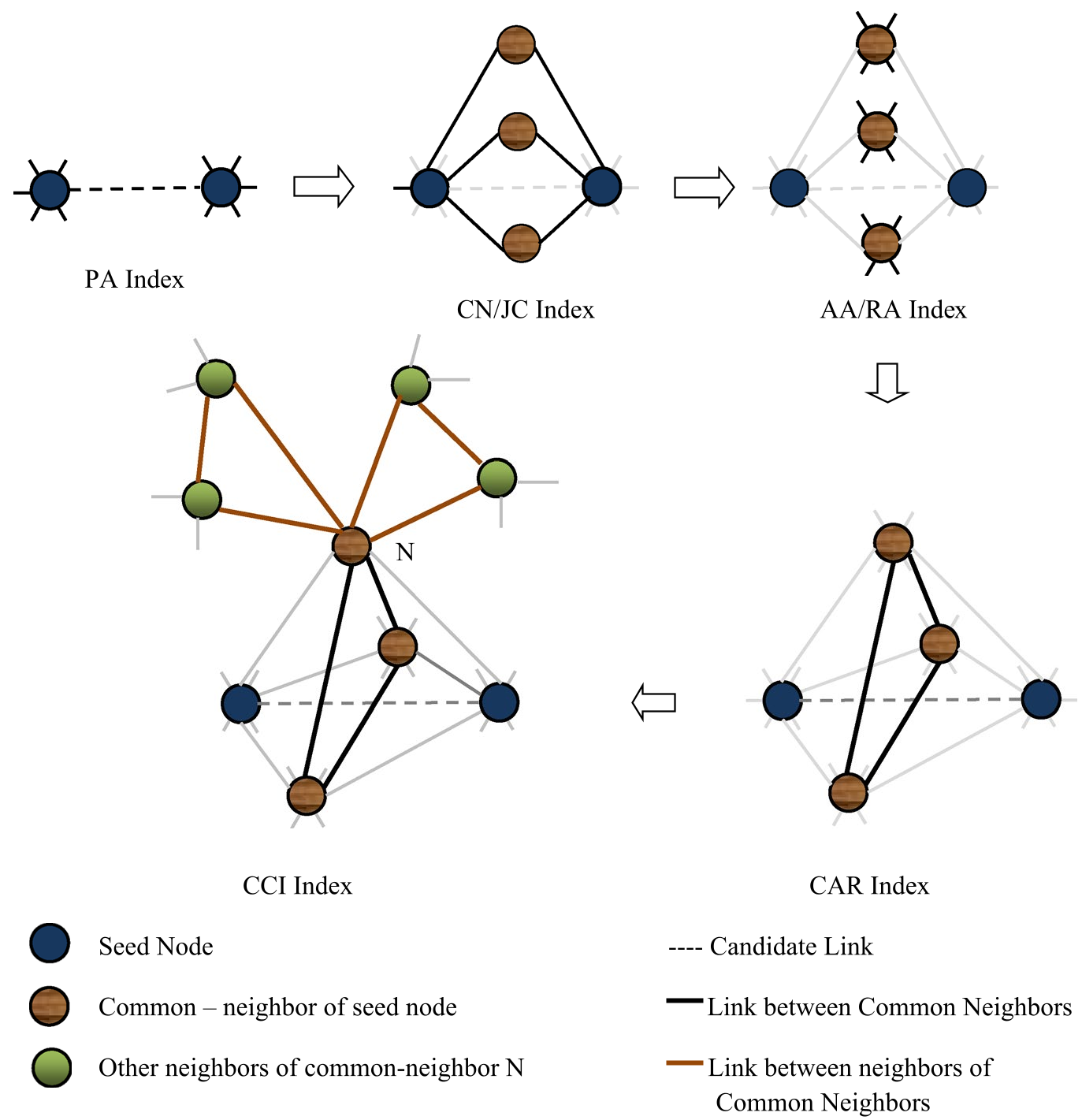 Figure 1: Evolution of similarity indices from Level-1 (CN) to Level-2 (CAR/CCI) structural analysis.
Experimental Battleground
The researchers tested CCI against five classic baselines across 12 diverse datasets, ranging from "Dolphin" social groups to "ego-Facebook" networks.
1. Accuracy (AUC)
The Area Under Curve (AUC) performance showed that CCI is dominant in "incomplete" biological and social networks (like C.elegans and H.friendships). While traditional indices like PA (Preferential Attachment) performed poorly, CCI consistently stayed near the top of the leaderboard.
2. Efficiency: Spark vs. MapReduce
The engineering results were even more striking. On large datasets like cit-Patents and roadNet-CA, the Spark implementation was roughly 50% faster than MapReduce. This is because MapReduce requires three separate jobs (Mapping, Pairing, and Reducing) with heavy disk writes between each, whereas Spark executes the entire DAG (Directed Acyclic Graph) in memory.
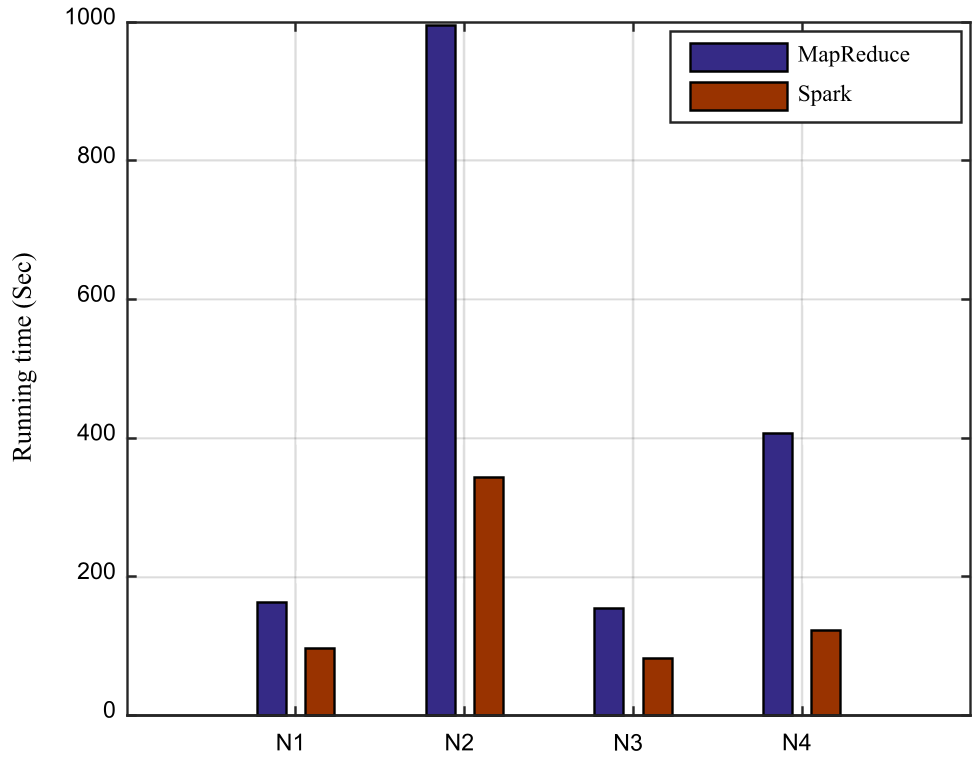 Figure 2: Execution time comparison. Note how Spark consistently outperforms MapReduce across all real-world networks.
Critical Insight & Practical Value
The value of this paper lies in its Inductive Bias: it assumes that social networks are not just random collections of edges but are built out of "geometric" building blocks (triangles).
Takeaways for Engineers:
- Context Matters: If you are building a recommendation engine, don't just count mutual friends; look at how "clustered" those friends are.
- Framework Shift: For graph algorithms, MapReduce is obsolete. The in-memory RDD partitioning of Spark GraphX is the baseline for modern graph big data.
Limitations: The current CCI approach is evaluated on undirected, unweighted graphs. In the real world, "closeness" between users often has weights (frequency of interaction) and direction (follower vs. followed), which provides an opening for future research into Weighted CCI.
Conclusion
By combining the physics of graph topology (triangles) with the power of distributed computing (Spark), the authors provide a scalable blueprint for the next generation of social recommendation systems. It proves that in the world of Big Data, how you are connected is just as important as who you are connected to.