
SparkRDF: Bridging HBase and Spark for High-Performance Distributed RDF Queries
SparkRDF: In-Memory Distributed RDF Management Framework for Large-Scale Social Data
SparkRDF is a hybrid two-layer distributed RDF management framework that combines HBase for persistent storage and Apache Spark for in-memory query processing. It utilizes a novel three-table indexing schema and a pipelined join strategy to achieve high-performance SPARQL Basic Graph Pattern (BGP) queries on large-scale social datasets.
TL;DR
SparkRDF is a high-performance framework designed to handle the complexity of Online Social Network (OSN) data. By combining HBase for massive-scale indexing and Apache Spark for in-memory pipelined execution, it eliminates the "disk I/O bottleneck" common in earlier MapReduce-based RDF engines, achieving a 10x speedup on complex SPARQL queries.
Background & Motivation
Social network data is characterized by its massive volume and interconnected structure. The Resource Description Framework (RDF) and SPARQL are perfect for modeling these relationships, but traditional systems fall short:
- Centralized Systems (RDF-3X, Hexastore): Limited by a single machine's RAM and CPU.
- Hadoop-based Systems (Iterative MapReduce): Suffer from "data shuffling" where every intermediate result of a join must be written back to HDFS, killing performance.
- Memory-only Systems (Trinity): Scalability is capped by physical RAM; if the graph doesn't fit, the system fails.
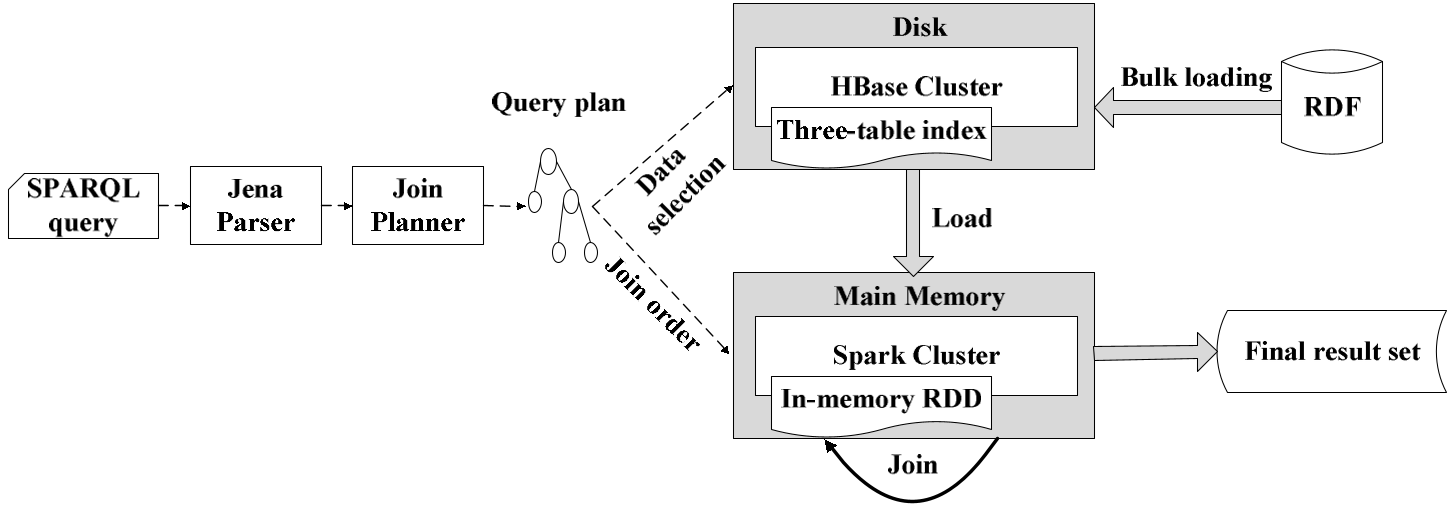
SparkRDF's insight is simple but powerful: Use the disk for what it’s good at (holding the massive index) and the RAM for what it’s good at (processing the intermediate "active" query data).
Methodology: The Two-Layer Architecture
1. The Storage Layer (HBase Indexing)
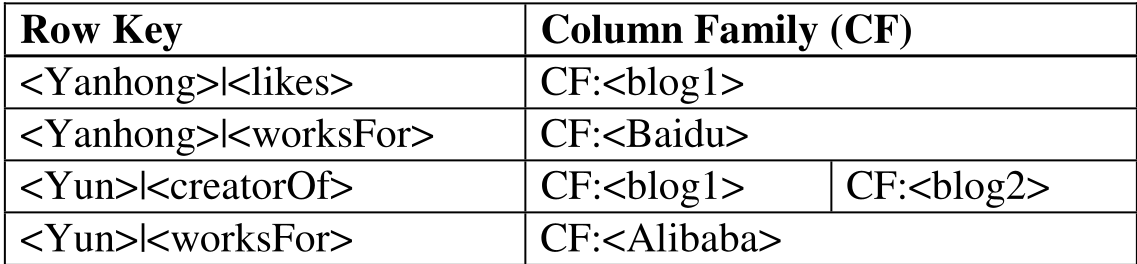
Instead of the traditional 6-index approach (Hexastore), the authors proved that only three indices (SPO, POS, OSP) are necessary to answer all 8 types of triple patterns with a single range scan.
- Row-Key Optimization: They pack two elements of the triple (e.g., Subject and Predicate) into the HBase row key and use the HBase column qualifier for the third. This leverages HBase’s internal B+ tree-like indexing for fast prefix lookups.
- Bulk Loading: To bypass the overhead of the HBase API, they use MapReduce to generate HFiles directly in HDFS and "side-load" them into the database.
2. The Compute Layer (Spark Join Pipelining)
Once data is filtered from HBase, it is pulled into Spark as Resilient Distributed Datasets (RDDs).
The framework uses a greedy heuristic planner to determine the join order:
- Pick the variable shared by the most triple patterns.
- Execute joins in a pipeline where the output of one join remains in RAM (via
RDD.cache) as the input for the next. - This bypasses the HDFS write-back entirely, drastically reducing latency.
Performance Benchmarks
Using the LUBM (Lehigh University Benchmark), the authors tested SparkRDF against IterMR and H2RDF.
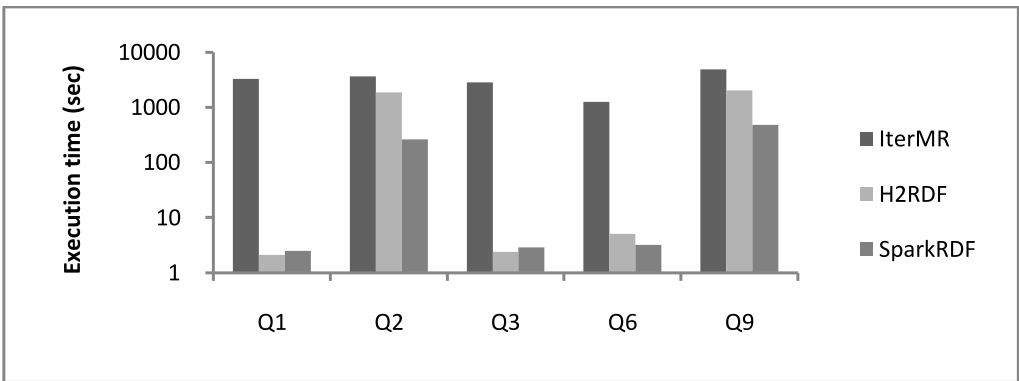
- Low-Selectivity Queries: In complex scenarios (Q2, Q9) where large intermediate results are generated, SparkRDF was nearly 10 times faster than H2RDF.
- Scalability: As the dataset grew from 110 million to 3.7 billion triples (809 GB), the execution time for complex joins increased almost linearly, proving the system can handle "Web-scale" data.
Critical Analysis & Conclusion
Takeaways
SparkRDF successfully demonstrates that in-memory pipelined joins are the key to making SPARQL viable for real-time social applications. By utilizing Spark's RDD abstraction, they solve the iterative join problem that plagued MapReduce.
Limitations & Future Work
- Cold Starts: SparkRDF is slightly slower on very simple, high-selectivity queries compared to centralized engines because of the overhead of initializing a Spark context.
- Static Planning: The current join optimizer is heuristic-based (greedy). The authors plan to implement a proper Cost-Based Optimizer (CBO) using data statistics (histograms) to handle even more complex graph topologies.
- Inference: The paper focuses on Basic Graph Patterns (BGP). Handling OWL/RDF Schema reasoning (transitive properties) remains a future challenge.
Final Thought: SparkRDF provides a robust blueprint for any engineer building a semantic knowledge graph on top of a modern Big Data stack.