
Sparrow: Taming the Stability-Efficiency Tradeoff in Long-Context RL
Sparrow: Sparse Rollout for Stable and Efficient Long-context RL of Large Language Models
This paper introduces Sparrow, a framework for stable and efficient Reinforcement Learning with Verifiable Rewards (RLVR) using sparse rollouts. By identifying the impact of tail-end distribution mismatch between sparse actors and dense policies, it achieves over 2.0x speedup in rollout generation while maintaining the performance of dense-attention models.
TL;DR
Reinforcement Learning with Verifiable Rewards (RLVR) is the engine behind modern "reasoning" models like O1 and DeepSeek-R1, but its cost is dominated by long-context generation. Sparrow solves the training collapse associated with sparse attention rollouts by focusing on the "tail distribution" of token mismatch. It delivers ~2x faster training while ensuring the resulting dense model remains state-of-the-art.
The "Thinking" Wall: Why RL Training is Slow
In the current frontier of AI, "Thinking" is synonymous with "Length." To solve a complex AIME math problem, models generate tens of thousands of Chain-of-Thought (CoT) tokens. In RLVR, where the model must self-generate paths to find a correct answer, this rollout stage becomes a massive bottleneck—often exceeding 70-90% of the total training time.
While Sparse Attention (pruning the KV cache) is a natural candidate for speedup, it has a fatal flaw in RL: it causes Training Collapse. If the rollout (the "actor") diverges too much from the model being trained (the "policy"), the gradients become noisy, the response length tanks, and the model's reasoning capabilities evaporate.
The Core Insight: It’s the Tail, Not the Average
The authors discovered a fascinating phenomenon: High Skewness. Even under aggressive sparsity, most tokens generated align perfectly with a dense model. The collapse is driven by a tiny minority of "renegade" tokens where the sparse-dense distribution diverges sharply.
As shown in the paper's analysis, the average L1 distance is a poor indicator of stability because the "good" tokens drown out the "bad" ones. Instead, Sparrow monitors the 5-percentile tail. By ensuring the worst-aligned tokens stay above a critical threshold ( acceptance rate), RL training remains rock-solid.
Methodology: Dynamic Scheduling and DistillSparse
To maintain this stability, Sparrow employs two key innovations:
- Dynamic Sparsity Scheduling: Since mismatch worsens as sequences get longer, Sparrow moves from aggressive to lenient sparsity budgets within a single generation. This keeps the per-token tail mismatch constant.
- DistillSparse: This is a clever "online refinement" loop. While the dense policy is being updated via PPO, a small set of LoRA weights is trained simultaneously to make the sparse rollout look more like the dense model. This "on-the-fly" distillation allows for even more aggressive pruning.
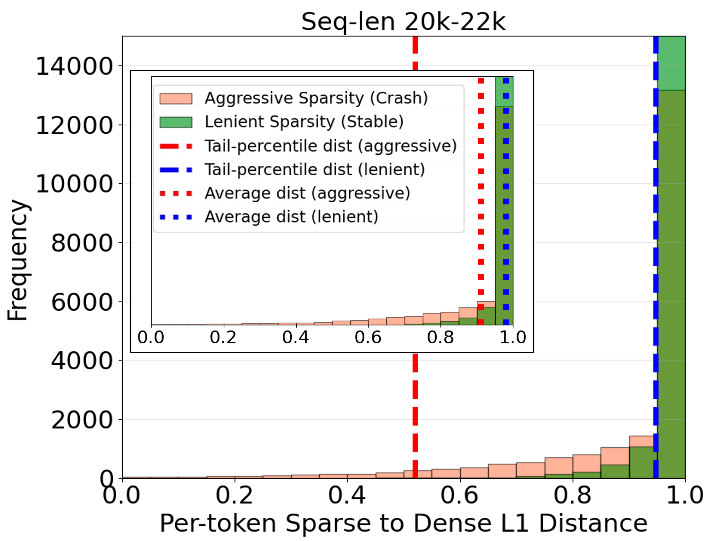 Figure: The skewness of the per-token mismatch and the effectiveness of sparsity scheduling.
Experimental Results: Scaling Efficiency
The team tested Sparrow across the Qwen3 "thinking" family. The results prove that the stability threshold is "model-agnostic"—a threshold found on a 1.7B model effectively predicts stability for a 14B model.
- Speedup: Rollout generation accelerated by 2.0x to 2.4x.
- Performance: On AIME and AMC math competitions, Sparrow-trained models matched or slightly exceeded the performance of models trained with 100% dense rollouts.
- Generalization: Successful application to Coding RL (MBPP+, HumanEval+) confirms the method isn't just a "math trick."
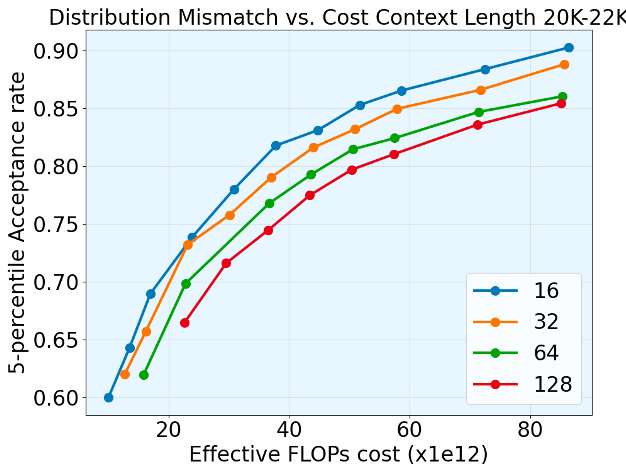 Figure: Speedup benefits and Pareto frontier of page-size vs. cost.
Academic Insight: Why Does This Matter?
The industry is currently obsessed with "Inference Scaling Laws"—buying more compute at test-time for better reasoning. Sparrow proves that we can achieve "Post-training Scaling" more efficiently. By treating the rollout actor as a lossy but steerable approximation of the policy, Sparrow provides a roadmap for training the next generation of 100k+ context reasoning agents without needing a linear increase in GPU clusters.
Conclusion
Sparrow is a rare "systems + algorithm" hybrid. It acknowledges the physical reality of memory-bound KV caches and provides a mathematically grounded way to bypass the "memory wall" of RL. For any lab training long-context reasoning models, dynamic tail-mismatch scheduling is no longer optional—it's the key to survival.