
Enhancing Speech Emotion Recognition: The Power of Sparse Autoencoders and Attention Mechanisms
Sparse Autoencoder with Attention Mechanism for Speech Emotion Recognition
The paper introduces a semi-supervised Speech Emotion Recognition (SER) framework combining a Sparse Autoencoder with an Attention-based Bidirectional LSTM (BLSTM). By utilizing a pseudo-class for unlabeled data and a local attention mechanism, the model achieves state-of-the-art results across three multi-lingual datasets (CASIA, EMODB, IEMOCAP).
TL;DR
Recognizing human emotion through speech is challenging due to the scarcity of labeled data and the presence of "noisy" non-emotional frames. This paper proposes a hybrid architecture that pairs a Sparse Autoencoder (for unsupervised feature extraction) with a BLSTM and Attention Mechanism (for focusing on emotional cues). The result is a significant performance boost in cross-language scenarios, setting new benchmarks on CASIA, EMODB, and IEMOCAP data.
The Core Challenge: Label Scarcity and Emotional Noise
In the world of Speech Emotion Recognition (SER), we face two critical hurdles:
- Subjectivity: Labeling "anger" or "sadness" isn't as objective as labeling a "cat." Different annotators have different perceptions, making massive, high-quality datasets expensive and rare.
- Temporal Sparsity: Not every millisecond of an "angry" clip contains anger. Silence, filler words, and background noise dilute the emotional signal.
Traditional methods that use static statistical features often wash out these temporal nuances. Modern deep learning helps, but still struggles with the "data hunger" problem.
Methodology: A Dual-Track Solution
The authors' innovation lies in their Semi-Supervised Sparse Autoencoder framework. The architecture is split into two primary paths working in tandem.
1. The Generative Path (Sparse Autoencoder)
By using a Sparse Autoencoder, the model can learn from both labeled and unlabeled data. The "sparsity" constraint forces the hidden layers to find the most efficient, salient features of the speech signal. This path is governed by a reconstruction loss (), ensuring the model truly understands the underlying structure of the Mel-spectrogram inputs.
2. The Discriminative Path (BLSTM + Attention)
Instead of treating all time frames equally, the Attention Mechanism assigns a "score" to each frame. Frames with high emotional intensity get higher weights, while silence or friction sounds are ignored during the final utterance-level pooling.
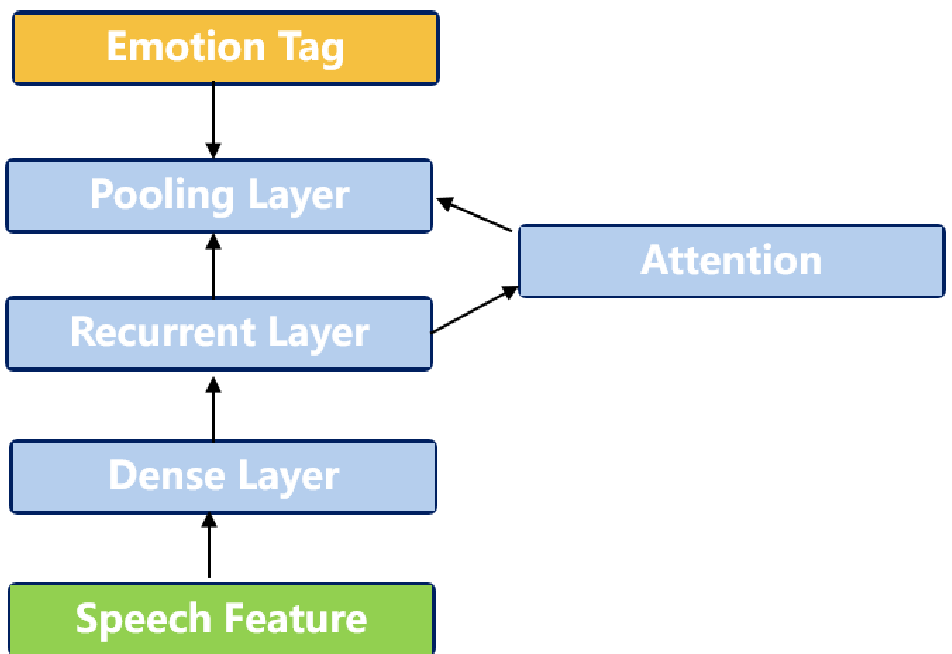
The Bidirectional LSTM (BLSTM) ensures that the model captures context from both the past and the future of a specific frame—crucial for emotion, which is a continuous and evolving human behavior.
Experimental Validation: Breaking Language Barriers
The model was tested across three vastly different languages: Mandarin (CASIA), German (EMODB), and English (IEMOCAP).
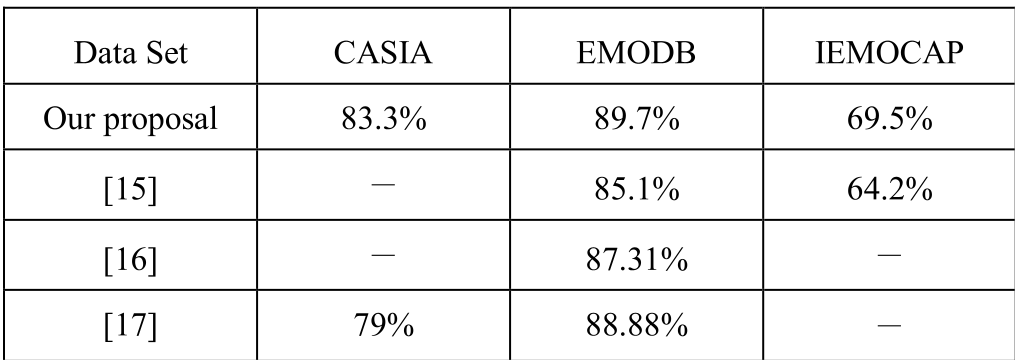
Key Results at a Glance:
| Dataset | Language | Proposal Accuracy (WA) | Previous Best |
|---|---|---|---|
| CASIA | Mandarin | 83.3% | 79.0% |
| EMODB | German | 89.7% | 88.8% |
| IEMOCAP | English | 69.5% | 64.2% |
The use of log Mel-spectrograms as raw input features proved more effective than traditional hand-crafted statistical features, allowing the deep learning layers to extract higher-level abstractions that generalize better across different languages.
Critical Insights & Takeaways
The paper confirms that in niche domains like Affective Computing, Autoencoders are back. By leveraging unlabeled data through a reconstruction task, the model becomes more robust and requires less "gold standard" human supervision.
Why did the Attention Mechanism work so well here? It acts as a dynamic filter. In many speech datasets, only 20-30% of a clip might contain the actual emotional peak. By mathematically isolating these peaks via Equation (1) and (2) in the paper, the final classifier receives a "distilled" version of the emotion, free from the noise of irrelevant audio segments.
Future Outlook
While the results are impressive, the computational complexity of the Sparse Autoencoder (due to larger hidden layers) is a consideration for real-time edge devices. However, for high-precision emotion analysis in healthcare and intelligent assistance, this architecture provides a powerful framework for extracting meaning from the subtle nuances of the human voice.