
Sparse Delta Memory: Scaling Linear RNN States to 1M Tokens via Sparsity
Sparse Delta Memory: Scaling the State of Linear RNNs through Sparsity
Sparse Delta Memory (SDM) is a novel sparse extension of Gated DeltaNet (GDN) that scales the hidden state of linear RNNs by three orders of magnitude using a Product-Key Memory (PKM) addressing scheme. It achieves SOTA long-context recall and lower training loss than both dense linear RNNs and traditional Transformers under isoFLOP constraints.
TL;DR
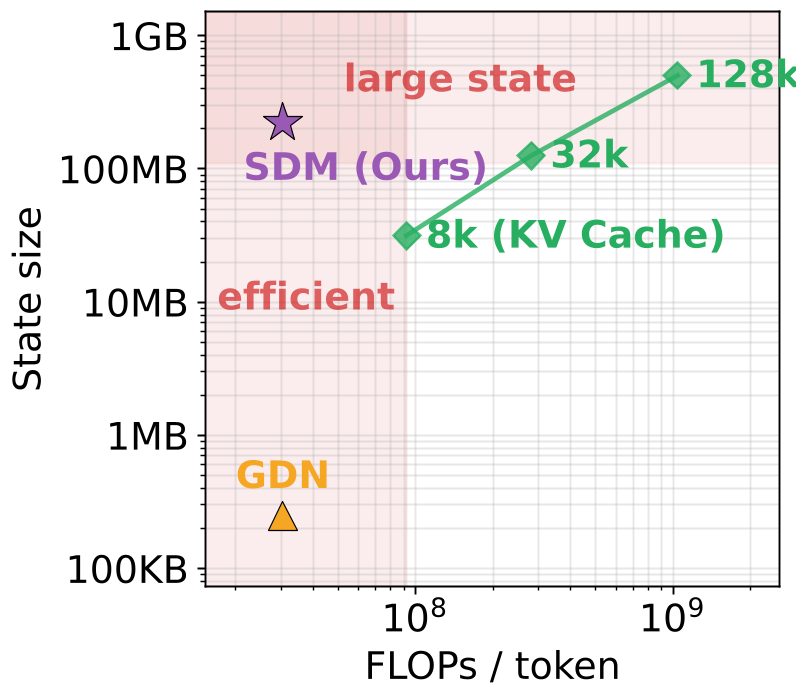
Researchers from Meta FAIR and Inria have introduced Sparse Delta Memory (SDM), an architecture that finally addresses the "memory bottleneck" of Linear RNNs. By utilizing sparse addressing (PKM), SDM scales the hidden state capacity by 1,000x without increasing the computational budget (FLOPs). The result? A model that outperforms Transformers in pre-training efficiency and bridges the long-context recall gap that has long plagued Mamba-style architectures.
The "State Size" Wall
In the world of sequence modeling, we face a fundamental trade-off:
- Transformers: Excellent at "recalling" specific details from the past (via the KV cache) but suffer from complexity.
- Linear RNNs/SSMs: Efficient scaling with a fixed-size state, but as the context grows, the "fixed state" becomes a crowded bottleneck, leading to "forgetfulness."
Current SOTA linear models like Mamba2 or Gated DeltaNet (GDN) are dense. If you want more memory, you need larger matrices, which means more FLOPs. SDM breaks this coupling.
Methodology: Sparsity as the Bridge
The core innovation of SDM is to treat the RNN state not as a dense matrix, but as a massive, sparsely-indexed table.
1. Sparse addressing via PKM
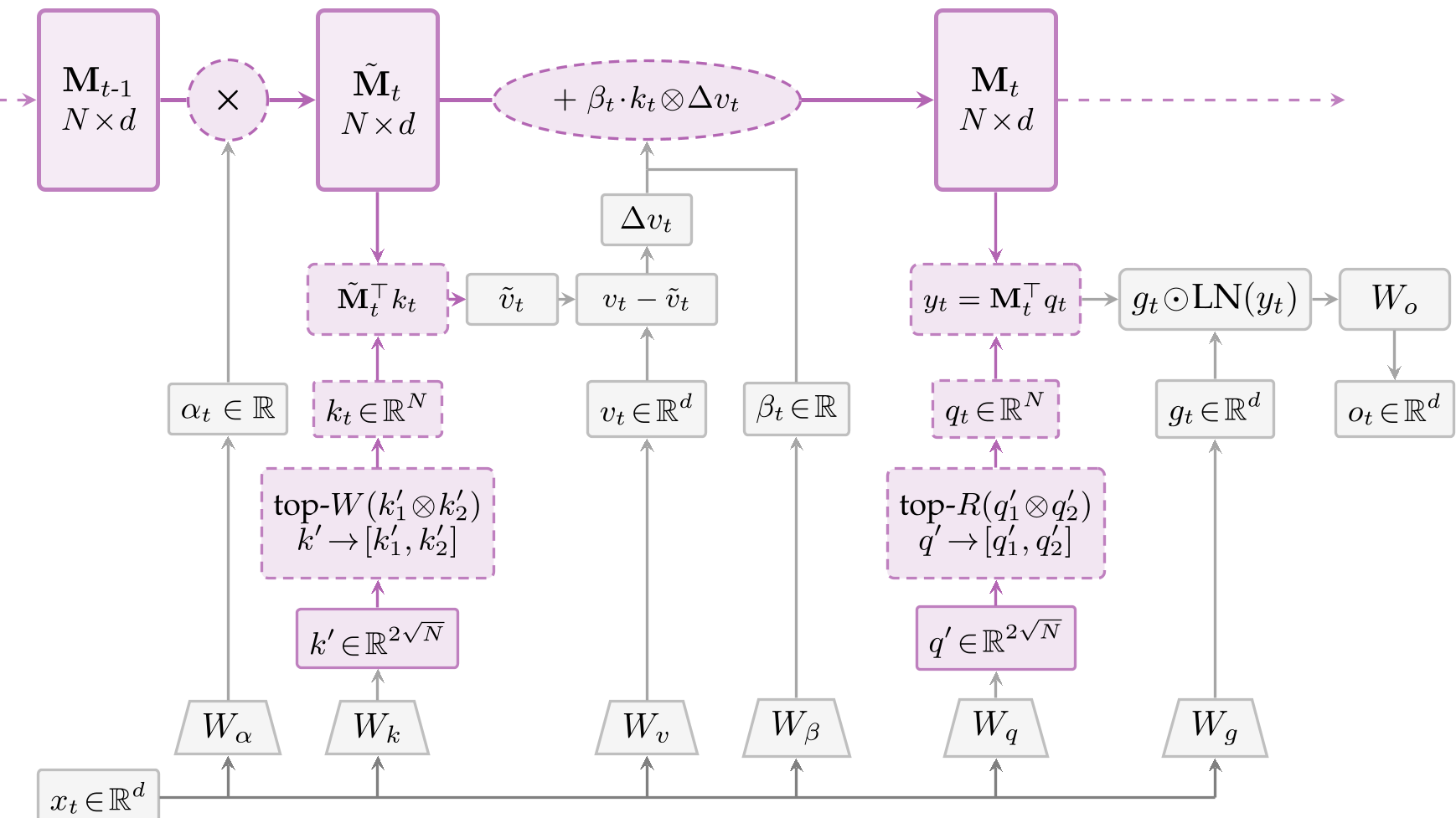
Instead of updating all memory slots, SDM uses a Product-Key Memory (PKM) scheme to select only the top write indices and top read indices. This allows the memory size to grow to millions of slots while the compute per token stays constant.
2. Gated Delta Updates
The model adopts the Delta Rule: before writing new information, it retrieves what was already there and subtracts it. This prevents the "saturation" or "explosion" of memory values.
3. The Power of (Learned Initial State)
Unlike traditional RNNs where the state starts at zero, SDM learns an initial state . This allows the model to store "world knowledge" directly in its recurrent state, effectively acting as a permanent parametric memory that costs zero additional FLOPs during inference.
Experimental Validation: Breaking the Scaling Laws
The authors trained a "Scaling Ladder" up to 8B parameters. The findings were striking:
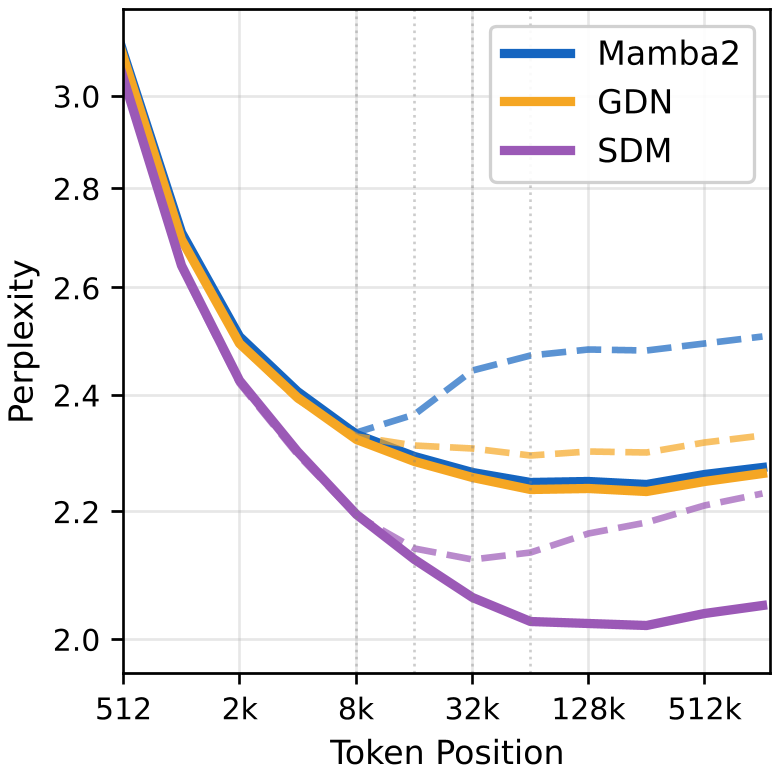
- IsoFLOP Dominance: At every compute scale, SDM achieved a lower training loss than the dense GDN baseline.
- Beating Transformers: At the 8B parameter scale (trained on 1T tokens), SDM reached a lower validation loss than a standard Transformer with Full Attention.
Long-Context Recall (The RULER Test)
The RULER benchmark tests a model's ability to find "needles in a haystack" across varying context lengths. SDM showed a massive jump over GDN:
- 1.4B Model: GDN (20.0%) vs. SDM (31.2%)
- 8B Model: GDN (34.2%) vs. SDM (50.2%)
While Full Attention still holds an edge in extremely complex "multi-key" retrieval (due to its unbounded cache), SDM is the first fixed-state model to remain competitive at lengths up to 1 million tokens.
Critical Analysis & Hardware Realities
While the math favors SDM, hardware implementation remains the "final boss."
- Bandwidth Overcompute: Sparse operations involve random memory access (Gathers/Scatters) in HBM, which is slower than the dense SRAM operations used by Mamba. Consequently, SDM's current training throughput is about 1.5x slower than GDN, despite having similar FLOP count.
- Memory Footprint: The large state of an 8B SDM model is significant—roughly equivalent to the memory cost of 200,000 tokens in a KV cache.
Conclusion
Sparse Delta Memory proves that the limitation of RNNs wasn't the linear recurrence itself, but the capacity of the dense state. By opening the door to sparse, high-capacity memory, we are moving toward a future where "memory-augmented" agents can reason over entire codebases or hours of video without the quadratic cost of Transformers.
The Takeaway: If you want to scale RNN context, don't build a bigger "engine" (FLOPs); build a bigger "warehouse" (State Size) and learn how to navigate it efficiently (Sparsity).