
SIT-NARMAX: Bridging the Gap Between Predictive Power and Clinical Transparency
Sparse, Interpretable and Transparent Predictive Model Identification for Healthcare Data Analysis
This paper introduces a Sparse, Interpretable, and Transparent (SIT) machine learning approach for healthcare data analysis based on the NARMAX (Nonlinear AutoRegressive Moving Average with eXogenous inputs) framework. By utilizing the Forward Regression Orthogonal Least Squares (FROLS) algorithm with ridge regularization, the method identifies parsimonious polynomial models that achieve SOTA-level predictive accuracy while maintaining human-readable mathematical structures.
TL;DR
In the era of "black-box" AI, this paper revisits NARMAX (Nonlinear AutoRegressive Moving Average with eXogenous inputs) to propose a Sparse, Interpretable, and Transparent (SIT) modeling framework. By transforming complex healthcare data into parsimonious mathematical equations, the method achieves high-precision forecasting (e.g., in ILI mortality and Beijing air quality) while remaining fully "auditable" by human experts.
Background & Positioning
As AI enters the high-stakes domain of healthcare, the "right to an explanation" becomes paramount. The author positions NARMAX not just as a control theory tool, but as a Single Hidden-Layer Recurrent Neural Network in disguise. It occupies a unique niche: it offers the mapping flexibility of nonlinear models with the structural clarity of classical regression.
The Problem: The Transparency Crisis in Healthcare AI
Most predictive modeling tasks in medicine prioritize accuracy, often leading researchers toward deep learning. However, these models suffer from:
- Overfitting: Capturing noise instead of the underlying physiological or epidemiological dynamics.
- Opacity: Providing a prediction without explaining which variables or what historical lags drove the result.
- Non-causality: Failing to respect the chronological "arrow of time" essential in dynamic system identification.
Methodology: Engineering Sparsity through FROLS
The SIT approach relies on the NARMAX representation, which models the output as a nonlinear function of past inputs, past outputs, and past errors.
1. Structural Representation
The model is formulated as a polynomial expansion, making it Linear-In-the-Parameters (LIP). This allows for the use of powerful linear algebra tools to solve fundamentally nonlinear problems.
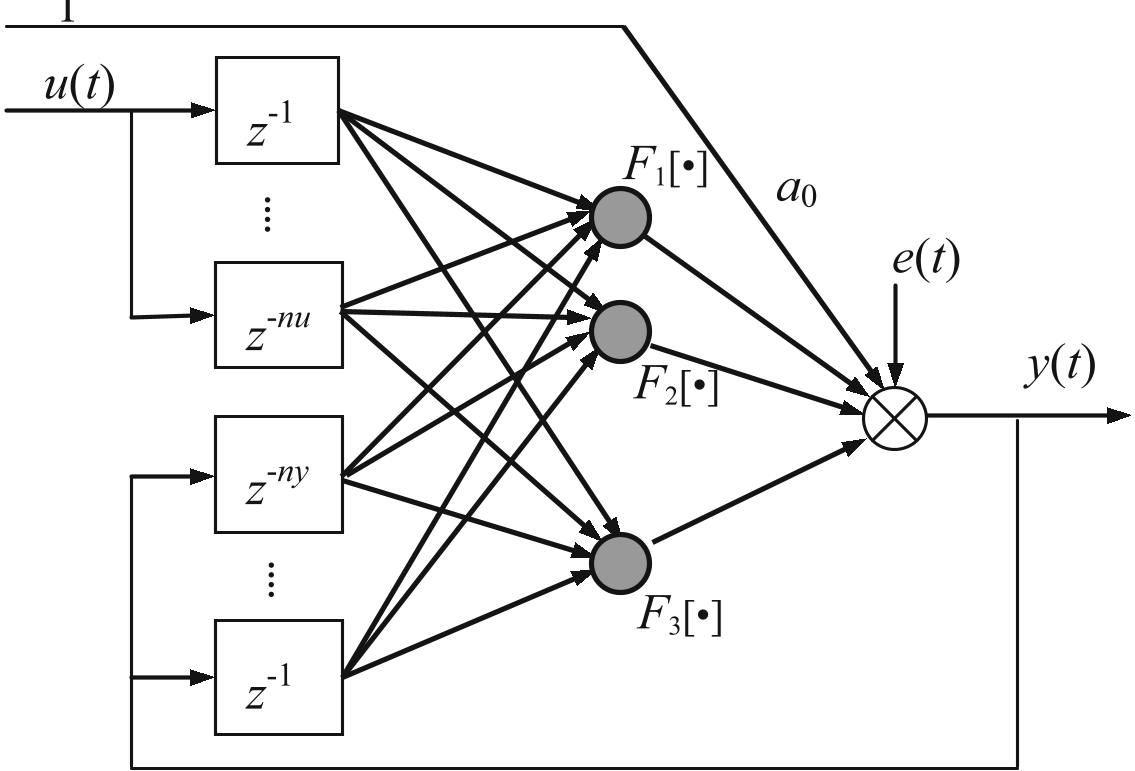 Fig 1: The architecture of a NARX model viewed as a recurrent network structure.
2. The FROLS Algorithm
To prevent a "combinatorial explosion" of terms (where a 3rd-degree polynomial with 10 variables could lead to hundreds of candidates), the author uses Forward Regression Orthogonal Least Squares (FROLS).
- How it works: It selects terms one by one, choosing the one that contributes most to the "Explained Variance" (Error Reduction Ratio).
- Result: A model that might only contain 5-10 terms but captures 99% of the system's behavior.
Experimental Evidence
Case Study 1: ILI Incidence vs. Mortality
The model successfully quantified how influenza-like illnesses drive weekly deaths.
- Insight: By including autoregressive variables (), the model captured the "inertia" of mortality rates, significantly smoothing the prediction.
- Visual Proof:
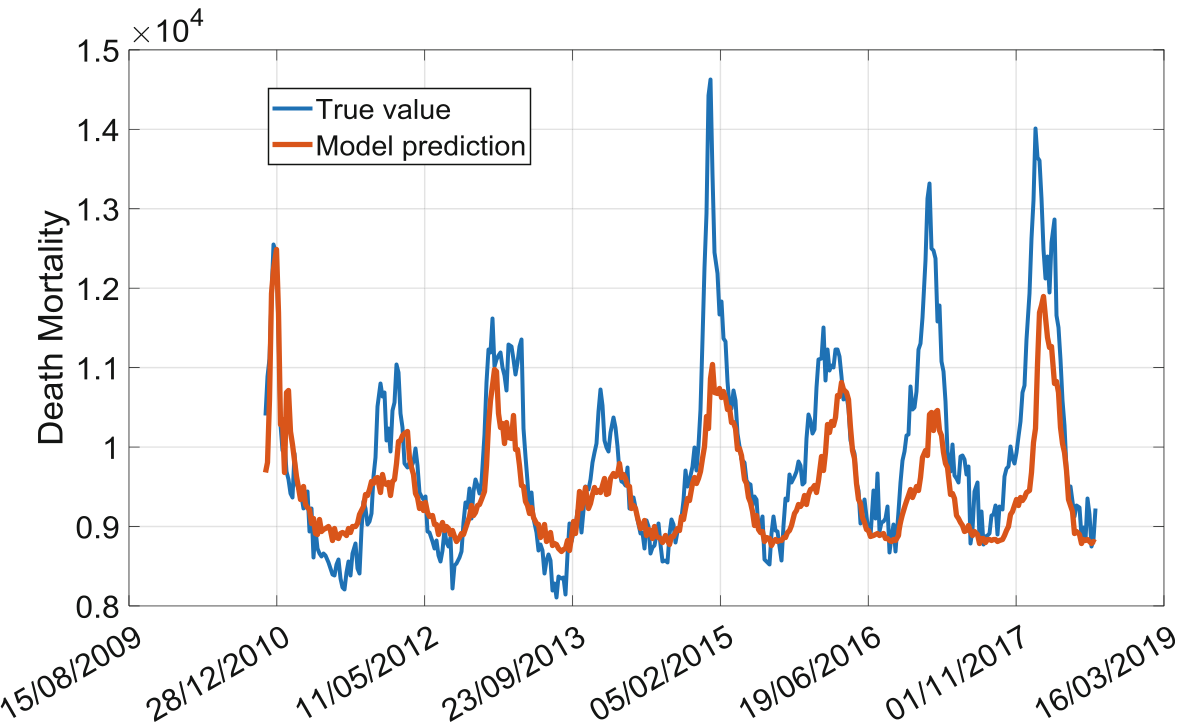 Fig 2: Comparison of SIT model predictions and true mortality values on a test dataset.
Case Study 2: Beijing Air Quality (PM2.5)
The methodology was applied to predict PM2.5 levels based on other pollutants (SO2, NO2, CO, etc.). The resulting equation (Equation 9 in the paper) is a masterclass in transparency—it explicitly shows that PM2.5 is largely driven by CO and PM10 interactions.
- Performance: R² = 0.845 on unseen test data, proving that "sparse" does not mean "weak."
Critical Analysis & Future Outlook
The Takeaway: This research demonstrates that for many healthcare and environmental tasks, we don't need deeper networks; we need smarter variable selection. The SIT-NARMAX framework provides a "mathematical white-box" that clinical practitioners can actually trust.
Limitations:
- The polynomial basis might struggle with extremely "discontinuous" or "switching" dynamics compared to RBF or Wavelet bases (though NARMAX supports those too).
- Sensitivity to initial "maximum lag" settings requires domain expertise to configure.
Future Work: Integrating these sparse identifications with Causal Inference frameworks could allow us to move from "Predictive Modeling" to "Prescriptive Modeling," telling doctors not just what will happen, but how to intervene.
Editor's Note: This paper is a vital reminder that in the quest for AI sophistication, parsimony remains the ultimate sophistication.