
Sparser, Faster, Lighter: Breaking the GPU Sparsity Paradox in LLMs
Sparser, Faster, Lighter Transformer Language Models
The paper introduces specialized CUDA kernels and sparse data formats (TwELL and Hybrid) to leverage unstructured sparsity in LLM feedforward layers. By applying mild L1 regularization, the authors achieve over 99% sparsity in activations, leading to a 20.5% inference speedup and 21.9% training speedup on billion-parameter models.
TL;DR
Sakana AI and NVIDIA researchers have unlocked a way to make LLMs significantly more efficient without losing "intelligence." By introducing TwELL (Tile-wise ELLPACK) and a Hybrid training format, they've bridged the gap between theoretical sparsity and real-world GPU performance. The result? 20%+ faster models that use less memory and energy, simply by encouraging the model to "turn off" unnecessary neurons during computation.
The Problem: The High Cost of "Dense" Intelligence
In modern LLMs, the Feedforward (FFN) layers are the heavy hitters—accounting for over 80% of total FLOPs. Research shows that these layers are naturally sparse (the "Lazy Neuron" phenomenon), yet we still compute every single zero because GPUs are built for dense matrix multiplication.
The "Sparsity Paradox" is frustrating: attempts to use sparse kernels often run slower than dense ones because the overhead of tracking which neurons are active (indexing) kills the throughput.
Methodology: Engineering for the Hardware
The core innovation lies in how data is "packed" for the GPU.
1. TwELL: Tile-wise ELLPACK
Traditional sparse formats like ELL require a global view of the matrix, which breaks the local "tiling" logic GPUs use. TwELL divides the work into 1D tiles that match the GPU’s thread blocks. This allows the model to determine what is sparse and compute the result in a single fused operation, eliminating the need to read and write to global memory multiple times.
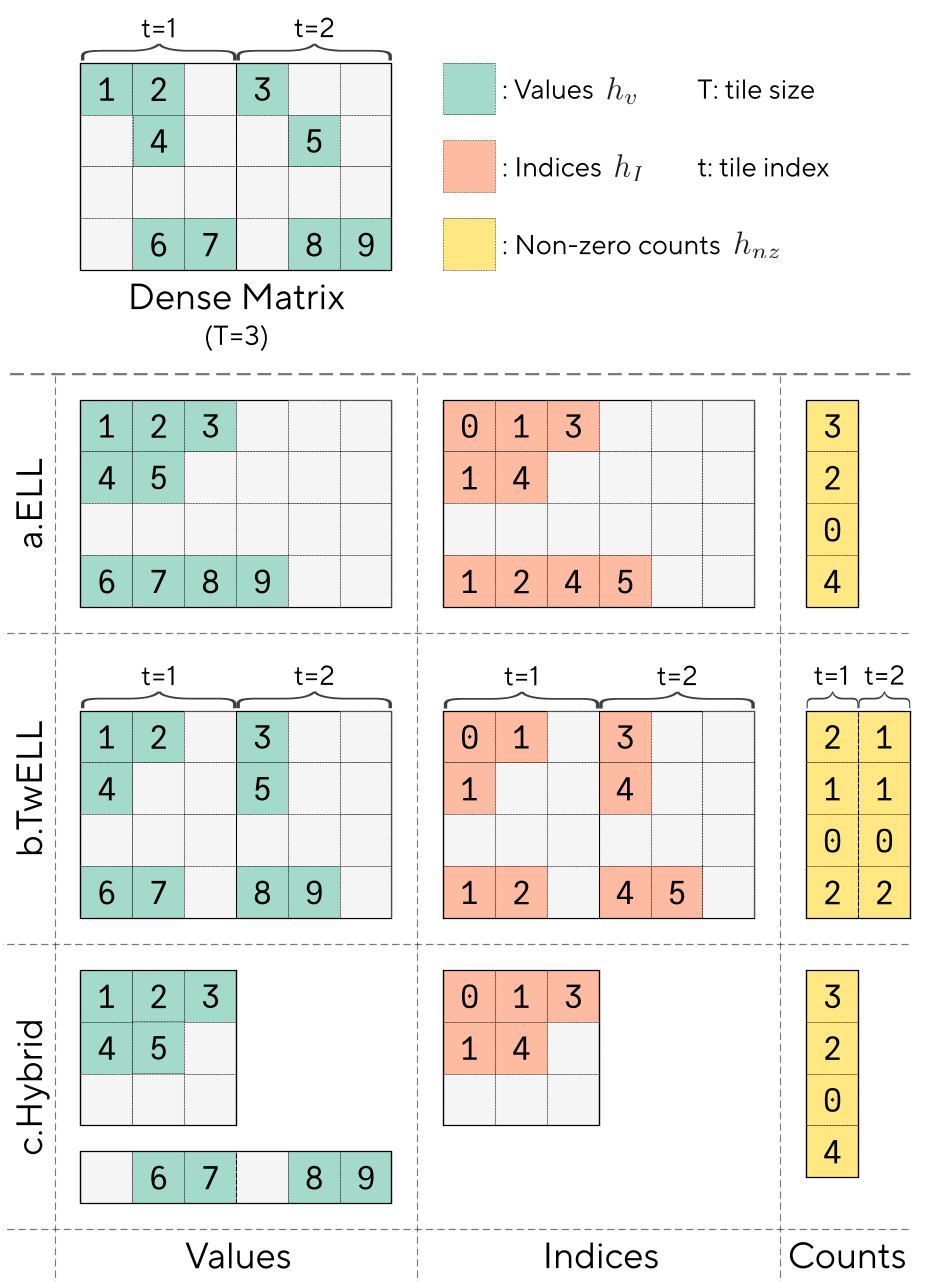 Figure 1: Comparison of the standard ELL format with the new TwELL and Hybrid formats designed for inference and training.
2. The Hybrid Training Algorithm
Training is harder because activation patterns change wildly between tokens. The authors use a Hybrid format:
- Compact ELL: Handles "normal" tokens with high sparsity.
- Dense Backup: Handles "outlier" tokens that excite many neurons. This dual-pathway ensures that the GPU remains busy and efficient even when a difficult token requires more capacity.
Experiments: More Efficiency, No Penalty
The authors tested this on a "Transformer++" architecture (similar to Llama) from 0.5B to 2B parameters.
| Metric | Non-Sparse (Baseline) | Sparse (This Work) | Improvement |
|---|---|---|---|
| Inference Speed | 87.8 tok/ms | 106 tok/ms | +20.5% |
| Training Speed | 22.4 tok/ms | 27.3 tok/ms | +21.9% |
| Peak Memory | 46.7 GB | 33.1 GB | -28.1% |
Crucially, Mean Task Accuracy remained stable (e.g., 49.1% vs 48.8% for the 2B model), proving that L1 regularization can prune internal representation without damaging the "reasoning" capabilities.
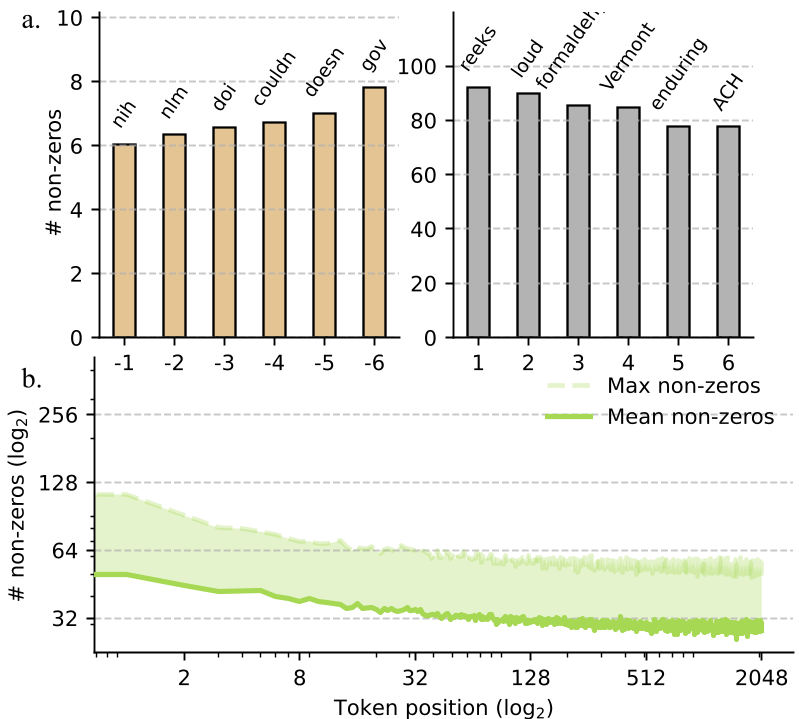 Figure 2: The model naturally allocates more "thought" (active neurons) to the beginning of a sequence and to high-information tokens like specific nouns.
Depth and Context: What is the Model "Thinking"?
The paper provides a fascinating visualization of where computation happens. The model is most "active" (least sparse) in its early-middle layers—precisely where researchers believe knowledge retrieval occurs. Furthermore, common words like "doesn't" or web-link fragments like "gov" trigger almost no neurons, while complex nouns like "formaldehyde" trigger heavy activation.
Critical Analysis & Conclusion
This work moves sparsity from a "theoretical curiosity" to a "production-ready tool." By releasing open-source CUDA kernels, Sakana AI is enabling the community to train larger models on smaller hardware (like the RTX 6000), where the benefits of these kernels are even more pronounced.
Limitations:
- The current method focuses on ReLU; shifting to SiLU (current SOTA) requires more investigation, though the authors show ReLU sparse models are nearly as strong.
- "Dead neurons" (neurons that never fire) remain a byproduct of aggressive L1, though reinitialization strategies look promising for future fixes.
In the race for sustainable AI, specialized kernels that respect the underlying physics of GPU hardware—like those proposed here—are the most viable path forward.