
The Flow of Society: Revealing Hidden Hierarchies via Sparsest Cuts
The use of sparsest cuts to reveal the hierarchical community structure of social networks ଝ
The paper introduces the MCF Cut algorithm, a divisive hierarchical clustering method for social networks based on the Maximum Concurrent Flow Problem (MCFP) and sparsest cuts. It achieves state-of-the-art accuracy in revealing multi-level community structures in dense, weighted graphs, outperforming the weighted Girvan-Newman algorithm.
TL;DR
Researchers have developed a powerful new divisive algorithm—MCF Cut—that uses the physics of "fluid flow" (Maximum Concurrent Flow) to slice through social networks. Unlike traditional methods that look for "busy" edges, this method finds the "thinnest" bottlenecks (Sparsest Cuts), successfully uncovering complex hierarchies in dense, weighted networks where other SOTA methods fail.
Problem & Motivation: The Dense Network Dilemma
In social network analysis, finding "who belongs where" is usually done by looking for clusters. However, most real-world networks (like professional sports leagues or corporate structures) are hierarchical and dense.
Agglomerative (bottom-up) methods often get stuck in "local traps"—two nodes might look similar but belong to different high-level branches. Meanwhile, popular divisive methods like the Girvan-Newman (GN) algorithm focus on edge betweenness (centrality). While GN works well for sparse graphs, it struggles when the network gets crowded. It often "snips" the wrong wires, failing to recognize that a group of edges might be part of a high-level conference rather than a low-level division.
Methodology: The Logic of Sparsest Cuts
The authors propose a shift from centrality to density. Their core insight: a community is best defined by the bottleneck that separates it from the rest of the world.
1. The Mathematical Intuition
The "Sparsity" of a cut is defined as: In a weighted graph, this represents the average weight of edges between two potential communities. The goal is to find the partition that is the least "linked" relative to the number of possible connections.
2. Maximum Concurrent Flow (MCF)
Finding the absolute sparsest cut is NP-hard. To solve this, the authors use the Maximum Concurrent Flow Problem. Imagine every node trying to send "data" to every other node simultaneously. The edges that become the absolute bottlenecks for this total throughput are the critical edges that constitute the sparsest cut.
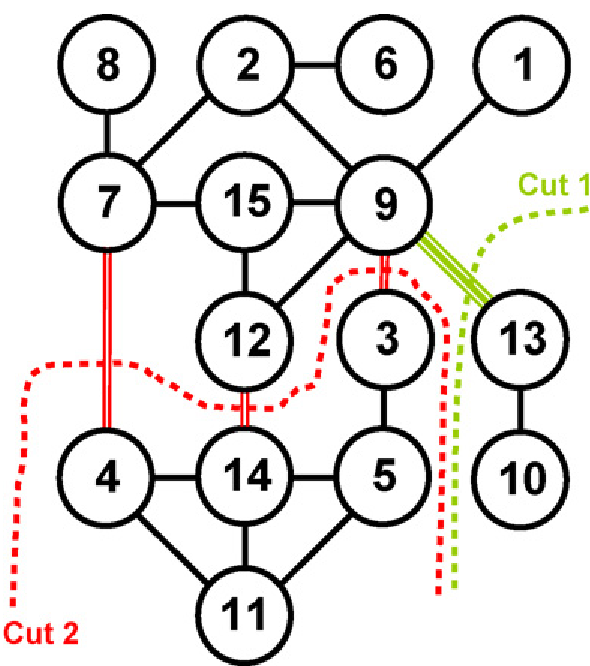 In the Florentine families network (above), the algorithm identifies the edge (9, 13) as the initial sparsest cut because it constrains the flow between the most pairs of nodes.
Experiments: NFL and NCAA Case Studies
The paper validates the MCF Cut algorithm using American football networks—systems with rigid, known hierarchies (Conferences > Divisions > Teams).
1. The NFL Test
On a 32-node weighted NFL network, the algorithm didn't just find the teams; it reconstructed the entire league's organizational chart.
- Level 1 Cut: Divided the AFC from the NFC.
- Level 2 Cut: Simultaneously split conferences into their respective East, North, South, and West divisions.
2. The NCAA Benchmark
In a massive 120-node network of college football, the MCF Cut algorithm achieved a perfect 1.000 accuracy score.
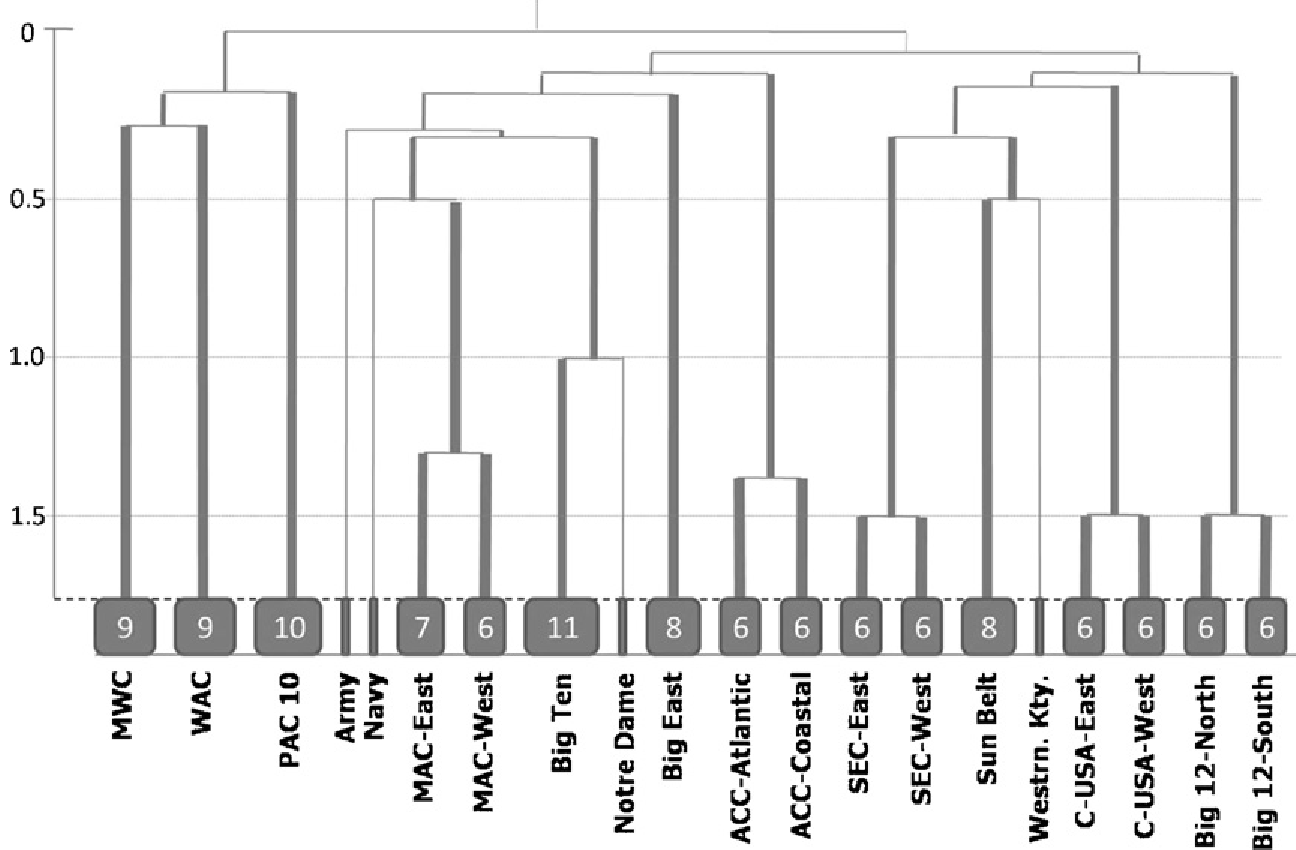 The resulting dendrogram (above) shows how cut density provides a literal ruler for social distance. As the density increases (moving down), the network resolves into finer, more cohesive sub-communities.
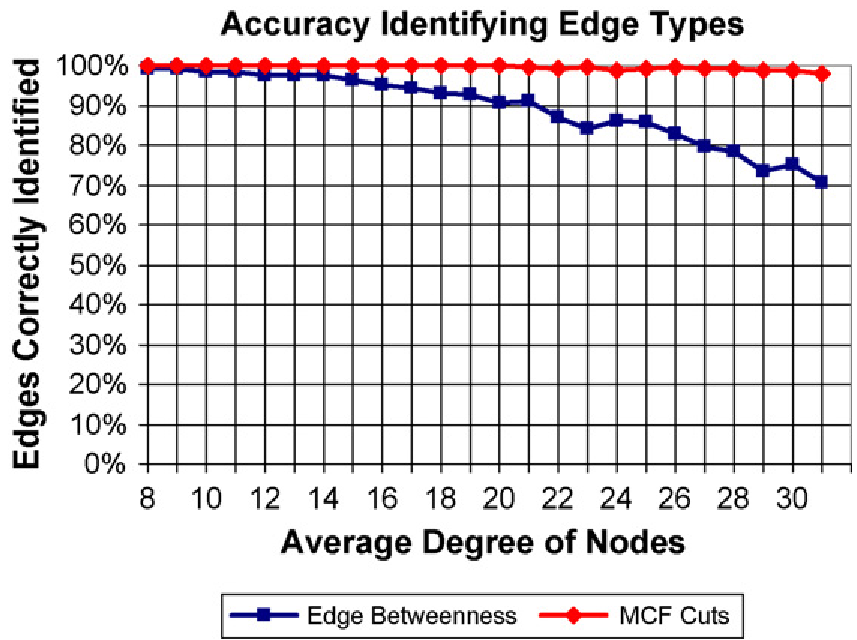 Performance Comparison: As the 'Average Degree' (graph density) increases, the MCF Cut algorithm (blue line) stays near-perfect, whereas the Girvan-Newman approach (orange line) collapses.
Critical Insight & Conclusion
The true value of this work lies in the Monotonicity Theorem (Theorem 3). The authors proved that in a unique hierarchical decomposition, the cut densities must strictly increase. This gives us a "divisive average-linkage" dendrogram that is mathematically more robust than simple edge-removal heuristics.
Takeaway: If you are analyzing a network where everyone seems to know everyone (dense) and the relationships have different strengths (weighted), stop looking for central nodes and start looking for flow bottlenecks.
Limitations: Currently, using Linear Programming (LP) to solve MCFP limits the algorithm to networks of a few hundred nodes. For Big Data (millions of nodes), we need the "flow-converging" approximation algorithms the authors suggest for future work.