
Mobile Agents and Human Collaboration: The Future of Urban Spatial Crowdsourcing
Towards Spatial Crowdsourcing in Vehicular Networks Using Mobile Agents
This paper introduces a decentralized spatial crowdsourcing framework for Vehicular Ad Hoc Networks (VANETs) based on mobile agents. By leveraging the mobility of vehicles and the autonomous decision-making of software agents, the system enables efficient data collection and query processing in urban areas without relying on costly centralized 3G/4G infrastructure.
TL;DR
Researchers have proposed a hybrid approach to urban data sensing that combines Mobile Agents (autonomous code that "travels" across cars) with Spatial Crowdsourcing. By paying drivers virtual currency to slightly alter their routes, the system can retrieve data from sensors across a city even when the wireless network is fragmented.
Background & Positioning
As the automotive industry pivots toward the "Connected Vehicle" era, every car has become a moving sensor platform. However, the bottleneck has always been connectivity. Relying on cellular networks (4G/5G) for massive sensor data is expensive, while local peer-to-peer (P2P) connections are notoriously flaky. This paper positions itself at the intersection of VANETs (Vehicular Ad Hoc Networks) and Social Computing, proposing a decentralized solution where human cooperation fills the gaps left by wireless technology.
The Problem: The "Dead Zone" Challenge
In a typical VANET, data is passed from car to car like a relay race. But what happens if the street is empty? Or if no car is heading toward the target "interest area" (e.g., a pollution hotspot)?
- Topology Volatility: Connections last only seconds.
- Network Fragmentation: Low vehicle density leads to "data islands."
- Cost vs. Coverage: Fixed sensors are too expensive to cover every corner of a city.
Methodology: Mobile Agents as Autonomous Messengers
Instead of sending raw data packets, the authors use Mobile Agents. These are self-contained programs that:
- Hop: Move from one vehicle's onboard computer to another via short-range wireless (Wi-Fi/WAVE).
- Taxi: If no hop is available, the agent stays on a vehicle, using it as a physical carrier.
- Process: Once they arrive at the destination, they run their own logic to filter and aggregate sensor data locally, reducing the amount of data that needs to be sent back.
Architecture Overview
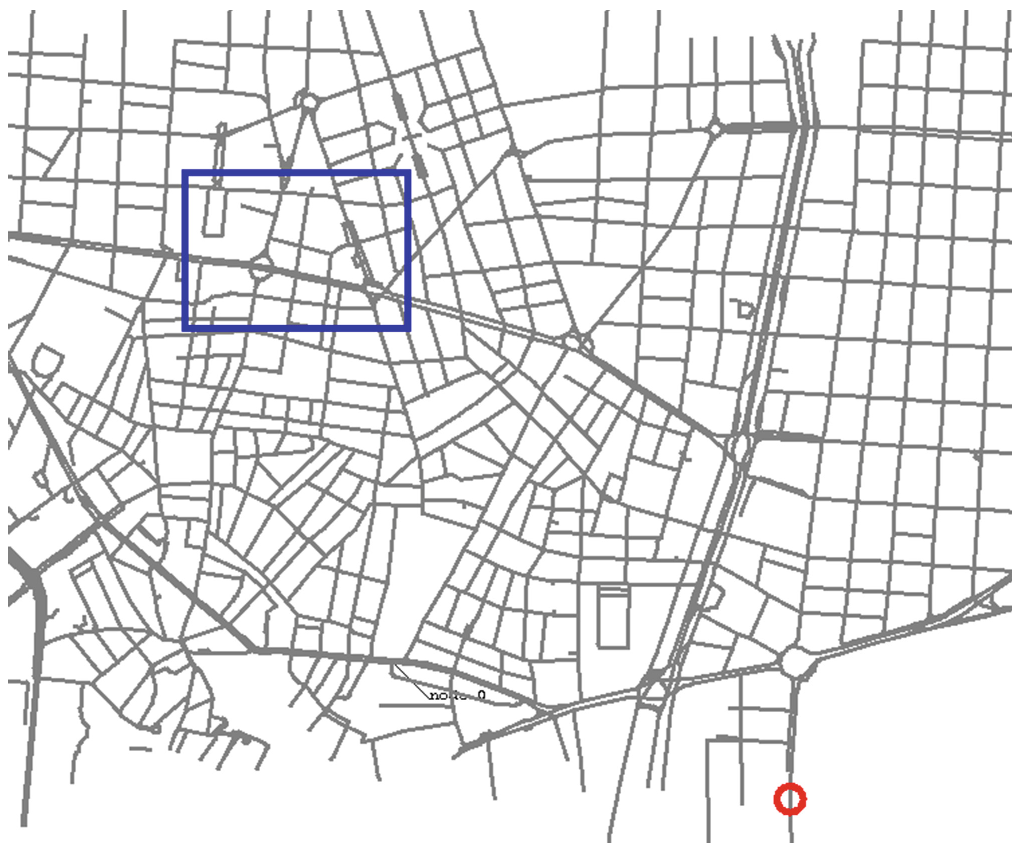 The query process: 1) Query creation -> 2) Travel to interest area -> 3) Local data collection -> 4) Return result.
The "Secret Sauce" here is Spatial Crowdsourcing. To avoid getting "lost" or stuck, an agent can offer virtual money to a driver. In exchange, the driver might take a 500-meter detour to bring the agent within range of another vehicle or the destination.
Experimental Insights
Using the MAVSIM simulator with real-world maps of Madrid, the study tested how different levels of driver collaboration affect efficiency.
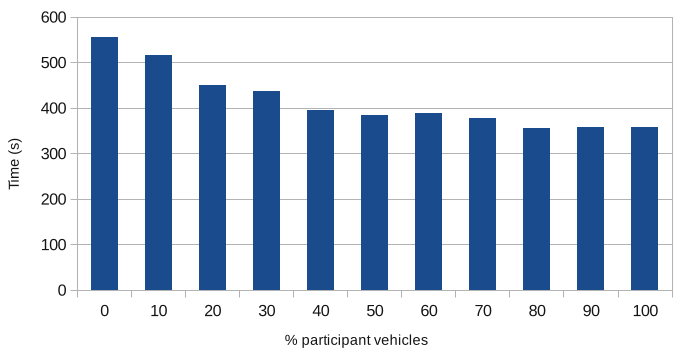 The charts above illustrate that as collaboration rates increase, the 'Number of Hops' decreases. This is because agents are physically carried over longer distances by collaborating drivers, rather than constantly jumping between random passing cars.
Key Findings:
- Efficiency Plateau: You don't need 100% participation. Reaching a 40% collaboration rate was enough to achieve near-optimal data retrieval speeds.
- Bandwidth Savings: Spatial crowdsourcing reduces "hop-count," meaning less wireless congestion and higher reliability.
Critical Analysis & Conclusion
Takeaway
The shift from purely technical routing to "incentivized human-assisted routing" is a game-changer for smart cities. It treats drivers not just as passive nodes, but as active participants in the data ecosystem.
Limitations
- Incentive Security: The paper assumes an "honest" virtual money system. In reality, preventing fraud in such a decentralized market would require a robust blockchain-based verification system.
- Privacy: Drivers sharing their trajectories to help agents might raise significant location privacy concerns.
Future Outlook
The next step for this research involves more complex negotiation strategies—perhaps agents could "bid" for different drivers based on how fast they can deliver the data. As autonomous vehicles become more common, this agent-based negotiation could happen entirely in the background, making city-wide sensing a seamless, invisible utility.