
Beyond the Link: Discovering Latent Regional Communities via Spatial LDA
A spatial LDA model for discovering regional communities
This paper introduces a generative probabilistic model based on an extension of Spatial Latent Dirichlet Allocation (SLDA) to discover "regional communities" in social networks. By leveraging geo-tagged Twitter data, the method identifies groups of users who share spatial and temporal proximity even without explicit social links, effectively uncovering localized topic clusters.
TL;DR
Most community detection algorithms look for "who follows whom." This paper asks: "who stays where?" By repurposing Spatial Latent Dirichlet Allocation (SLDA), the authors prove that geographic and temporal proximity can reveal robust social communities that traditional link-based graphs completely miss.
The "Sparse Link" Problem
In the world of social media analysis, the "Shadow Community" is a major hurdle. While we have millions of users, the explicit link structure (mentions and replies) is surprisingly thin. The authors found that in large Twitter datasets, only about 1.11% to 3.66% of users have active, measurable links.
If we only cluster based on links, we ignore the vast majority of human behavior. The core insight here is the Spatial Hypothesis: users who are physically close and post at similar times are likely part of the same socio-economic or cultural community, even if they have never clicked "Follow" on each other.
Methodology: Adapting SLDA for Geography
The researchers didn't just use standard LDA (which treats documents as bags of words). They adapted Spatial LDA, a model originally designed for computer vision to detect objects in images.
How it Works:
- Snapshots as Images: The social network is divided into temporal slices (e.g., 24-hour windows).
- Regions as Documents: Instead of text documents, the model creates "spatial documents" (regions) using Gaussian distributions centered around user locations.
- Occurrences as Visual Words: Each geo-tagged tweet acts as an observation point.
- Generative Process: The model assumes that a region has a distribution of communities , and each community has a distribution of users .
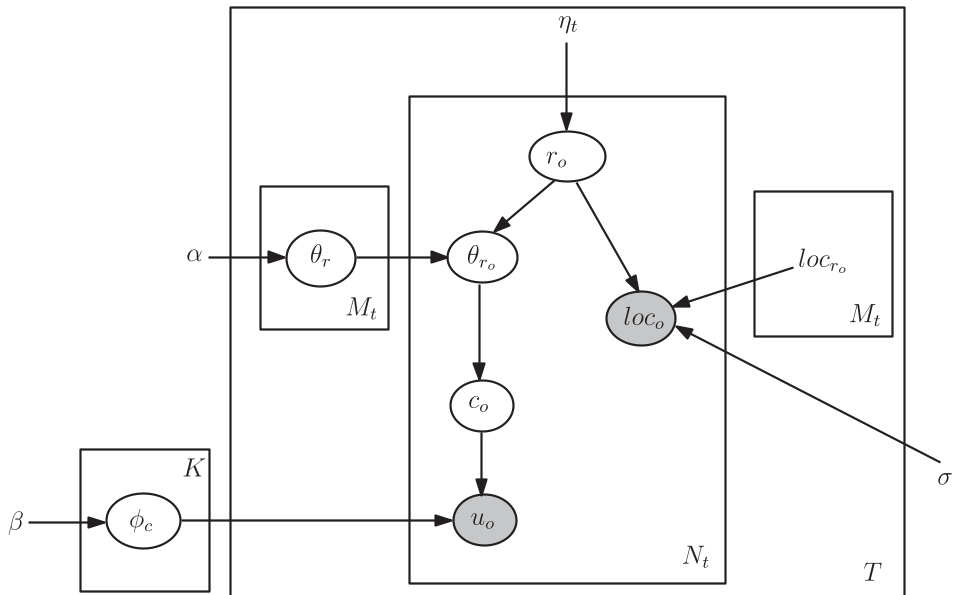
The beauty of this approach is that it captures latent structures. It uses Gibbs sampling to estimate the probability of a user belonging to a community based on where and when they "co-occur" with others.
Experimental Insights: High Precision, Low Entropy
The authors tested their model on a massive dataset of 170 million tweets from the US and Europe. Focusing on the London area, they compared their SLDA approach against traditional modularity-based graph clustering.
Key Findings:
- Spatial Density: The SLDA-based communities showed significantly lower Entropy (Fig 3), meaning they were more geographically compact and "meaningful" in a physical sense.
- The Link Correlation: Interestingly, in the discovered regional communities, about 40% of users did have explicit links. This validates the model: it finds the "known" social circles and then expands them to include the "latent" members who share the same space and interests.
- Topic Coherence: When applying LDA to the messages within these regional communities, clear patterns emerged. Communities weren't just random groups; they were talking about specific local themes like "Starbucks/Coffee" in specific neighborhoods or "Football" during match days.
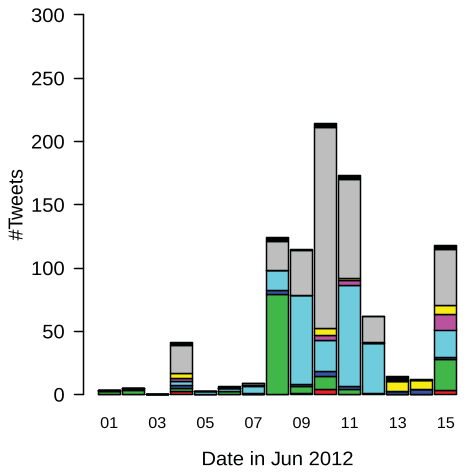 Fig: Visualization of four distinct regional communities in London, showing both their spatial distribution and temporal activity peaks.
Critical Analysis & Takeaways
The most striking takeaway is the distance-decay of social ties. As shown in the paper's preliminary analysis, most Twitter interactions happen within a 150km radius. By using location as the primary feature, the authors have created a more "human-centric" model of community.
Limitations:
- Data Sparsity: Only ~3% of tweets are geo-tagged. While this is enough for research, a production-level tool would need to infer locations for non-tagged posts.
- Computational Complexity: Gibbs sampling over millions of occurrences is intensive.
Future Outlook: This work paves the way for "Spatial-Semantic" social networks. Imagine a recommendation engine that suggests content not based on what your friends like, but based on what the "community in your neighborhood" is discussing. For urban planning and hyper-local marketing, this is the gold standard.
Conclusion
The SLDA model for regional communities proves that we are more than our "follow" list. We are defined by the spaces we inhabit and the people we share those spaces with. By merging computer vision techniques (SLDA) with social network analysis, this paper identifies a vital, previously invisible layer of the social web.