
SMATDL: Taming Uncertainty in Large-Scale Spatial Crowdsourcing with Multi-Agent RL
Combining Spatial Optimization and Multi-Agent Temporal Difference Learning for Task Assignment in Uncertain Crowdsourcing
The paper introduces SMATDL (Spatially Aware Multi-Agent Temporal Difference Learning), a novel framework for dynamic task assignment in uncertain spatial crowdsourcing. It combines grid-based spatial decomposition with multi-agent reinforcement learning (SARSA/Q-learning) to optimize worker quality and travel distance simultaneously in large-scale environments.
TL;DR
Spatial crowdsourcing—assigning physical tasks like delivery or emergency response to nearby workers—is notoriously difficult due to "uncertainty" (workers coming and going) and "scale" (thousands of agents). This paper proposes SMATDL, a framework that splits the map into grids and assigns a "learning agent" to each. By using Temporal Difference (TD) learning, these agents collaboratively optimize task quality and travel distance in real-time.
The Problem: The Chaos of the Real World
Most crowdsourcing algorithms operate under a "Laboratory Assumption": they believe we know the quality of every worker and that no one will log off mid-task. In reality:
- Uncertainty: Worker performance is unstable, and availability is dynamic.
- Scalability: As the number of tasks and workers grows, the "state space" of the problem explodes, making traditional mathematical optimization (like Integer Linear Programming) or centralized RL far too slow.
Methodology: Divide, Learn, and Conquer
The authors' core insight is that Spatial Optimization should come before Learning.
1. Grid-Based Decomposition
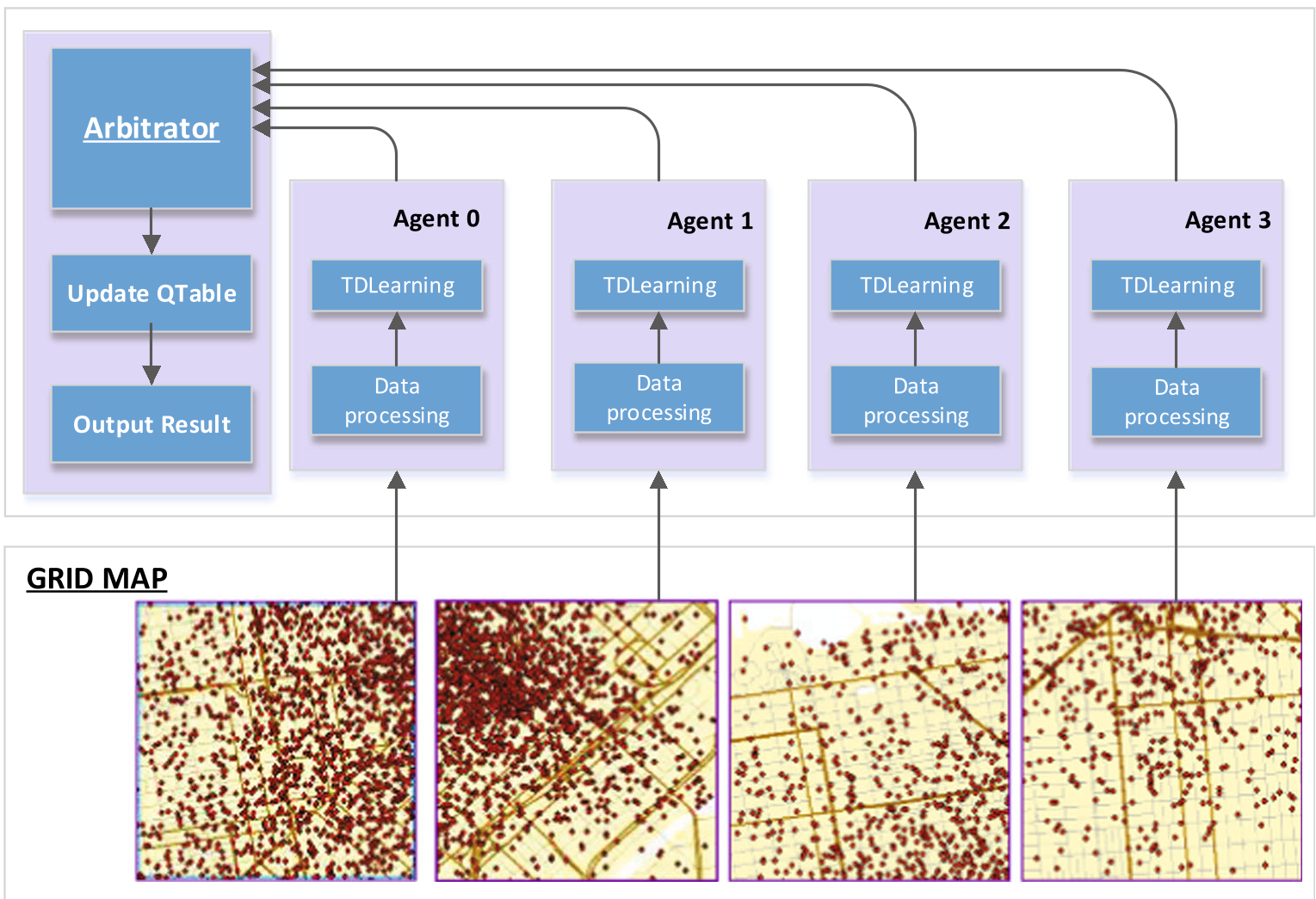
Instead of one "Great Brain" trying to solve the whole city, SMATDL uses a grid structure to partition the map. Each cell is controlled by a specific agent . This reduces a massive global problem into manageable local sub-problems.
2. Multi-Agent TD Learning
Each agent uses a Markov Decision Process (MDP) to model its local environment. The reward function is multi-objective, balancing:
- Worker Quality (): Maximizing the estimated performance score.
- Travel Cost (): Minimizing the Euclidean distance between worker and task.
The agents utilize SARSA (State-Action-Reward-State-Action), an on-policy learning method, which is more suitable for online applications where the agent must update its "knowledge" of worker quality after every single assignment.
3. Collaborative Coordination
To ensure global optimality, the system uses a Top-Q learning technique. It identifies the highest-valued action across agents () to coordinate assignments across grid boundaries.
Experiments: Performance at Scale
The researchers tested SMATDL using check-in data from Gowalla in San Francisco.
Scalability and Quality
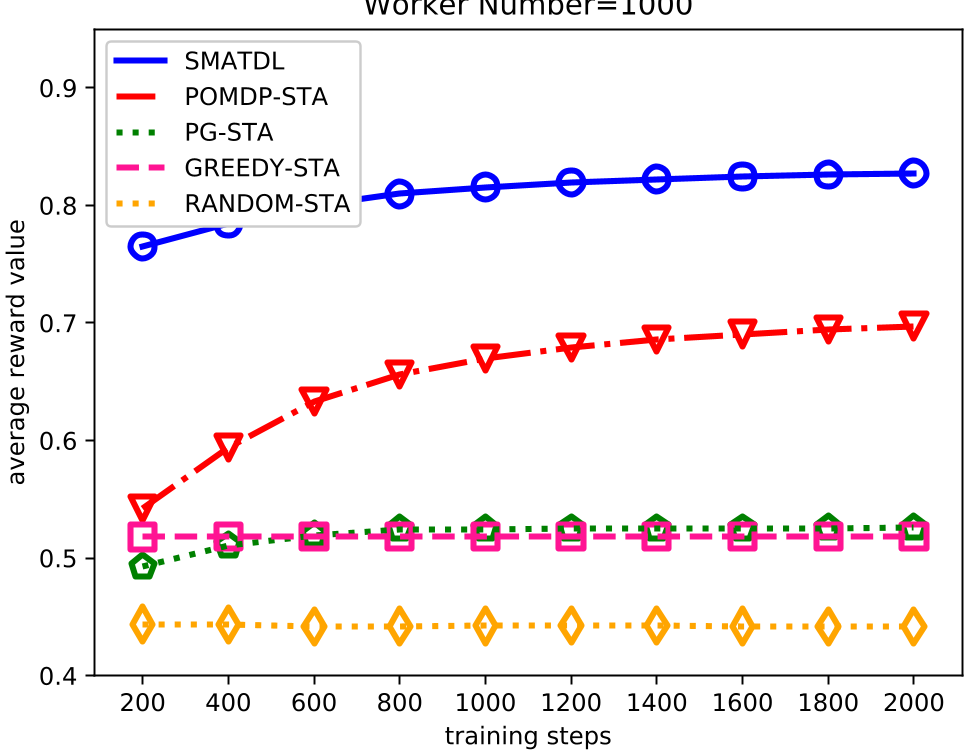
Unlike Random (RND-STA) or Greedy (Greedy-STA) methods, SMATDL's "reward" (a proxy for success rate and efficiency) remains high even as the number of workers increases to 1,000. It effectively "learns" who the reliable workers are over time.
Computational Efficiency
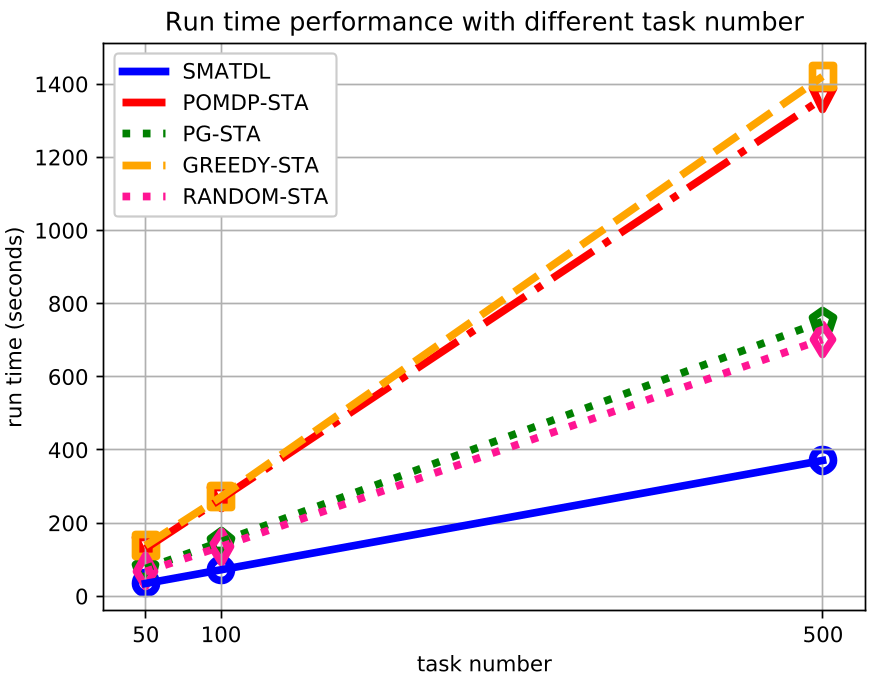
The most striking result is in execution time. By delegating work to local agents, SMATDL bypasses the exponential complexity faced by centralized POMDP (Partially Observable MDP) models.
Critical Insight & Future Outlook
While SMATDL is a significant leap forward in making RL practical for crowdsourcing, it relies on basic value-based learning. The authors acknowledge that moving toward Deep Policy Gradients or Actor-Critic models could further refine how the agents handle continuous state spaces.
Takeaway: In complex, large-scale spatial systems, "spatial awareness" (the grid) is the best regularizer for "intelligence" (the RL agent). By constraining the search space geographically, we make real-time learning feasible for massive urban systems.