
Harmonizing Social Ties and Spatial Calculus: A New Paradigm for Underlay D2D Networks
Spatial and Social Paradigms for Interference and Coverage Analysis in Underlay D2D Network
This paper introduces a novel dual-paradigm framework for analyzing interference and coverage in underlay Device-to-Device (D2D) networks using a Proximity-based Independently Marked Poisson Point Process (pIMPPP). By integrating spatial distribution with social homophily (Zipf-distributed content popularity), the authors derive upper and lower bounds for the cellular user's coverage probability, demonstrating that simple power control can enable ultra-dense D2D deployments.
TL;DR
Researchers have developed a more realistic model for underlay D2D networks by combining spatial proximity with social behavior (what content users actually want). By using a marked Point Process (pIMPPP) and Zipf distribution, the study reveals that while social clustering increases interference, localized uplink power control on cellular users can effectively shield them, enabling ultra-dense D2D connectivity.
The Missing Dimension: Why Spatial Logic Isn't Enough
For years, site planning and interference analysis in cellular networks relied on the Poisson Point Process (PPP). It treats users like dots on a map, appearing randomly but uniformly. However, D2D communication isn't just about being close; it's about sharing.
Existing models fail because they ignore Homophily—the tendency of individuals to associate with similar others. In D2D terms, this translates to common content requests. If a group of users all want the latest viral video (high social "mark"), they are more likely to form D2D pairs, creating "interference hotspots" that traditional PPP models simply miss.
Methodology: The pIMPPP Framework
The authors propose a Proximity-based Independently Marked Homogeneous Poisson Point Process (pIMPPP). This sounds complex, but it essentially adds a "social weight" to every spatial coordinate.
1. The Social Mark (Zipf Distribution)
Content popularity follows a Zipf distribution. The authors use the shape parameter to control how "concentrated" the interest is.
- Low (s=1): Interest is spread out; fewer D2D pairs; less interference.
- High (s=10): Everyone wants the same thing; many D2D pairs; high interference.
2. The Spatial Thinning
Not all users with the same interest can connect. The model applies a "retention" probability , which thins the process by ensuring only nodes within a physical distance are considered potential interferers.
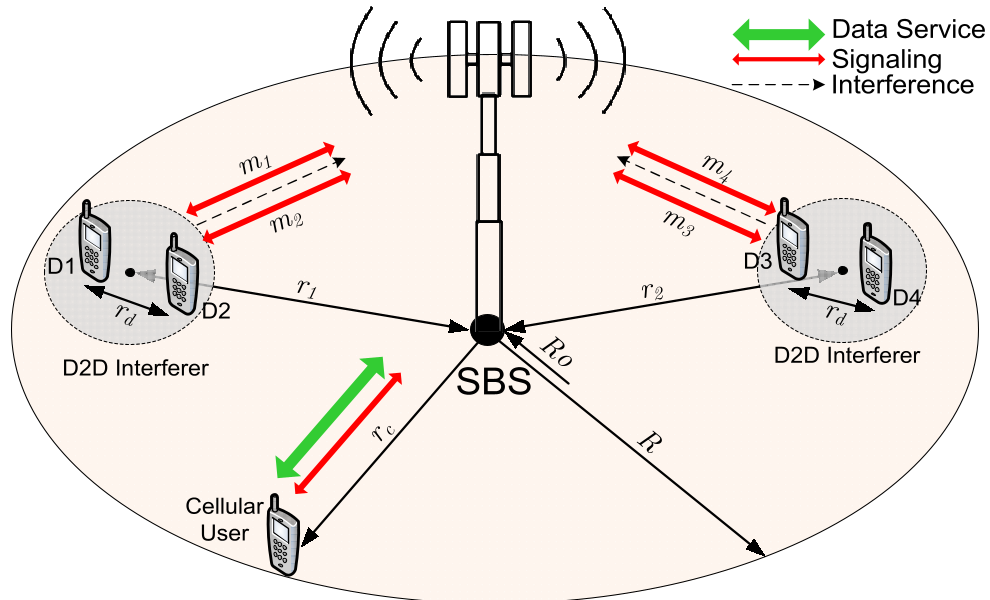 Figure 1: Illustration of a single cell scenario where cellular users and underlay D2D users coexist, creating a complex interference environment.
Mathematical Intuition: Bounding the Intractable
The Laplace functional for this joint spatial-social process does not have a closed-form solution. To solve this, the authors identified two specific scenarios that bound the system performance:
- Upper Bound (s=1): Uses the Digamma function to model a scenario with minimal social clustering.
- Lower Bound (s=10): Uses Polygamma functions to model a worst-case scenario where content popularity is extremely skewed.
Critical Results: Power Control is the "Silver Bullet"
The paper's most impactful finding lies in its analysis of Fractional Power Control (FPC).
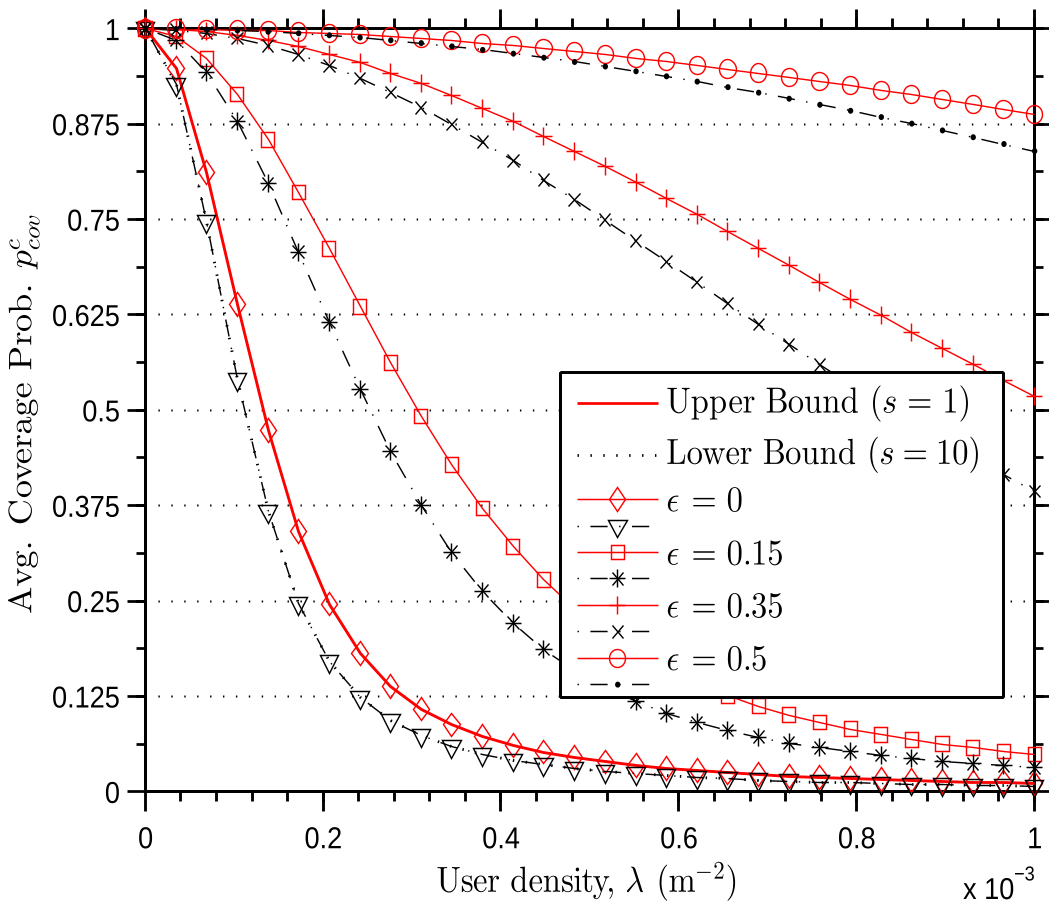 Figure 2: Impact of Power Control Factor (ε) on Coverage. As the density of D2D users increases, increasing ε from 0 to 0.5 dramatically stabilizes cellular user coverage.
As shown in the figure above, when (no power control), the coverage probability of the cellular user collapses as the network becomes denser. However, by slightly increasing the cellular user's transmit power relative to its distance from the base station ( or ), the "noise floor" created by social D2D groups becomes negligible.
Deep Insight & Conclusion
This paper shifts the D2D analysis from "Can they connect?" to "Do they want to connect?".
Key Takeaways:
- Social-Spatial Awareness: Network operators can no longer just look at heatmaps; they must look at content trends to predict interference.
- Capacity Gains: Underlay D2D can reach ultra-high densities (the "Ultra-Dense Network" vision) if—and only if—uplink power control is dynamically managed.
- Limitations: The model assumes a single-cell scenario. In a multi-cell environment, the increased power of a cellular user (to overcome D2D interference) might cause significant inter-cell interference for neighboring base stations.
Future research should extend this social-spatial modeling into mmWave and THz bands, where spatial proximity is even more critical due to blockage, but social clustering remains a constant human factor.