
Maximizing Information Gain: Navigating the Complexity of Spatial Crowdsourcing
Spatial Task Assignment Based on Information Gain in Crowdsourcing
The paper introduces an Information Gain based Maximum Task Matching (IG-MTM) framework for spatial crowdsourcing, utilizing Greedy and Extremum approximation algorithms. It further enhances coordination for complex tasks through a feedback-based cooperation mechanism that models worker affinity and group matching degree.
TL;DR
This research tackles the challenge of assigning spatial tasks (like traffic reporting) to moving workers. Instead of just picking the closest worker, it maximizes Information Gain—ensuring reports come from diverse directions—and uses a feedback-based affinity model to help teams work together better. The authors prove the problem is NP-hard and solve it using advanced approximation algorithms that nearly double the efficiency of standard greedy approaches.
Problem & Motivation: The Redundancy Trap
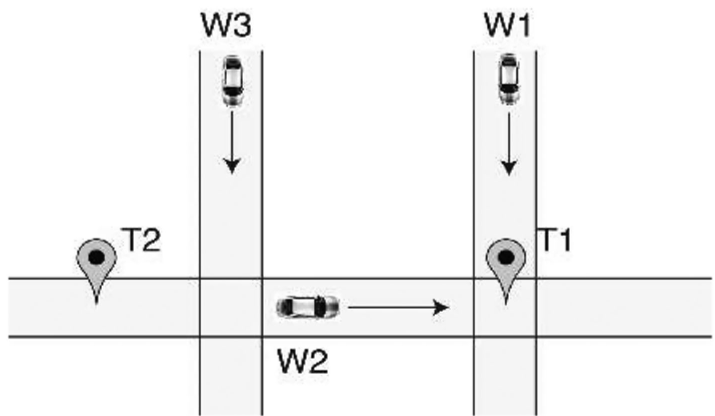
In spatial crowdsourcing, simply assigning a task to the nearest person is often inefficient. Imagine a traffic jam at a crossroad: three workers approaching from the North provide redundant data. However, one worker from the North and one from the West provide a much richer, "high information gain" view.
The technical hurdles are three-fold:
- Worker Preference: Workers often reject tasks that deviate from their current trajectory.
- Dynamic Constraints: Tasks have expiration times, and workers are constantly moving.
- Complexity: Finding the "perfect" match among thousands of workers and tasks is computationally impossible (NP-hard).
Methodology: Directional Diversity and Iterative Refinement
The authors define the IG-MTM (Information Gain based Maximum Task Matching) problem.
1. Information Gain Metric
Unlike standard models, this paper calculates quality based on the radians of approach. If workers are spread out around a task location, the entropy (and thus the information gain) is higher.
2. The Extremum Algorithm (EA)
While a Greedy algorithm is fast, it often gets stuck in a "local trap." The Extremum Algorithm starts with a greedy solution but then looks for "swap" opportunities. If removing one match allows the addition of two or more new valid matches, the algorithm performs the swap, iteratively climbing toward a higher global task count.
3. Feedback-Based Cooperation
For complex tasks requiring multiple workers, the authors introduced an Affinity Matrix. Using Matrix Factorization (similar to how Netflix recommends movies), the system predicts how well two workers will cooperate based on historical peer feedback, even if they haven't worked together before.
Experiments & Results
The researchers used the T-Drive dataset (10,000+ taxis in Beijing) and 6 million POIs to test their theories.
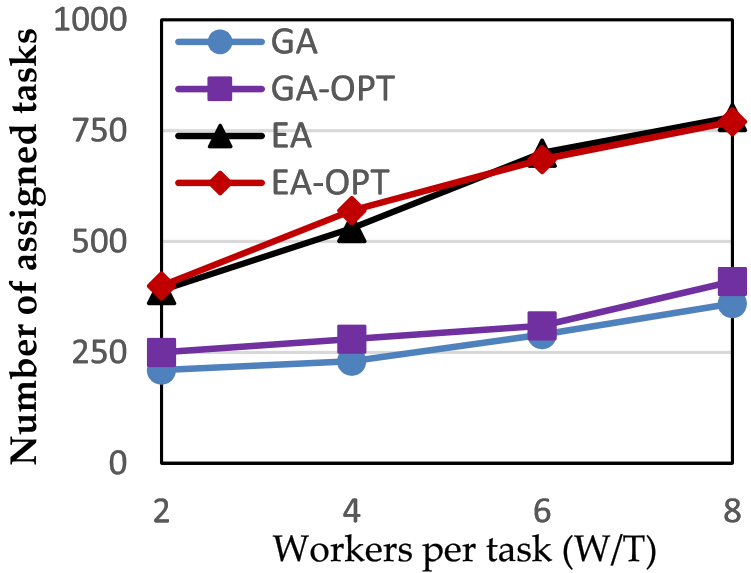
- Efficiency: The Extremum Algorithm consistently assigned significantly more tasks than the standard greedy approach across both synthetic and real-world data.
- Scalability vs. Accuracy: While the full Extremum Algorithm is slower, the EA-OPT (Optimized version) provides a "sweet spot"—it limits the group size to keep computations fast while still outperforming basic greedy methods.
- Expiration Impact: The study found a "sweet spot" for task expiration at around 2-4 hours; beyond this, the marginal gain in task completion drops as most reachable workers have already been considered.
Critical Analysis & Conclusion
Takeaway
The core contribution is the realization that direction matters more than distance in information-heavy crowdsourcing. By treating worker mobility as a vector rather than a point, the system collects more unique data.
Limitations
The model assumes workers move at a constant velocity (), which does not account for urban traffic variability or stops. Furthermore, the Matrix Factorization for affinity assumes that worker behavior is consistent over time, ignoring potential "bad days" or evolving skill sets.
Future Outlook
This framework provides a blueprint for next-generation gig-economy platforms. By moving from "Server-Assigned" to "Intelligence-Assigned," platforms can reduce redundancy and increase the value of every single worker's contribution.