
The Spatial-Temporal Perspective: Redefining Modern Social Worm Propagation
The Spatial–Temporal Perspective: The Study of the Propagation of Modern Social Worms
This paper presents a novel macroscopic simulation model for modern social worm propagation, specifically targeting online social networks (OSNs). It introduces the "Sorting-Attenuation" and "Social Network-Based Sharing" methods to accurately simulate reinfection-notification mechanisms and hierarchical network dynamics, achieving a high degree of correlation with real-world data like the Nyxem and Cckun worms.
TL;DR
Researchers have developed a sophisticated simulation model that finally bridges the gap between how we interact socially online and how malware spreads physically across devices. By accounting for human mobility (dynamic host usage) and psychological message processing (sorting-attenuation), this model corrects the massive underestimations found in previous SOTA propagation models, providing a high-fidelity tool for predicting cyber outbreaks.
Background: Why Previous Models Failed
For years, network security researchers modeled social worms—like those found on Twitter or Facebook—using a 1:1 ratio: one user, one account, one host. However, the modern reality is hierarchical. We log into our accounts from office desktops, home laptops, and public terminals.
Previous models typically suffered from two fatal flaws:
- Spatial Staticity: They ignored that a single infected user moving between locations can "seed" multiple physical hosts.
- Temporal Over-simplification: They assumed users either read all messages or a random subset, ignoring the "Intimacy" and "Vigilance" factors that dictate which messages a human actually clicks.
Methodology: The Core Innovations
1. Sorting-Attenuation Method (The Human Factor)
The authors recognized that message checking isn't random. They introduced a Sorting Value which calculates the priority of a message based on:
- Tie Strength (): A refined metric superior to "Shortest-Path," accounting for the number of common neighbors and community density.
- Attenuation (): Combining Ebbinghaus’s forgetting curve with a long-tail power law to model how unread messages eventually lose the user's attention.
2. Social Network-Based Sharing (The Mobility Factor)
To solve the problem of Dynamic Host Usage, the model uses the scaling laws of human travel (). It calculates the probability that an infected user "i" will share a public host with a susceptible user "j" based on their betweenness centrality and social proximity.
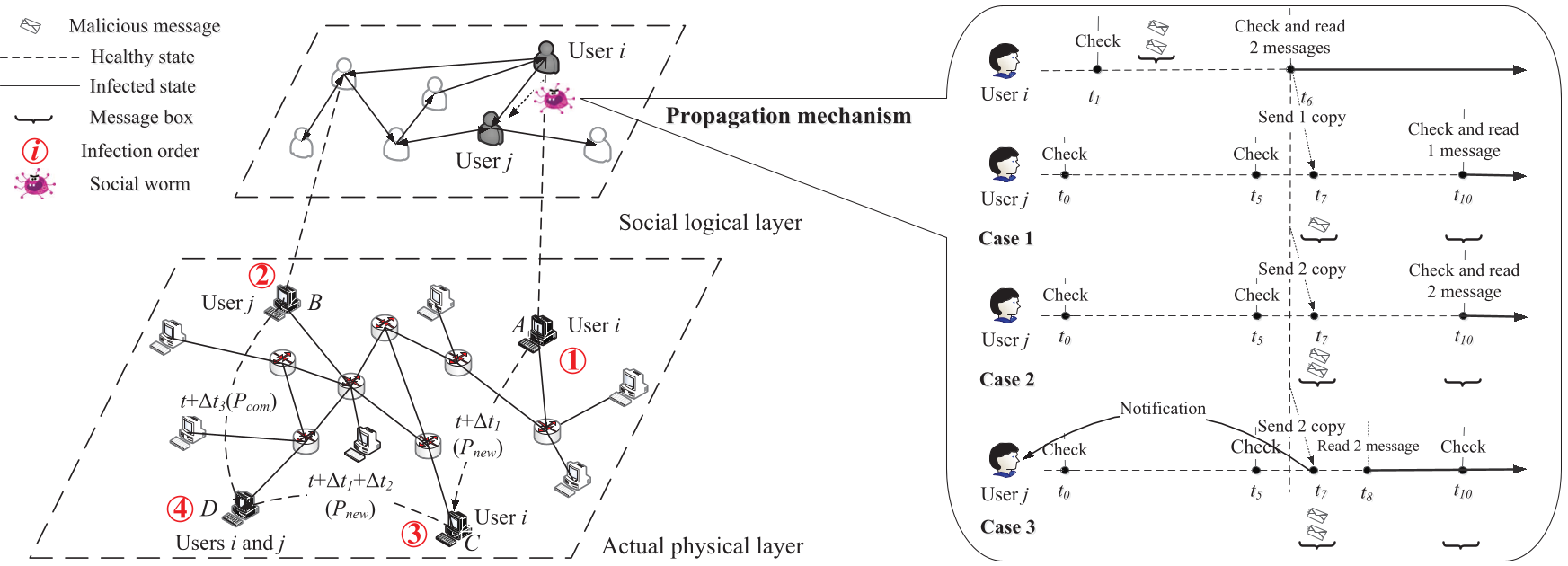 Figure 1: The hierarchical structure showing the mapping from the Social Logical Layer (Users) to the Physical Layer (Hosts/Locations).
Experimental Results & SOTA Comparison
The model was tested against the Nyxem Email worm and SMS worms (Cckun, xxShenQi).
- Underestimation Correction: Previous models (like SII or SII_R) underestimated the infection scale by nearly 40% because they stayed confined to the "logic layer."
- Vigilance Paradox: Surprisingly, the simulation showed that while low user vigilance speeds up initial outbreaks, it can actually limit the final infection scale because hosts are re-infected before the user moves to a new location, "wasting" the worm's propagation potential.
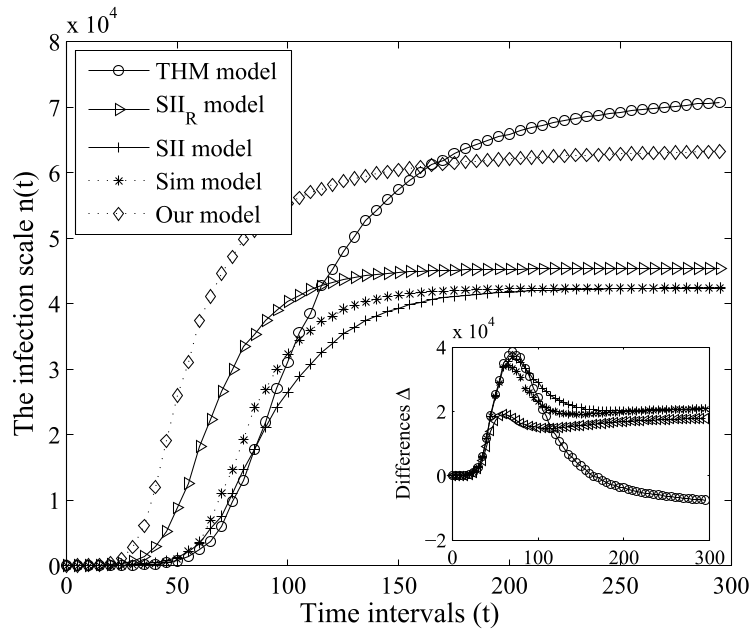 Figure 2: Performance comparison in real-world Facebook topology. The proposed model (Red) shows a significantly more realistic and aggressive propagation curve compared to legacy models.
Critical Insight: The "Celebrity Effect"
The research highlights that social worms exhibit a "celebrity effect." When a high-degree node (a "social butterfly") is compromised, the propagation speed increases exponentially. This is significantly compounded by the Notification Mechanism, where modern apps push alerts to users, prompting immediate (and often less vigilant) message checking.
Conclusion & Future Outlook
The "Spatial-Temporal Perspective" proves that cybersecurity is no longer just about software vulnerabilities; it’s about human behavior and mobility patterns.
Key Takeaways for the Industry:
- Cross-Layer Defense: Security protocols should consider the "Betweenness Centrality" of users. High-impact users in social networks are high-risk vectors for physical network infrastructure.
- Public Host Risk: The "Social Network sharing" mechanism demonstrates that public terminals remain a massive, under-modeled risk for rapid worm dispersal.
While the model is robust, it primarily focuses on topology-based worms. As the authors suggest, the next frontier is combining this spatial-temporal simulation with scanning-based worms to create a unified theory of malware dynamics.