
Precise Dynamic Pricing in Spatial Crowdsourcing: A Tensor-Driven Insight
Spatial and Temporal Pricing Approach for Tasks in Spatial Crowdsourcing
This paper introduces HCTD (History-based Context-aware Tensor Decomposition), a spatial-temporal pricing framework for spatial crowdsourcing. By modeling prices as a three-dimensional (task-space-time) tensor and integrating historical data with context matrices, the system achieves SOTA performance in maximizing platform revenue while capturing dynamic user preferences.
Executive Summary
In the hyper-competitive world of Spatial Crowdsourcing (SC)—where Uber, DiDi, and Gigwalk operate—pricing is the ultimate balancing act. Price too high, and the requester disappears; price too low, and the platform bleeds revenue. This paper introduces the Spatial and Temporal Pricing Framework, utilizing History-based Context-aware Tensor Decomposition (HCTD).
The core breakthrough is moving away from slow-to-converge online learning models (like MAB) toward a data-centric reconstruction of "price preference" using high-dimensional tensors. By intelligently filling in the gaps of sparse transaction data using historical trends and contextual correlations, the authors achieve a 33% reduction in error (MAE) compared to baseline methods and a tangible boost in total platform revenue.
The Problem: The "Slow-Start" and Context Blindness
Current SC pricing algorithms (e.g., UCB-based methods) are often "interactive." They explore different prices to learn acceptance rates over time. In a real-world scenario like rush-hour taxi hailing, this "learning" is too slow.
Furthermore, user preferences are highly non-linear:
- Time: Requesters accept higher prices at 8:00 AM than at 2:00 PM.
- Space: A trip from a luxury mall to an office zone carries a different valuation than a suburban commute.
- Category: Economic cars and luxury cars have vastly different price elasticities.
Previous works failed to unify these axes into a single digestible model, often ignoring the rich historical data already sitting in the platform's databases.
Methodology: High-Dimensional Price Reconstruction
The paper's "Secret Sauce" is the HCTD algorithm. Instead of treating every pricing decision as a new experiment, it treats the entire pricing landscape as a Task-Space-Time Tensor.
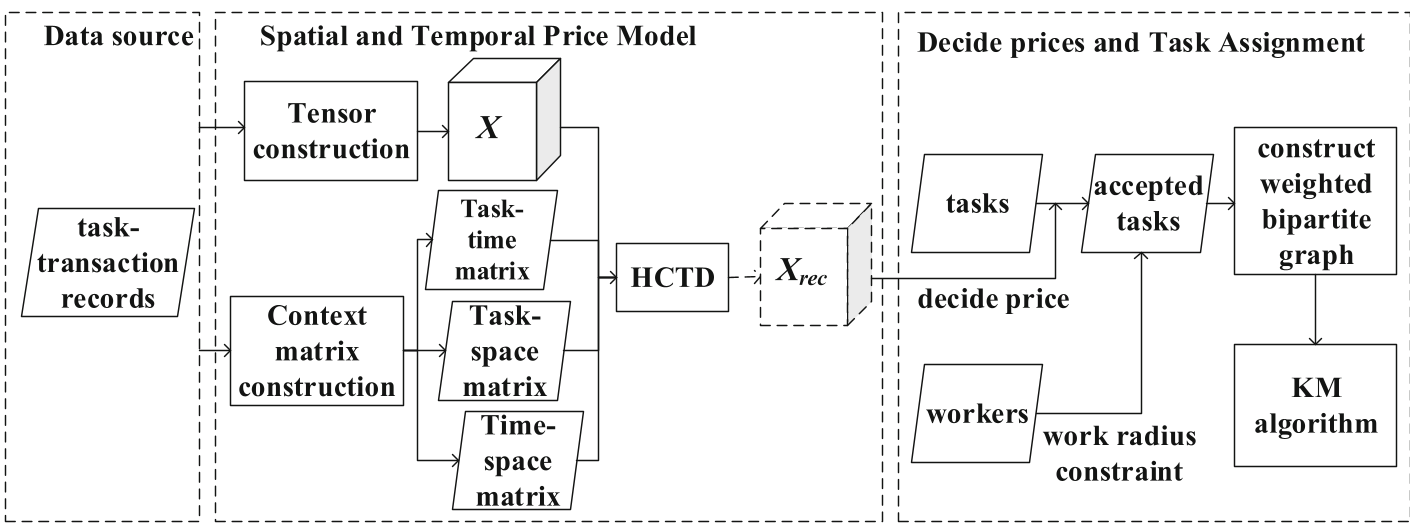
1. Architectural Overview
The framework consists of two main pillars:
- STPM (Spatial and Temporal Price Model): Uses tensor completion to estimate what the "market" price should be even where transaction data is currently missing (zero-entries).
- DPTA (Decide Prices and Task Assignment): Uses the estimated prices to build a bipartite matching graph between workers and tasks, solved via the Kuhn-Munkras (KM) algorithm.
2. Solving Sparsity via Multi-Source Fusion
A major challenge in SC is sparsity. In the NYC dataset, only 0.061% of possible task-space-time combinations have data. To fix this, the authors don't just use the sparse current tensor (); they infuse:
- Historical Tensor (): Aggregated data from a longer window (e.g., 2 weeks) to provide a "global" price baseline.
- Context Matrices (A, B, C): These matrices capture similarities between task categories, spatial labels, and time slots. For instance, if two neighborhoods have similar "functionality" (e.g., both are school zones), the model propagates price knowledge between them.
Experimental Validation: Outperforming the Baselines
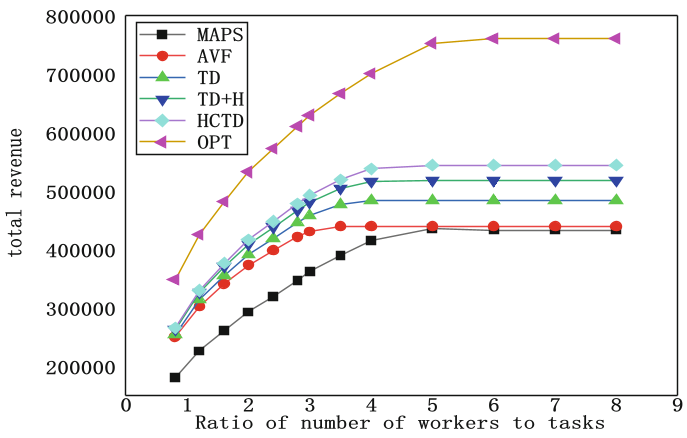
The authors validated HCTD using a real-world NYC taxi dataset. They compared their method against AVF (Average Value Filling), TD (Standard Tensor Decomposition), and MAPS (a previous SOTA online learning-based matching approach).
Key Result: Estimation Accuracy
HCTD achieved the lowest MAE and RMSE across the board, proving that context matrices significantly improve the "intelligence" of the completion.
| Method | MAE | RMSE |
|---|---|---|
| AVF (Baseline) | 4.476 | 39.304 |
| TD | 4.243 | 21.522 |
| HCTD (Proposed) | 2.962 | 15.903 |
Revenue Performance
As shown in the graph below, HCTD (the blue line) consistently achieves higher revenue than the previous SOTA (MAPS) and other decomposition variants.
Critical Insight & Future Outlook
The paper's success lies in its Inductive Bias: it assumes that price preference is not random but structured across space and time. By using Tucker Decomposition to exploit this structure, the model can "guess" the right price for a new task in a new location with high precision.
Limitations:
- The model currently focuses on requester pricing only.
- It assumes workers will "definitely accept" tasks, which is a simplification of real-world labor behavior where workers also have preferences.
Future Directions: The logical next step is Two-sided Pricing. Integrating worker incentives into the same tensor framework would allow platforms to balance supply and demand even more effectively, creating a holistic ecosystem for spatial crowdsourcing.
Takeaway
If you are building a real-time matching platform, stop waiting for your agents to "learn" through trial and error. Leverage your historical tensors; the context of space and time already contains the answers to your pricing questions.