
STSA: Decoding Urban Identity from Sparse Social Media Footprints
Exploiting spatial-temporal-social constraints for localness inference using online social media
The paper introduces STSA (Spatial-Temporal-Social-Aware), an unsupervised inference framework designed to identify the localness of users and the attractiveness of venues using online social media data. By integrating spatial check-in ranges, temporal trace lengths, and social connection constraints, it achieves state-of-the-art performance in urban mobility analysis without requiring expensive labeled training datasets.
TL;DR
Inferring whether a social media user is a "local" is vital for targeted advertising and urban planning, yet ground truth data is notoriously scarce. This paper presents STSA, an unsupervised framework that bypasses the need for training labels by exploiting the hidden constraints in where, when, and with whom we check in. It turns noisy Foursquare data into a dual-inference engine for user localness and venue attractiveness.
The "Statistical Ghost": Why Simple Metrics Fail
Intuitively, one might assume locals check in more often or have smaller activity ranges than tourists. However, the authors' initial analysis of Foursquare data in major U.S. cities reveals a startling reality: the distributions of check-in frequency and activity ranges for locals and non-locals are almost indistinguishable.
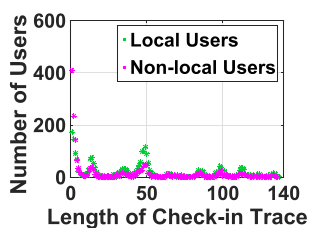 Figure 1: Notice how the curves for local and non-local users overlap significantly, rendering simple statistical thresholds useless.
Methodology: The STSA Framework
The core innovation of STSA is its ability to treat localness as a latent variable in a joint optimization problem.
1. Spatial-Temporal Modeling (The EM Core)
The framework views the check-in matrix through the lens of Maximum Likelihood Estimation (MLE). It defines:
- Temporal Constraint: The duration (in days) between a user's first and last check-in.
- Spatial Constraint: The maximum distance (range) spanned by a user's activity.
Using an Expectation-Maximization (EM) algorithm, the model iteratively updates its belief about a user's identity based on the "local attractiveness" of the venues they haunt, and vice versa.
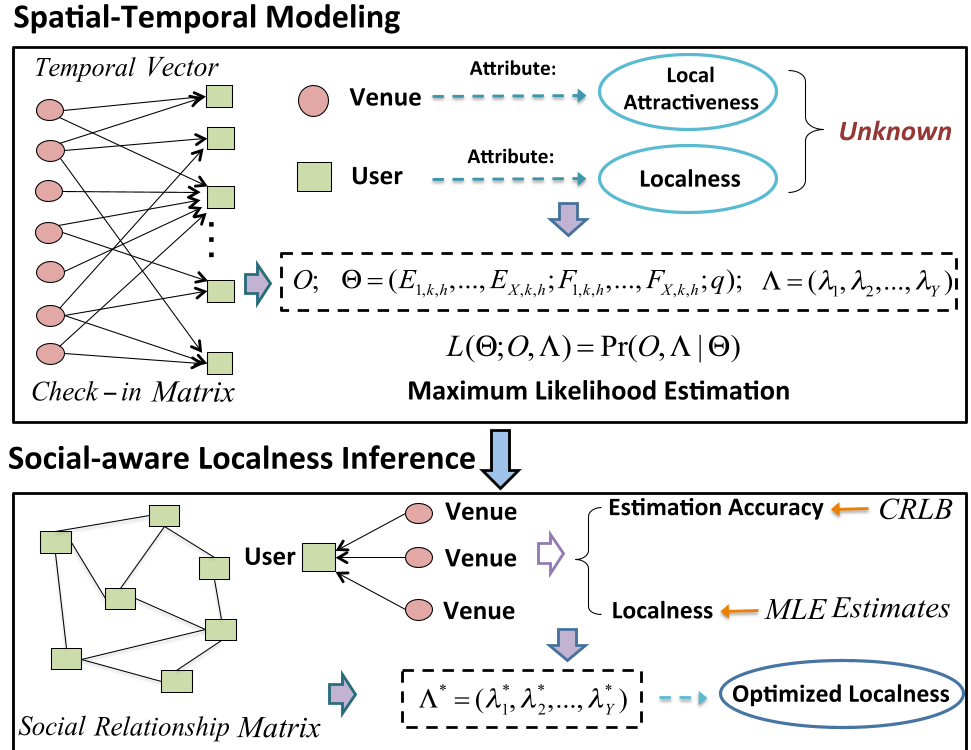 Figure 2: The STSA workflow combining probability modeling with social graph constraints.
2. Social-Aware Refinement
Not all inferences are certain. STSA uses the Cramer-Rao Lower Bound (CRLB) to quantify the variance (uncertainty) of its estimates. If a user's behavior is too ambiguous for the EM step, the model looks at their Social Relationship Matrix. By applying a weighted median algorithm, it aligns a user’s localness with that of their social circle, assuming that "birds of a feather flock together" even in digital check-ins.
Experimental Results: SOTA Performance
The STSA framework was tested against several heavyweight baselines, including supervised and heuristic models.
| Metric | STSA (Our) | MLP | HLI | Reg-EM |
|---|---|---|---|---|
| Accuracy | 0.691 | 0.501 | 0.557 | 0.523 |
| F1-Score | 0.761 | 0.548 | 0.663 | 0.627 |
| RMSE | 0.387 | 0.509 | 0.502 | 0.581 |
The results in Chicago (shown above) demonstrate that STSA isn't just slightly better—it provides a paradigm shift in accuracy for unsupervised localness inference.
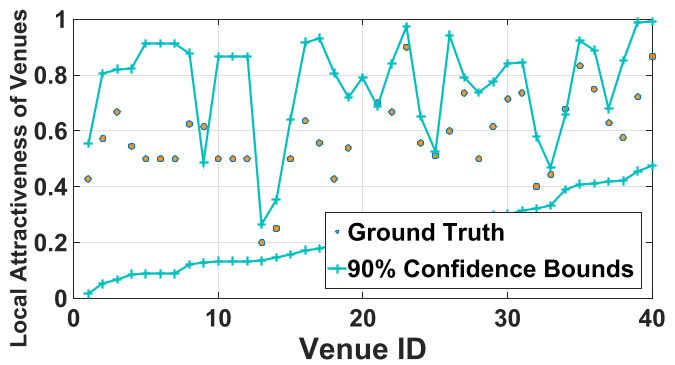 Figure 3: Validation of confidence bounds. Ground truth values (red dots) stay largely within the predicted 90% confidence intervals.
Deep Insight: Beyond Labels
The genius of STSA lies in its holistic view of urban mobility. Most prior works treated a user's home location as a static point to be guessed. STSA treats "localness" as a dynamic probability influenced by the popularity of venues among residents.
However, the framework does have limitations:
- It relies on a certain density of social connections to "rescue" uncertain EM inferences.
- It assumes that social ties primarily exist between people of the same local status, which might not hold for users with globally distributed networks (e.g., international business travelers).
Conclusion
By fusing spatial-temporal paths with social graphs, STSA provides a robust, privacy-respecting, and unsupervised way to map the human heartbeat of a city. For researchers in Smart Cities and RecSys, it offers a blueprint for turning noisy, sparse sensor data into actionable demographic intelligence.