
Co-Evolving Motion and Emotion: Growing Spatially Embedded Social Networks via ATS
Growing Spatially Embedded Social Networks for Activity-Travel Analysis Based on Artificial Transportation Systems
The paper introduces a novel method to generate realistic spatially embedded social networks by integrating Artificial Transportation Systems (ATS) with an agent-based social interaction model. Leveraging human mobility simulation and reinforcement learning, the system successfully reproduces the topological and spatial distributions observed in real-world social networks.
TL;DR
Social activities account for nearly 40% of travel in developed nations, yet modeling them is notoriously difficult due to data privacy. This paper presents a breakthrough by using Artificial Transportation Systems (ATS) to "grow" social networks from the bottom up. By simulating agents' daily commutes and interactions through Reinforcement Learning, the authors create synthetic social networks that exhibit the same "Small World" and "Spatial Proximity" properties found in real cities.
The Missing Link: Why Mobility Matters
Most social network models (like Erdös-Rényi or Barabási-Albert) are "space-blind." They focus on who knows whom but ignore where they meet. Even existing spatial models often assume people have fixed locations.
The authors argue that human mobility is the missing engine. We don't just meet people based on where we live; we meet them based on where we go—offices, schools, and malls. The interaction is dynamic: movement patterns shape the network, and the network eventually influences travel decisions.
Methodology: The Interaction-Based Engine
The researchers integrated two sophisticated components into their TransWorld simulation platform:
1. The Social Relation Model
Social tie strength () isn't static. It follows three core logical rules:
- Initial Meeting: Influenced by Homophily (similarity in age/gender) and the number of existing friends (diminishing utility).
- Strengthening: Repeated interactions increase tie strength, but as a friendship matures, the marginal gain from one more meeting decreases.
- Decay: Ties weaken over time () if agents stop interacting, eventually disappearing if they fall below a threshold.
2. Reinforcement Learning (RL) for Socializing
How does an agent decide who to talk to? The paper uses an RL framework where agents choose from four actions:
- : No interaction.
- : Random meeting (Exploration).
- : Selective interaction with an existing friend.
- : Meeting a "friend of a friend" (Transitivity).
Using Softmax selection, agents learn over time which actions provide the highest "social reward," balancing the cost of social maintenance against the utility of strong connections.
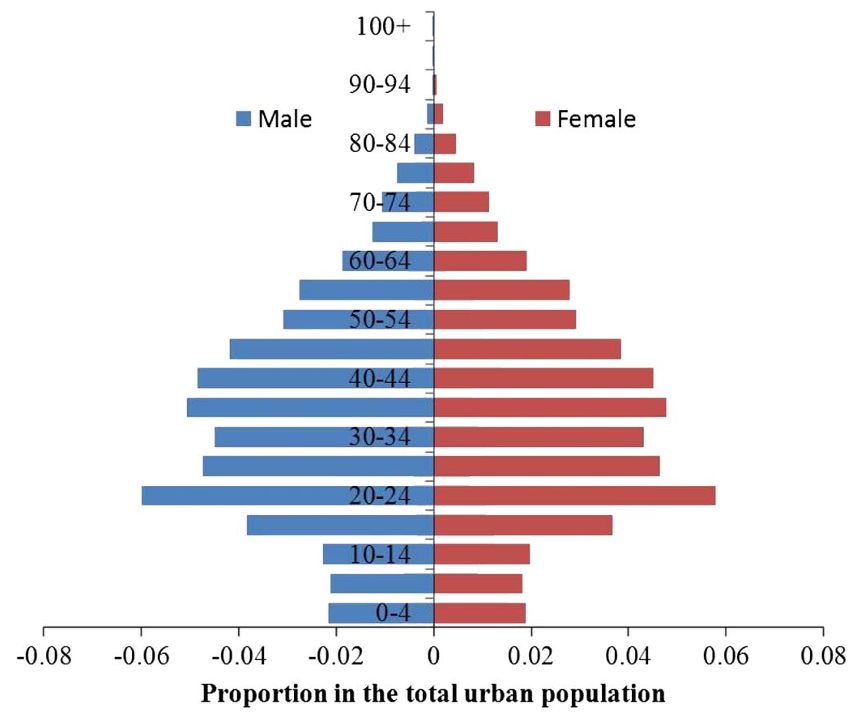 Figure 1: The logic flow of agent social interactions upon reaching a destination.
Experimental Evidence: The Beijing Case Study
The team simulated 20,000 agents in the Zhongguancun district of Beijing over 62 days.
Topological Fidelity
The resulting network perfectly mirrored real-world characteristics:
- Clustering: High clustering coefficients (0.14–0.20), far exceeding random graphs.
- Small World: An average shortest path of ~5.0 steps, validating the "six degrees of separation" in a simulated environment.
- Assortativity: High-degree agents tended to connect with other high-degree agents, a hallmark of human social structures.
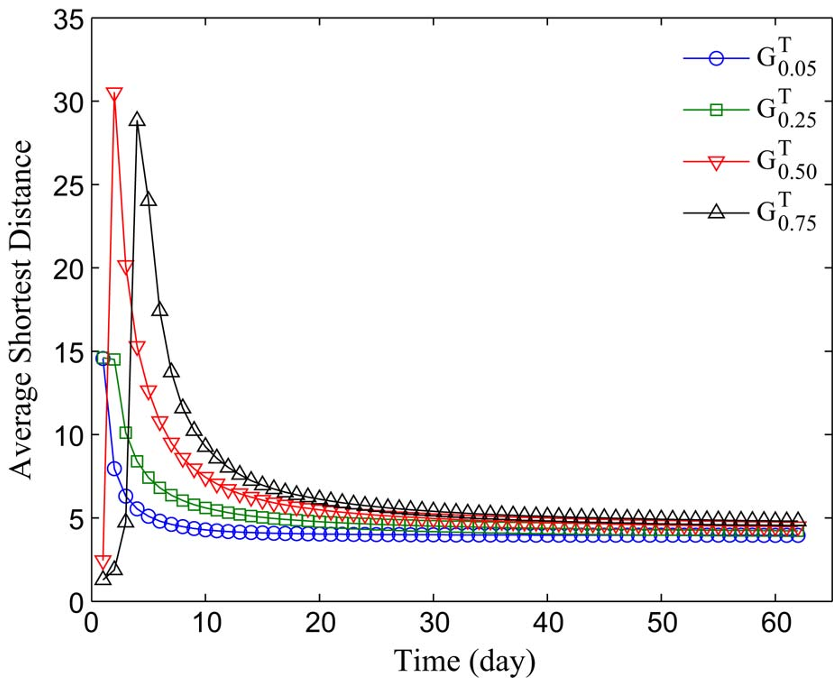 Figure 2: Evolution of Clustering Coefficients across different tie-strength thresholds.
The Geometry of Friendship
The most striking result was the Spatial Characteristics analysis. The probability of a social tie existing between two agents followed a power-law distribution relative to their home distance. Specifically, for distances under 6 km, the exponent was -0.83. This matches empirical survey data from Zurich and Toronto, proving that "growing" a network via mobility simulation naturally captures the geographic constraints of human life.
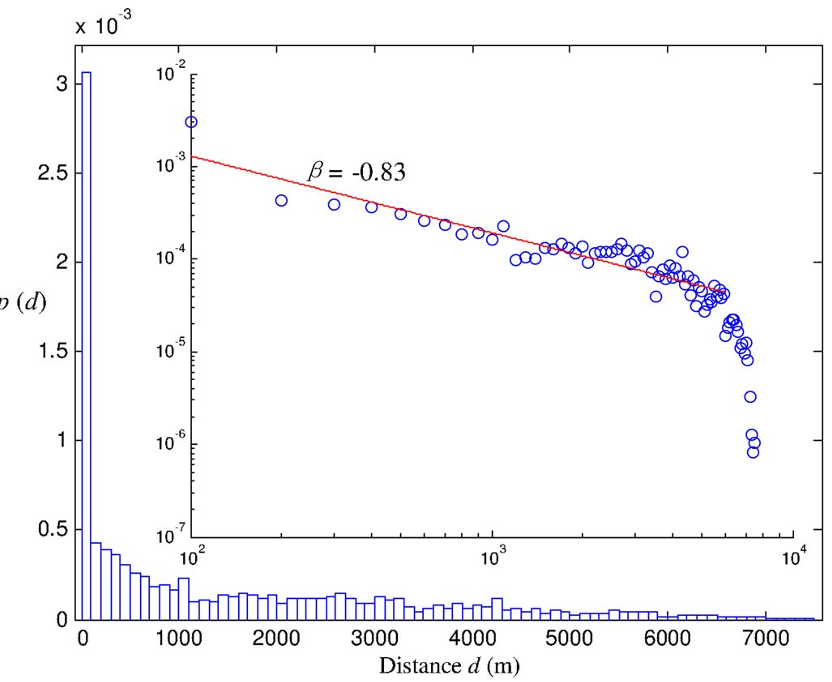 Figure 3: Tie distance distribution showcasing the geographical proximity effect.
Critical Analysis & Takeaways
This paper shifts the paradigm from observing social networks to synthesizing them through process-based simulation.
Key Contributions:
- Proves that daily activity chains are sufficient to generate realistic network topologies.
- Introduces a cost-benefit RL framework for social tie maintenance.
Limitations: Currently, the model assumes interactions are mostly "accidental" (meeting by being in the same place). In reality, many trips are "appointed" (meeting specifically because of an existing tie). The authors acknowledge this and plan to integrate "appointed travel" in the next stage of their research.
Future Impact: For urban planners, this means we can finally simulate how a new subway line or a new shopping mall might not just change traffic flow, but actually reshape the social fabric of a neighborhood.