
Beyond the Buzz: Decoding "Topic Versatility" in Social Media
Analysis of Spatially Oriented Topic Versatility over Time on Social Media
The paper introduces "Topic Versatility," a spatiotemporal metric to measure how sub-topics of a global social media topic vary across different geographic regions. Using Twitter data, the authors distinguish between topics that converge into a global narrative and those that diverge into localized sub-interests.
In the world of social media analytics, Volume has long been the king. We measure the success of a hashtag by how many times it’s tweeted or the popularity of a brand by its mention count. But Gwan Jang and Sung-Hyon Myaeng from KAIST argue in their paper that volume is a blunt instrument.
They introduce a more surgical metric: Topic Versatility. This concept moves beyond how much people are talking to how differently they are talking across various regions.
The Problem: The "Global" Misnomer
Most social media research treats a topic like a monolithic block. If #iPhone is trending, we assume everyone is talking about the same thing. However, a user in San Francisco might be discussing the new CPU architecture, while a user in London is complaining about local store availability.
Prior work in spatiotemporal analysis often missed these "sub-topics." By ignoring the internal variance of a topic, researchers fail to identify minority interests—sub-groups whose unique local concerns are buried under the weight of global statistics.
Methodology: Measuring Uniqueness and Versatility
The authors propose a simple yet robust pipeline to quantify these differences.
1. Defining Uniqueness
For any given topic, each region (e.g., a US metro area) generates a term distribution. The Uniqueness of a region is the dissimilarity (1 - Cosine Similarity) between its local distribution and the combined distribution of all other regions.
2. The Versatility Formula
Versatility isn't just an average of uniqueness. The authors argue that if even one region has an exceptionally unique take on a topic, that topic is "versatile." Their formula balances the mean uniqueness with the maximum uniqueness:
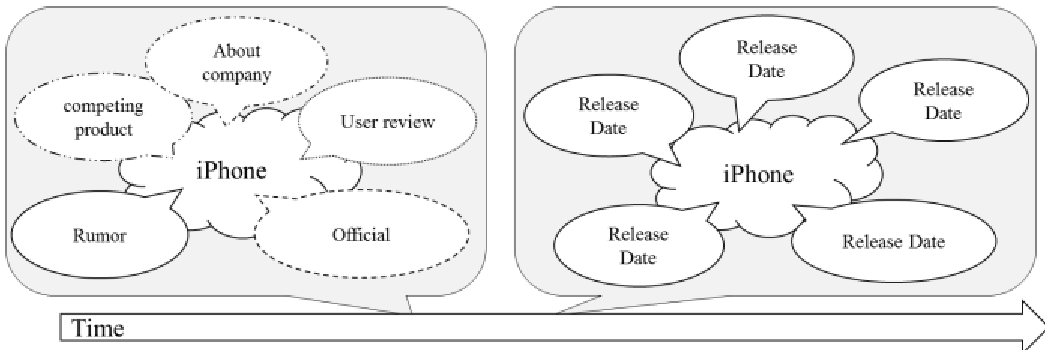 Fig 1: Conceptual illustration of how sub-topics under "iPhone" can converge or diverge over time.
Key Insights: Volume vs. Versatility
One of the most striking findings is that Volume and Versatility are often unrelated.
- Positive Correlation (Divergence): Topics like #NBA or #Wine. As more people talk about them, the conversation becomes more diverse. Local games or local vineyards create regional sub-clusters.
- Negative Correlation (Convergence): Topics like #Ebola or #OOMF (One Of My Friends). When these spike in volume, the conversation unifies. Everyone focuses on the same global news or the same meme, regardless of where they are.
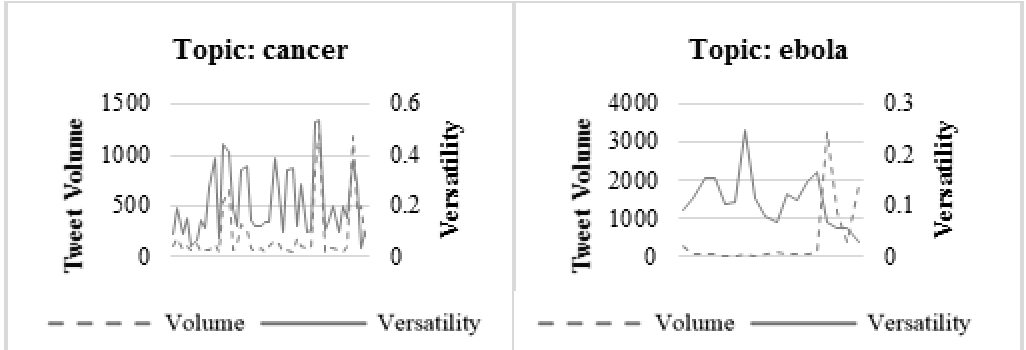 Table II: Classification of topics based on their versatility-volume correlation.
Dynamics: Peaks, Dips, and Fluctuations
The research categorizes topic behaviors into three temporal patterns:
- Peaks: Stable topics that suddenly fragment into regional sub-discussions (e.g., #Ferguson after a specific incident).
- Dips: Diverse topics that suddenly unify due to a major global event (e.g., #NBA during a championship).
- Fluctuation: Topics like #Dogs that follow social cycles (weekends vs. weekdays) but maintain a steady relationship between volume and diversity.
The "Minority Group" Value
Perhaps the most socially significant application of this work is Minority Group Detection. By using heat maps to visualize inter-region cohesiveness, researchers can spot "dark lines"—regions that are consistently dissimilar to the global trend. These regions often harbor sub-topics that are culturally or politically vital but mathematically "invisible" in global averages.
Conclusion and Future Outlook
This paper shifts the paradigm from counting tweets to analyzing the structure of the conversation. For businesses, this means better regional targeting. For governments, it means better situational awareness during crises.
The next frontier? Trigger word prediction. If we can identify the specific words that cause a topic to "fragment" (diverge) or "unify" (convergent) in real-time, we can predict social trends before they even hit their peak volume.