
Uncovering the "Weak Signals": How Small-Scale Events Pulse Through Twitter
Studying the Spatio-Temporal Dynamics of Small-Scale Events in Twitter
The paper investigates the "Spatio-Temporal Dynamics of Small-Scale Events" on Twitter (e.g., festivals, protests, local accidents). Using focus and entropy metrics, the researchers analyzed over 400 events in New York City, revealing how these "weak signals" propagate across different location granularities.
TL;DR
Unlike global disasters that shake the entire Twittersphere, "small-scale events" like local festivals or neighborhood fires act as weak social sensors. This research analyzes 410 such events in NYC, finding that they are incredibly localized—most activity happens within 500 meters of the epicenter— and they follow a stable evolution pattern without the dramatic "bursts" seen in global news.
The "Small-Scale" Blind Spot
In the world of social media analytics, "big" usually gets the attention. We know how earthquakes and election nights look on Twitter. However, small-scale events (localized protests, street fairs, or incidents) are vital for localized information services and urban planning.
The problem? These events are "weak signals." They generate low volumes of data and are easily drowned out by global noise. Previous studies only looked at a handful of incidents; this paper provides a systematic look at the physics of how these micro-events live and die in space and time.
Methodology: Measuring Focus and Entropy
The researchers didn't just look at what people said, but where they were when they said it. They used two key metrics:
- Geographical Focus (): Does the event stay in one spot? (Focus of 1.0 means all tweets come from one exact location).
- Event Entropy (): How diverse is the geographic spread?
They mapped tweet coordinates to three levels of granularity: Borough, Neighborhood, and Point of Interest (POI) (e.g., Yankee Stadium).

Key Insights: The Three Faces of Local Events
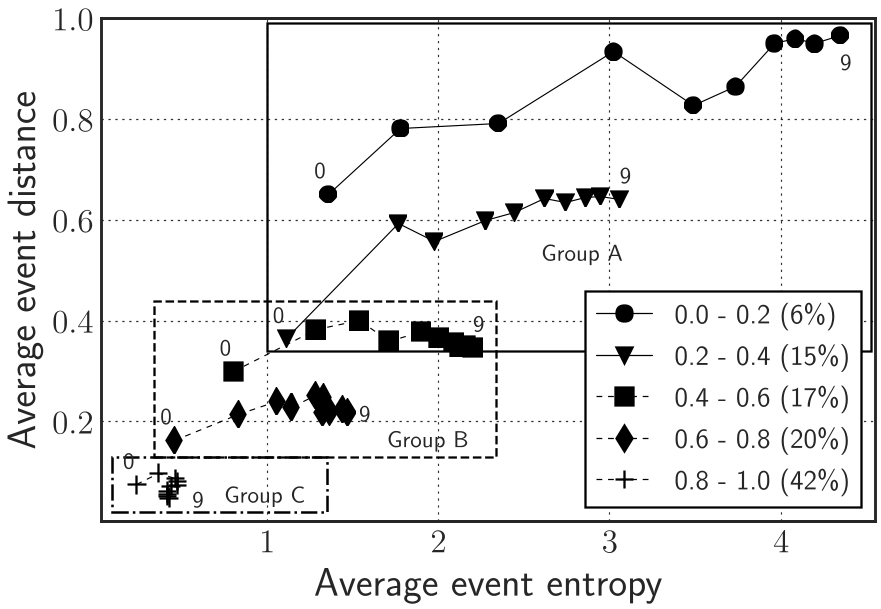
By clustering the dynamics of these events, the authors identified three distinct "species" of small-scale occurrences:
1. Group A: The Dynamic Spreaders (21%)
These are the "big" small events (e.g., the Global Citizen Festival). They start at 2 POIs and quickly spread across up to 20 locations. They have the largest audience (avg. 74 users per event).
2. Group B: The Moderate Clusters (37%)
Events like the US Open or Comic-Con. They remain concentrated in a specific area but spread over 2 to 4 distinct POIs. They peak quickly and then stabilize.
3. Group C: The Hyper-Local (42%)
These are micro-events (private concerts, local soccer matches). They are intense but physically confined to a single POI. The audience is smaller, but the topical diversity is high.
Why There are No "Peaks"
One of the most surprising findings is the lack of temporal peaks. While a global event has a massive surge of interest, small-scale events are remarkably stationary. 72% of the events showed no significant "burst" after their initial onset. They are steady burns rather than explosions.
Critical Analysis & Conclusion
This work shifts the focus from detection to understanding. By proving that small-scale events are structurally different from large-scale ones (no peaks, high focus, limited radius), it tells us that we cannot use the same algorithms for both.
The Takeaway: 88.3% of situational awareness stays within 500 meters of the event. For developers building "What's happening near me?" apps, the data suggests that looking at neighborhood-level data is too broad—the "action" is almost always at the POI level.
Limitations: The study is NYC-centric. Urban density in New York is unique; would a "small-scale event" in a suburban area behave the same way? Future research needs to test these "local physics" in more diverse geographic landscapes.