
Harmonizing Space, Time, and Popularity: A New Frontier for Social Network Search
Spatio-Temporal Keyword Queries in Social Networks
This paper introduces a unified data model and ranking function for Spatio-Temporal Keyword Queries in Social Networks. It proposes a multi-dimensional ranking approach that integrates spatial proximity, temporal recency, textual relevance, and social popularity (user/message engagement) to retrieve top-k microblogging results.
TL;DR
Social network data is inherently four-dimensional: What was said, When, Where, and by Whom. This paper presents a unified ranking framework for social interactions, moving beyond simple keyword matching to include spatial-temporal proximity and social influence. By testing on 10 million real-world tweets, the authors reveal that while relational databases can handle these queries via indexing, the "popularity" metric creates significant computational challenges for traditional top-k optimization algorithms.
Background & Motivation: Beyond the Keyword
When a hurricane hits, a user's search intent isn't just "show me posts about Hurricane Isaac." They are likely looking for:
- Freshness: What happened 10 minutes ago, not 10 days ago (Temporal).
- Locality: Reports from the eye of the storm (Spatial).
- Authority: Insights from verified meteorologists or high-engagement eyewitnesses (Social Popularity).
The "Point of Interest" in social media is a moving target. Existing SOTA methods often silo these dimensions—indexing space and text but ignoring time, or vice-versa. This paper seeks to break those silos by defining a unified RF(I, q) function.
Methodology: The Unified Ranking Function
The authors define an Interaction as a tuple —Time, Location, User, and Message. To rank these, they decompose the problem into four sub-scores:
- Textual Rank (): Based on keyword presence.
- Temporal Rank (): A decay function that favors recency, scaled between 0 and 1.
- Spatial Rank (): Calculated using the Haversine distance from the query point .
- Popularity Rank (): A weighted combination of User Popularity (in-degree/mentions) and Message Popularity (replies).
The Architecture of the Interaction
Social interactions aren't isolated; they form trees via the replyTo relationship. The model accounts for this forest-like structure to determine message engagement.
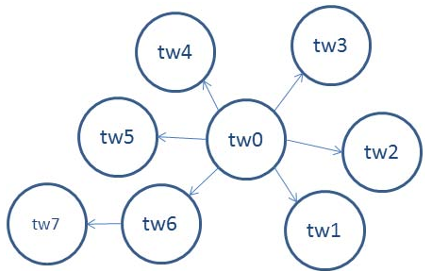 Figure 1: The tree structure of social interactions based on replies.
The final ranking function is an aggregation: This allows users to tune the "Importance" of each dimension (e.g., zeroing out space for a global news search).
Experiments & Performance Bottlenecks
The study utilized a snapshot of Twitter data during Hurricane Isaac (August 2012). They compared three execution models:
- M1 (Linear Scan): Brute force. Highly inefficient as data scales.
- M2 (Index Scan): Uses PostgreSQL's GIST (Spatial/Time) and GIN (Text) indices.
- M3 (Relational Threshold Algorithm): An early-termination strategy designed to find top-k results without scanning the whole DB.
Performance Results
The Index Scan (M2) proved robust for keyword-heavy queries, but the authors found a critical weakness in the Threshold Algorithm (M3).
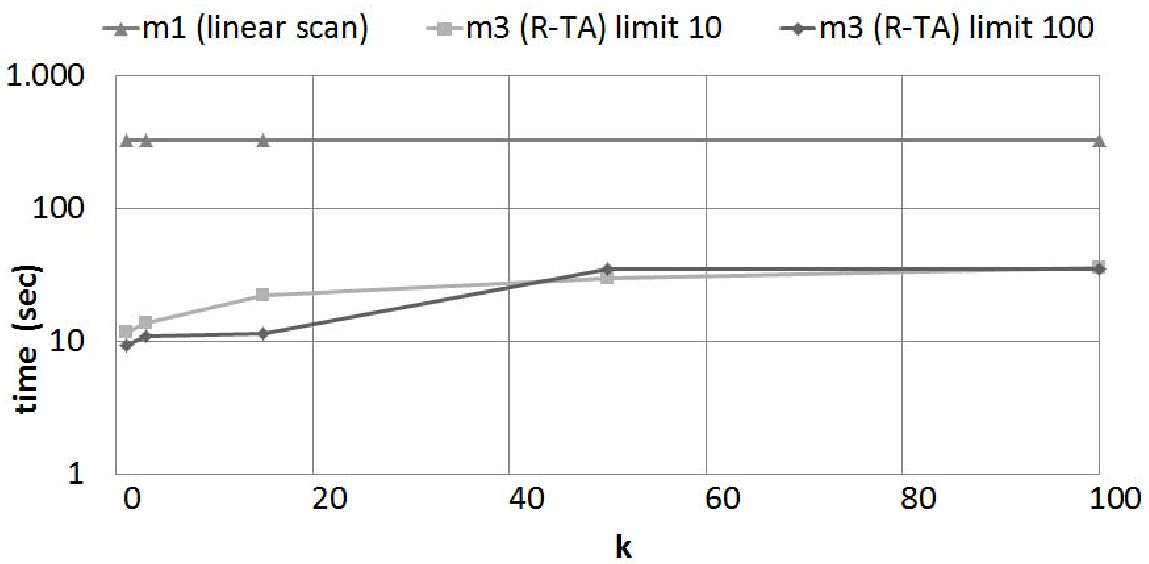 Figure 5: The trade-off between limit-based scanning and execution time.
While M3 works well for spatio-temporal queries, the introduction of Social Popularity disrupts the convergence. Why? Because the most "popular" users are often globally distributed and not necessarily near the spatial query point. This lack of correlation between dimensions forces the algorithm to scan nearly the entire dataset anyway.
Critical Insight: The Popularity Paradox
One of the paper's most salient conclusions is that Popularity isn't always helpful. In Example 3 (Emergency handling in Biloxi), including the Popularity rank actually obscured relevant local reports in favor of high-profile actors or singers talking about the storm from afar.
Takeaway for Practitioners: When designing search for crisis management, spatial and temporal weights must override "Social Proof" to ensure that the "boots on the ground" are heard over the "celebrities in the studio."
Conclusion & Future Work
This work provides a solid mathematical foundation for multi-dimensional social search. However, the performance data suggests that standard relational databases struggles to "pivot" between these disparate indices efficiently.
The future of this field lies in Hybrid Indexing Structures—indices that physically co-locate textual data within spatial tree nodes (like an IR-tree) to allow for true multi-dimensional pruning at the hardware level.