
Unmasking Urban Rhythms: Decoding Foursquare Dynamics with Diffusion-Type ICA
Discovery of Spatio-Temporal Patterns from Foursquare by Diffusion-type Estimation and ICA
The paper proposes a novel framework for extracting urban spatio-temporal dynamics from sparse Foursquare check-in data. It combines a Diffusion-type Estimation formula to interpolate continuous user movement with Independent Component Analysis (ICA) to decouple statistically independent spatial and temporal behavioral patterns.
TL;DR
Researchers have developed a method to turn sparse, discrete social media check-ins into a continuous map of urban life. By applying Diffusion-type Estimation (inspired by physics) to smooth Foursquare data and Independent Component Analysis (ICA) to separate the signals, the study identified distinct patterns like "The Pulse of Tokyo" and "Kamakura's Tourist Independence."
The Problem: The "Swiss Cheese" Nature of Social Data
Location-based Social Networks (LBSNs) like Foursquare provide a goldmine of human mobility data. However, there is a catch: data sparsity. A user checks in at a cafe at 10:00 AM and then at an office at 11:00 AM. What happens in between? Most current algorithms see this as two isolated dots.
To perform advanced signal processing like ICA—which requires continuous, overlapping data—we need a way to fill these gaps without making arbitrary guesses. Previous attempts using PCA (Principal Component Analysis) often struggled because PCA finds orthogonal components, which don't necessarily correspond to independent real-world behaviors.
The Methodology: From Physics to Social Dynamics
The authors solve this using a two-step "Smooth and Separate" pipeline.
1. The Diffusion-Type Smoothing
Instead of assuming users teleport between points, the model treats them like particles diffusing in a 2D space. They use a Gaussian Diffusion formula:
This formula creates a probability "cloud" that is narrow at the check-in points and spreads out between them, naturally modeling the uncertainty of a user's location.
2. ICA: The "Source Separator"
After smoothing the data and creating a spatio-temporal covariance matrix, the authors apply ICA. Unlike PCA, which looks for maximum variance, ICA looks for statistical independence. This allows the algorithm to separate "Background Noise" from "Commuter Rhythms" and "Event-Specific Surges."
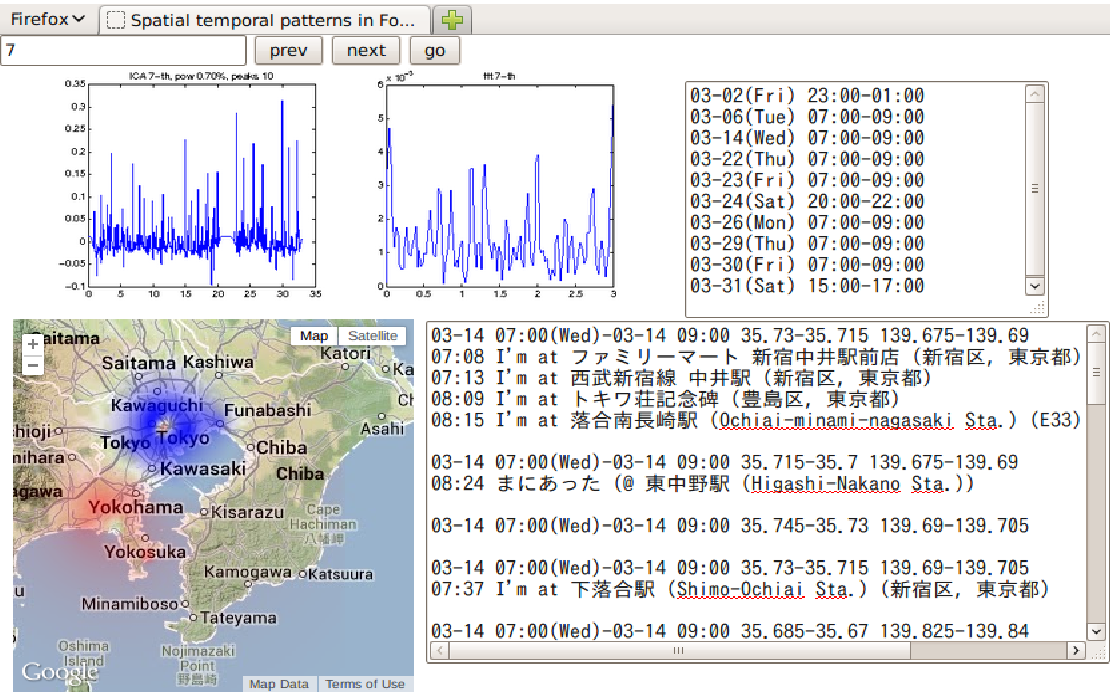 Figure 1: The system visualizes temporal patterns (time/frequency domains) alongside spatial heatmaps on Google Maps.
Experimental Insights: Tokyo’s Digital Heartbeat
The study analyzed over 800,000 tweets from Tokyo. The ICA decomposition revealed fascinating urban insights:
- Stationary Baseline (SP1): A global pattern representing the general population density of the Tokyo metropolitan area.
- The Commuter Pulse (SP2): A highly periodic pattern centered on Tokyo's business districts. Its frequency analysis shows clear peaks at 12-hour and 24-hour intervals—the "inhalation" and "exhalation" of a city at work.
- The Tourist Exception (SP3): While most of Tokyo's outskirts follow the metropolitan rhythm, Kamakura (a historic site) showed complete independence. Its mobility pattern is driven by leisure and tourism, not the corporate clock.
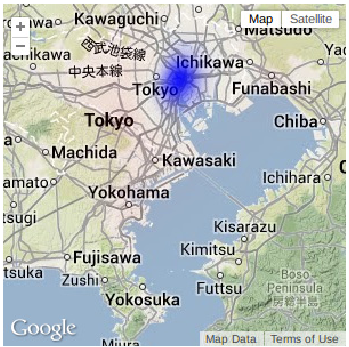 Figure 2: Extracted spatial patterns ranging from global metropolitan distributions (SP1) to localized hubs (SP2, SP3).
Critical Analysis: Why This Matters
The brilliance of this work lies in its inductive bias: User movement is a diffusion process, not just a series of coordinates.
Strengths:
- Independence over Correlation: By using ICA, the researchers could isolate the "Traffic Jam" signal (SP7) from the "General Commute" signal, which would likely be blurred together in a standard PCA analysis.
- Statistical Foundation: The use of Maximum Likelihood to estimate the scale parameter ensures the smoothing isn't just "blurring" but is optimized to the actual data distribution.
Limitations:
- Computational Cost: The diffusion estimation is expensive. The authors had to downsample to 100 users for this paper, though they used a 60-core machine.
- Social Bias: Foursquare/Twitter users are not a perfect proxy for the total population; they tend to represent a technologically active subset.
Conclusion
This paper serves as a bridge between Signal Processing and Urban Sociology. By treating a city's movement as a complex signal that can be decomposed into independent "behavioral tracks," the authors provide a powerful tool for understanding how cities breathe. As we move toward smarter cities, methodologies that can extract high-level "truth" from messy, sparse social data will be the backbone of urban intelligence.