
Beyond Truth Tables: Scalable Report Confirmation via Spatio-Temporal and Social Signals
Spatio-temporal proximity and social distance: a confirmation framework for social reporting
The paper introduces a "Confirmation Framework" for assessing the quality of social reporting in Location-Based Social Networks (LBSNs). It moves beyond explicit user verification (fact-checking) by proposing a reciprocal confirmation mechanism based on spatio-temporal proximity and social distance.
TL;DR
Social reporting—where citizens act as sensors for events like wood fires or bird sightings—suffers from a massive scalability problem regarding data quality. This paper introduces a framework that confirms reports not by asking users to "verify" them, but by calculating the reciprocal confirmation between reports based on how close they are in time/space and how distant the authors are in their social network.
Background: The Scalability Trap of Verification
In professional journalism, facts are vetted by editors. In the age of Volunteered Geographic Information (VGI), we have thousands of reports but zero "professional editors" to check them.
Current systems like SwiftRiver attempt to solve this with "veracity sliders" (user ratings), but these are prone to bot manipulation and social bias. The authors argue that we shouldn't look at what people think of a report, but rather where, when, and by whom the report was generated relative to others.
The Core Insight: Two Dimensions of Complexity
The paper categorizes the difficulty of report confirmation along two axes: Spatio-temporal Coverage and Social Bias.
| Large Coverage | Small Coverage | |
|---|---|---|
| High Social Bias | Medium Complexity (e.g., Game scores) | High Complexity (e.g., Political violence) |
| Low Social Bias | Low Complexity (e.g., Regional weather) | Medium Complexity (e.g., Rare bird sighting) |
The framework focuses on solving "Medium Complexity" cases where either the event is fleeting (rare birds) or the observers have an agenda (competitive games).
Methodology: The Confirmation Framework
The system doesn't produce a simple "True/False" binary. Instead, it builds a Confirmation Graph.
1. The Math of Proximate Truth
The framework calculates a confirmation value as a weighted sum of Spatio-temporal Proximity (stp) and Social Distance (sd):
- (alpha): A tuning parameter. For bird watching (no bias), . For games (high bias), .
- STP: Higher if reports are at the same GPS coordinate and within the same time window.
- SD: Higher if observers belong to different teams or social circles (Independence = Reliability).
2. Architecture of Evaluation
The process moves from raw stamps and tags to a structured graph where edges represent support or contradiction.
 Figure 1: The conceptual layers of report complexity, moving from sensor stamps to causal comments.
Case Studies: Birds and Games
The authors validated the framework using two extreme ends of the spectrum:
- Bird Watching: Here, spatial proximity is a strict requirement. If two people report a rare stork at the same nest within the breeding window, the reports confirm each other.
- CityExplorer (Photo Game): In a competitive game, reports from your own teammates are worth zero confirmation value because of inherent bias. The framework only boosts the confidence of a report if an opponent team or an independent source (like a Flickr geotag) places an object at the same location.
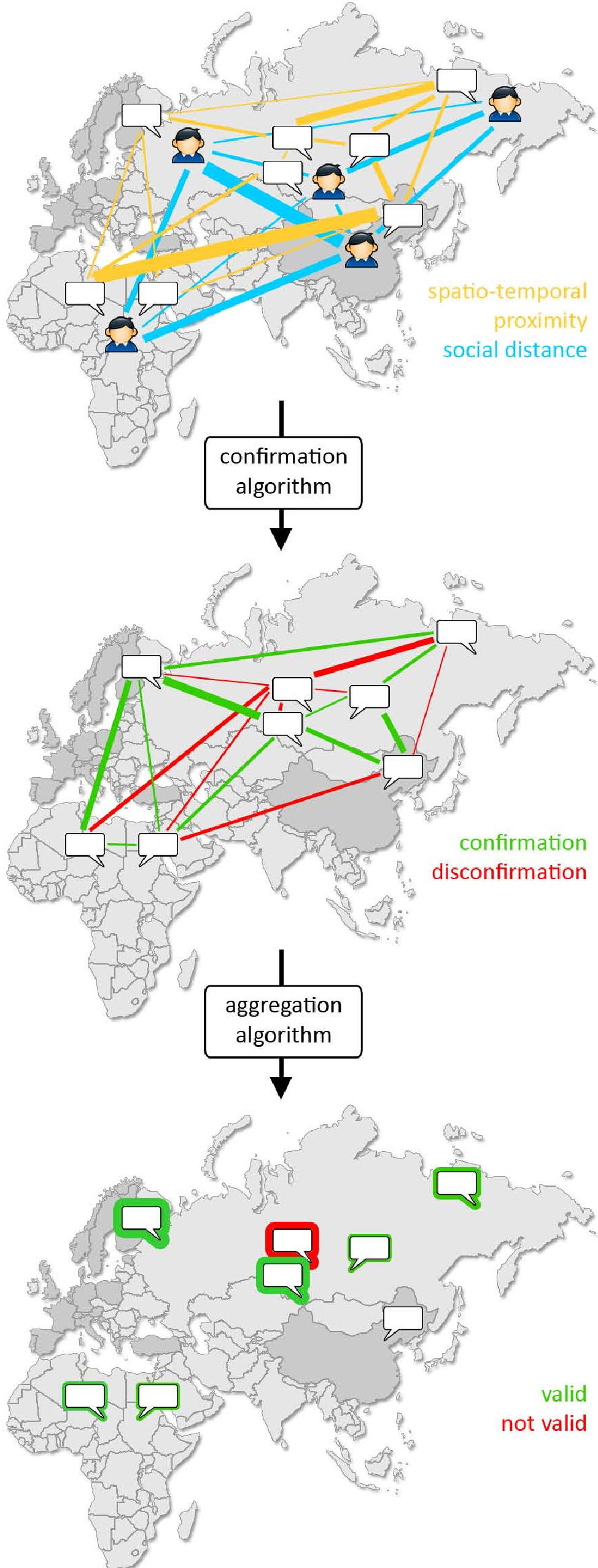 Figure 2: The pipeline from social reporting data to the final confirmation graph ranking.
Critical Insight & Conclusion
The genius of this work lies in its Inductive Bias: it assumes that "Independence + Proximity = Truth."
While this isn't a "fraud detection" system (a clever group of liars could still spoof GPS and social IDs), it provides a robust, algorithmic baseline for cleaning crowd-sourced data. As we move toward 2026, where AI-generated misinformation is rampant, these "physical-world anchoring" techniques—tying digital metadata to physical proximity—stay more relevant than ever.
Future Outlook: The next step is integrating Semantic Partonomies. For example, a report of a "Bird" should be partially confirmed by a report of an "Ouzel" at the same spot, as one is a subset of the other.