
The Power-Law of Crowds: Decoding OpenStreetMap's Hidden Editing Patterns
Spatiotemporal crowdsourcing behavior: Analysis on OpenStreetMap
This paper investigates user-editing behavior in OpenStreetMap (OSM) across varied spatial and temporal scales, specifically examining emergent events like the 2015 Nepal earthquake. Through comprehensive data analysis, the authors demonstrate that contributor activity consistently follows a Power-Law distribution, and they quantitatively characterize the "long-tail" nature of crowdsourced geographic information.
TL;DR
Is crowdsourced mapping a chaotic free-for-all or a structured phenomenon? This paper analyzes OpenStreetMap (OSM) data from NYC, Osaka, and the 2015 Nepal Earthquake to prove that user behavior follows a rigid Power-Law (Zipf’s Law) distribution. Whether across centuries of city growth or 48 hours of disaster relief, a tiny fraction of "power editors" does the heavy lifting, while the vast majority of geographic objects remain untouched after their first creation.
Contextual Positioning
In the realm of Volunteered Geographic Information (VGI), OSM has moved from a hobbyist project to an "indispensable means" for disaster rescue. While previous studies focused on general statistics, this work places OSM behavior into a rigorous mathematical framework, identifying the universal scaling laws that govern how we collectively map our world.
The Problem: The Mystery of the "Long Tail"
Traditional map services like Google Maps rely on centralized updates. OSM relies on the "crowd." This raises critical questions:
- Do contributors behave the same way in a sleepy suburb as they do in the middle of an earthquake?
- Do short-term mapping "sprints" follow different logical patterns than long-term urban evolution?
The authors argue that without understanding these patterns, we cannot predict "tag wars" or manage computational resources during humanitarian crises like those handled by the Humanitarian OSM Team (HOT).
Methodology: Proving the Power-Law
The researchers analyzed datasets across varying scales:
- Spatial Scales: From Xinyi District to Taipei City to the entire island of Taiwan.
- Temporal Scales: Comparing short-term (under 1 year) and long-term (8 years) activity in Tainan City.
- Emergent Cases: The 2015 Nepal Earthquake, where 2,000+ mappers mapped 13,000 miles of road in just 48 hours.
They utilized the Zipf Distribution formula: Where is the frequency and is the count. If the log-log plot of versions-per-object results in a straight line, the behavior follows a Power-Law.
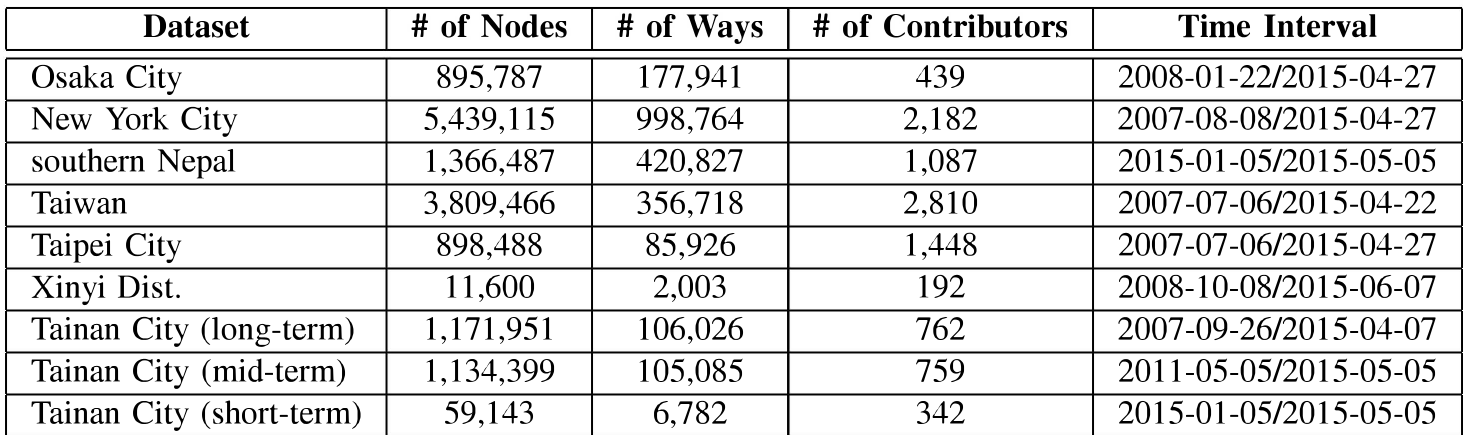 Table 1: The diverse datasets used to validate the universal applicability of the Power-Law.
Key Insights and Results
1. The Stability of the Majority
The results were striking: the Power-Law held perfectly across almost every observation. In Taiwan, 84% of nodes have only one version. This implies that the majority of our digital world is "mapped once and forgotten."
2. The Impact of Disasters
Even during the 2015 Nepal Earthquake, where urgency was at its peak, the distribution didn't flatten. People didn't suddenly edit everything equally; instead, they hyper-focused on specific arterial roads and buildings, leaving a massive long-tail of less-edited objects.
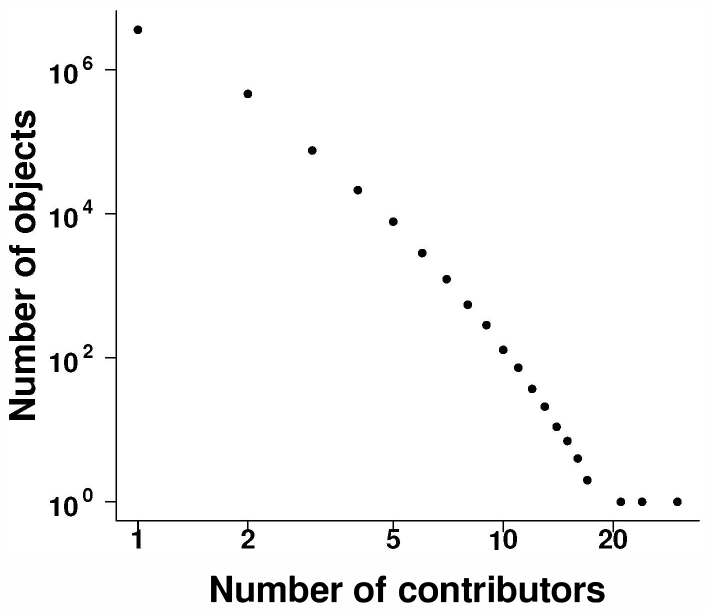 Figure: The log-log plots for Osaka, NYC, and Nepal show the unmistakable linear trend characteristic of a Power-Law relationship.
3. Spatial and Temporal Invariance
The exponent () remained relatively consistent across different time intervals (Long-term: -5.19, Short-term: -4.40). This suggests that the "social physics" of crowdsourcing is invariant to time—the way we collaborate collectively has an inherent structural signature.
Critical Analysis: Why This Matters
The discovery of this "long-tail" nature suggests a significant risk: Information Expiration. Since the crowd naturally gravitates toward "popular" or "controversial" tags (tag wars), large swaths of map data may become out-of-date without anyone noticing.
Takeaways for the Industry:
- Rescue Strategies: Authorities should identify "experienced regional editors" (the hubs in the power-law) to lead situation-awareness tasks during disasters.
- Marketing: Frequent updates in a specific "power-law hub" can serve as a proxy for economic growth or the opening of new business hubs.
Conclusion and Future Work
This paper proves that OSM isn't just a map; it's a living system governed by the same mathematical laws as Internet topology and natural language. The authors plan to investigate further: do contributors follow each other's updates? Is editing "dense" or "random" over time? Understanding these dynamics is the key to building more resilient, self-healing crowdsourced platforms.