
Deciphering the Social Script: Speaker Role Recognition via Network Analysis
Speakers Role Recognition in Multiparty Audio Recordings Using Social Network Analysis and Duration Distribution Modeling
This paper presents a framework for Speaker Role Recognition in multiparty audio, such as radio news, by leveraging Social Network Analysis (SNA) and Duration Distribution Modeling (DDM). The system achieves a significant role labeling accuracy of approximately 85% on a 19-hour corpus involving six predefined roles.
TL;DR
In multiparty audio recordings, the "role" of a speaker (e.g., Host, Guest, or Interviewee) defines the structural backbone of the content. This seminal work by Alessandro Vinciarelli introduces a method to automatically identify these roles without knowing the speakers' identities. By combining Social Network Analysis (SNA)—viewing the conversation as a graph—with Duration Distribution Modeling (DDM), the system manages to label 85% of radio broadcast time correctly.
The "Why": Beyond Identity to Function
In a typical news bulletin or talk show, the identity of the person matters less for indexing than their function. An "Anchorman" dictates the flow, while a "Guest" provides the substance. Why is this hard?
- Speaker Variability: In the corpus studied, 50% of speakers appear only once.
- Role Fluidity: The same journalist might be an Anchorman today and a Guest tomorrow.
- Segmentation Noise: Automatic systems often produce "spurious turns" caused by coughs, jingles, or brief overlaps, which distort the perceived social structure.
Methodology: The Social and the Temporal
The author's pipeline starts with an HMM-based unsupervised speaker clustering. To fix the "noisy" segmentation, a Poisson Stochastic Process (PSP) is applied to filter out segments that are statistically too short to be meaningful turns.
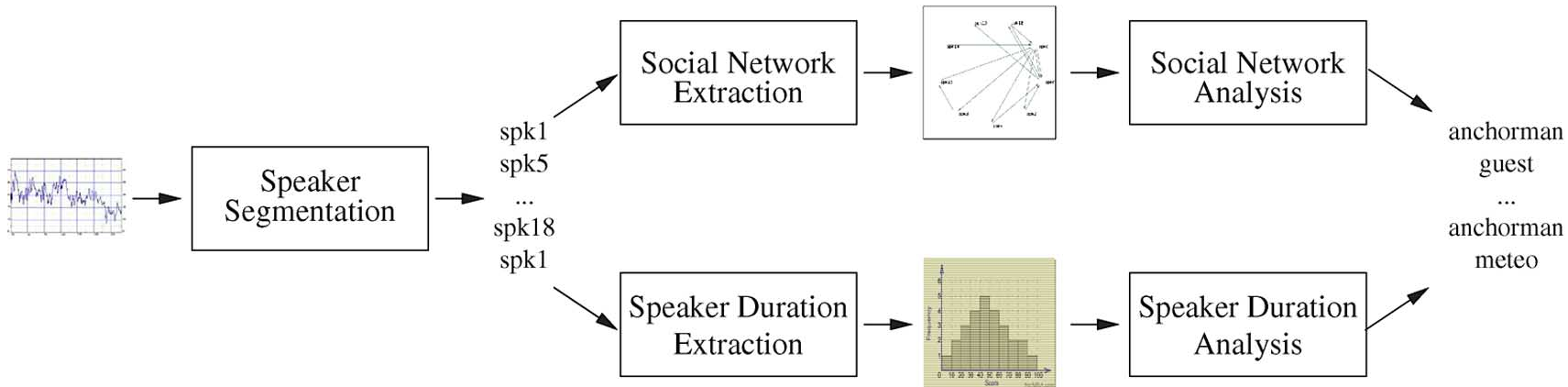
1. Social Network Analysis (SNA)
The conversation is transformed into a Sociomatrix. If Speaker A speaks immediately before Speaker B, a directed edge is drawn.
- Centrality: The Anchorman (AM) is identified through high "Closeness Centrality." They are the "hub" of the network.
- Relational Interaction: Roles like "Secondary Anchorman" are found by identifying who interacts most frequently with the identified AM.
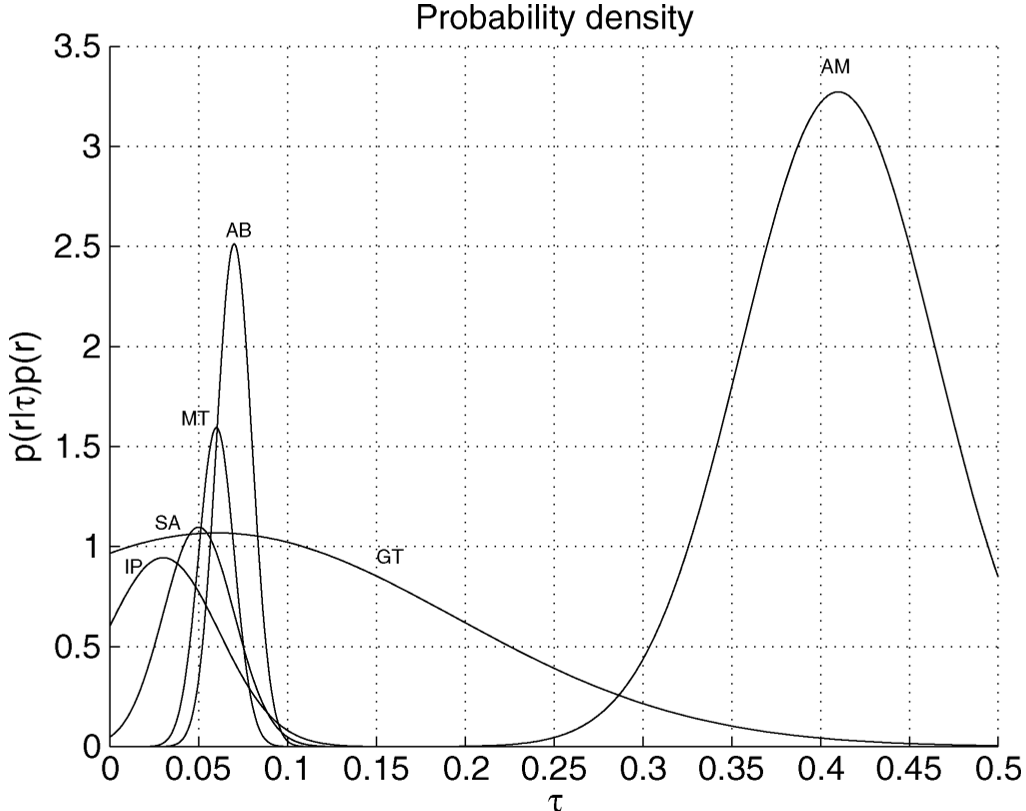
2. Duration Distribution Modeling (DDM)
Not all roles talk for the same amount of time. The method models the fraction of total recording time for each role using Gaussian distributions. As shown in the study, Anchormen take up ~41% of the time, while Secondary Anchormen account for only ~5.5%.
Experimental Battleground
The experiments were conducted on 96 radio bulletins (19 hours total). The researcher compared SNA and DDM separately and in combination.
| Metric | SNA | DDM | DDM + SNA |
|---|---|---|---|
| Accuracy (Filtering Applied) | 80.1% | 79.7% | 85.1% |
| Purity (Consistency) | 0.80 | 0.80 | 0.83 |
Key Insights from the Results:
- Diverse Errors: SNA and DDM are "diverse" models. SNA relies on who communicates, while DDM relies on how much they talk. Their combination compensates for each other's weaknesses.
- The Power of Smoothing: Without PSP filtering, accuracy drops significantly because spurious segments create "fake" social connections that confuse the centrality algorithms.
- Role-Specific Difficulty: Roles with very short interventions (Secondary Anchorman and Interview Participants) remain difficult to capture because they are often accidentally "smoothed away" as noise.
Critical Analysis & Conclusion
This work demonstrates that social interaction patterns are a "Hidden Layer" of multimedia content. Even if we don't know the topic of discussion, the topology of the turn-taking reveals the organizational intent of the producers.
Limitations: The current model assumes a "star" or "hub-and-spoke" social structure (one central figure). It might struggle in more democratic or chaotic environments like informal meetings or debates where multiple central figures emerge.
Future Outlook: For modern AI practitioners, this research provides the foundation for using Graph Representation Learning in audio. Moving forward, integrating these relational features into Large Language Models (LLMs) could allow for highly sophisticated "Role-Aware" summarization and retrieval.