
Unmasking the Speaker: Removing Speech Distortions for Precision Emotion Recognition
Speaking Effect Removal on Emotion Recognition From Facial Expressions Based on Eigenface Conversion
This paper introduces an eigenface conversion-based framework to eliminate the "speaking effect"—facial muscle distortions caused by articulation—from emotion recognition tasks. By converting "speaking faces" into "non-speaking faces" using a GMM-based mapping, it achieves state-of-the-art accuracy in the Arousal-Valence (A-V) emotion plane.
TL;DR
Recognizing emotions while a subject is talking is notoriously difficult because the mouth and jaw movements of speech override the subtle cues of emotion. This paper introduces a GMM-based Eigenface Conversion technique that mathematically "filters out" speech movements, transforming a speaking face into a synthesized "silent" face that retains pure emotional expression, resulting in a nearly 14% boost in recognition accuracy.
The "Talk-Emotion" Conflict
In affective computing, we often treat faces as static canvases. But in reality, we talk. Mouth muscle contractions for phonemes like /o/ or /m/ physically conflict with the facial landmarks of happiness or anger.
Previous solutions were "blunt instruments":
- Smoothing: Treated speech as high-frequency noise, but also blurred out the emotional nuances.
- Frame Discarding: Simply ignored segments where the person was talking, losing the most critical parts of the interaction.
Methodology: The Conversion Engine
The core innovation lies in treating speech as a predictable transformation of the facial manifold. The authors utilize an Articulatory Attribute (AA) Class Detection system to understand what is being said, and then apply a conversion.
1. Feature Extraction & Normalization
Using the Active Appearance Model (AAM), the system extracts 68 facial feature points. These are converted into normalized binary images to project into an eigenspace (PCA), reducing high-dimensional facial data into manageable weights.
2. GMM and Decision Tree Mapping
The system doesn't just use one global conversion. Instead, it builds 44 specialized decision trees. Why? Because the way a "happy" mouth looks depends on whether you just said a bilabial consonant (/b/, /p/) or a rounded vowel (/o/, /u/).
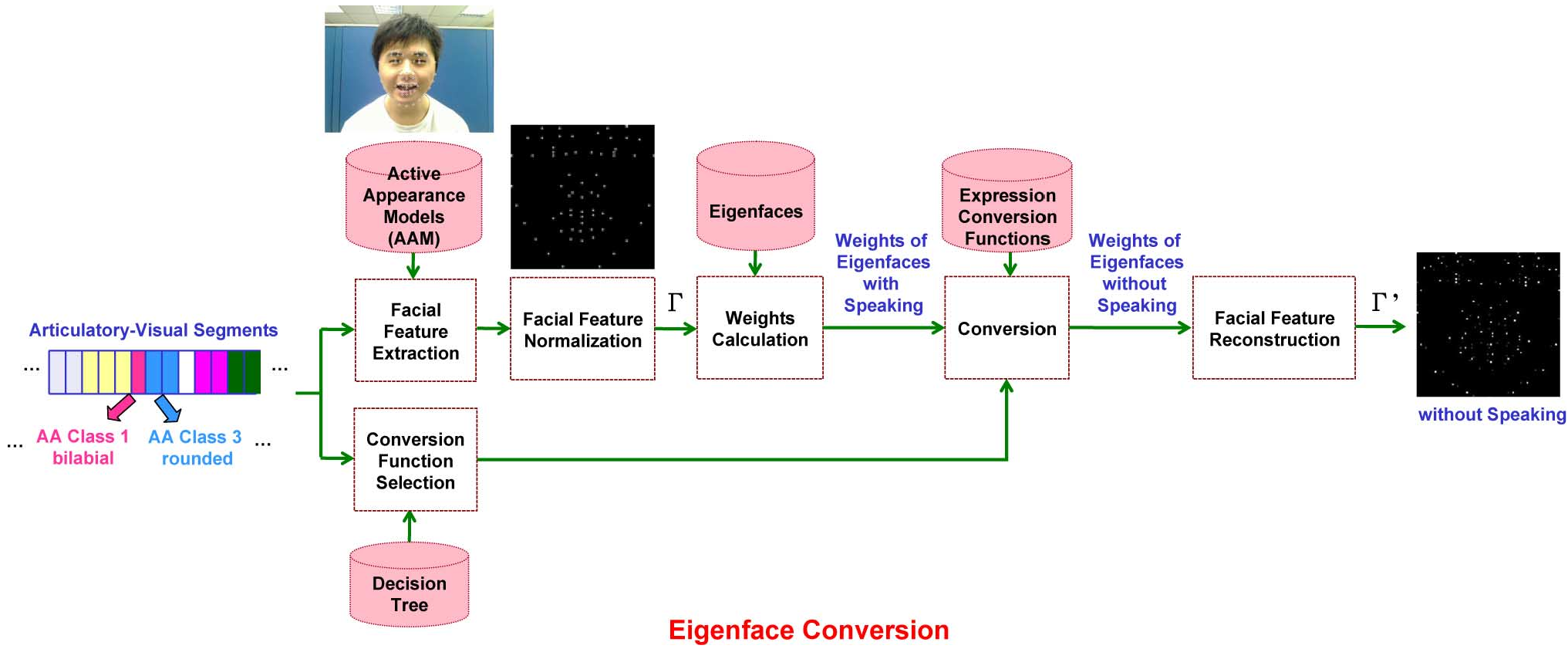 Fig 1: The architecture details how audio MFCCs guide the visual conversion through Articulatory Attribute detection.
3. Verification in the A-V Plane
Once the "speaking effect" is removed, the reconstructed points are compared against "Expression Templates" in the Arousal-Valence (A-V) plane. This allows the system to not just label an emotion (e.g., "Sad"), but to plot it as a precise coordinate on a graph of activation vs. pleasantness.
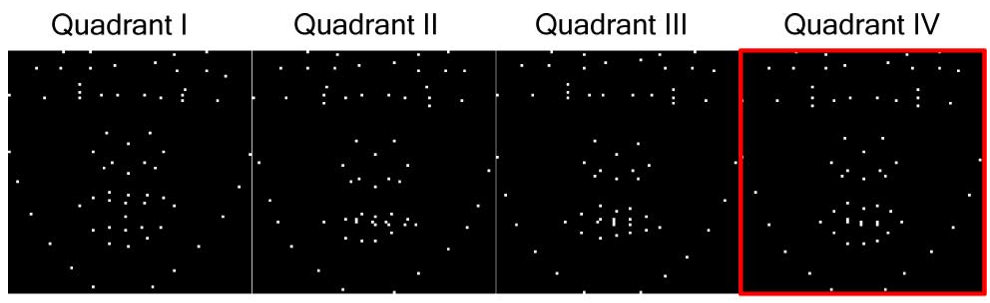 Fig 2: Example of reconstructed facial feature points mapped across the four emotional quadrants.
Experimental Battleground
The researchers tested their approach against the MHMC audio-visual database. The results were clear:
- Baseline (No Removal): 74.58% accuracy.
- Smoothing (Zeng et al.): 80.42% accuracy.
- Proposed Method: 88.33% accuracy.
The most dramatic gains were seen in Quadrant IV (Relaxed/Calm). Subtle, low-arousal emotions are usually the first to be "drowned out" by speech; the eigenface conversion effectively recovered these signals where other methods failed.
 Table 1: Detailed accuracy breakdown showing the superiority of the conversion approach across all quadrants.
Critical Insight: Why it Works
The "Secret Sauce" is the Articulatory Attribute (AA) alignment. By using the audio stream to provide a "contextual map" for the visual stream, the model knows exactly which mouth distortions are due to linguistics and which are due to affect. This cross-modal synergy is far more effective than trying to process the video in a vacuum.
Conclusion & Future Paths
This work demonstrates that for AI to truly understand human interaction, it must acknowledge the simultaneous nature of talking and feeling. While the current model uses linear PCA, the authors suggest that 2DPCA or non-linear manifold learning could further refine the synthesis. For developers of virtual assistants or social robots, this methodology provides a blueprint for reading "between the lines" of a user's speech.