
Prometheus: Reclaiming the Social Graph through Decentralized Inference
Special Issue on Foundations of Social Computing: Enabling Social Applications via Decentralized Social Data Management
This paper introduces Prometheus, a decentralized peer-to-peer (P2P) service for socially aware data management. It aggregates fragmented social information from various sensors into a weighted directed multigraph, enabling complex social inferences such as trust and proximity while ensuring user-controlled privacy.
TL;DR
Prometheus is a decentralized P2P service designed to manage social data across multiple platforms. By mapping the P2P infrastructure to real-world social ties, it enables complex social inferences (like "how much can I trust this friend-of-a-friend?") without central authorities, reducing network overhead by up to 65% while enhancing privacy and attack resilience.
Problem & Motivation: The Centralization Trap
In our current digital ecosystem, social data is a fragmented asset owned by giant corporations. This centralization creates two massive failures:
- Privacy & Ownership: Users have zero control over their data, making them vulnerable to "Big Brother" monitoring and restrictive corporate policies.
- Context Silos: Social signals on Facebook are isolated from professional ties on LinkedIn or interaction logs on mobile devices.
While mobile-only decentralized solutions exist, they fail when an application needs to reach beyond a user's immediate contacts. Prometheus fills this "middle ground" by creating a persistent, peer-contributed infrastructure that can handle multi-hop social queries across different life contexts.
Methodology: The Socially-Aware Multi-Graph
The core innovation lies in the Socially-Aware Mapping. Instead of randomly distributing data across a Distributed Hash Table (DHT), Prometheus encourages users to store their encrypted data on peers hosted by people they actually trust.
1. The Multigraph Architecture
Prometheus represents the social world as a directed, weighted, and labeled multigraph.
- Labels: Represent the domain (e.g., "Work," "Gaming," "Facebook").
- Weights: Represent the intensity of interaction (0 to 1).
- Directionality: Acknowledges that social relationships are often asymmetrical.
2. The Inference API
Unlike a simple database, Prometheus exposes an API that performs "Social Inferences." For instance, the Social Strength function calculates the bond between two non-directly connected users by analyzing parallel paths and edge weights, following the sociological "horizon of observability" principle.
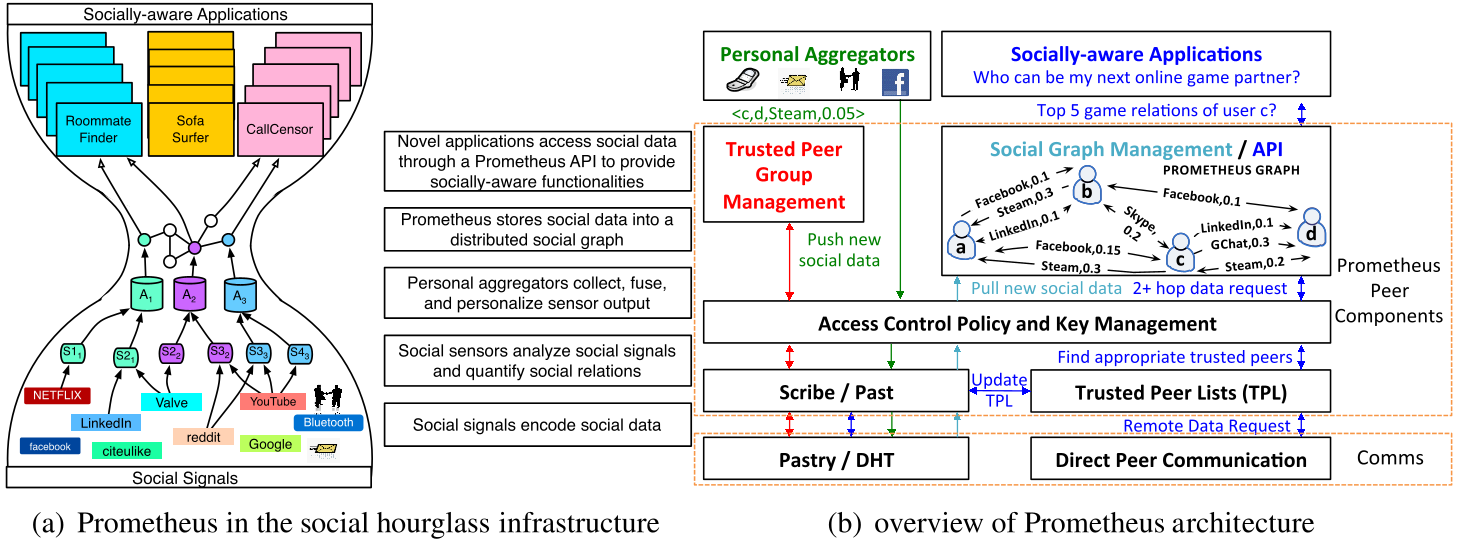 Caption: The Prometheus architecture within the "Social Hourglass" framework.
Experiments & Results: Efficiency through Proximity
The researchers tested Prometheus using large-scale simulations (up to 1 million users) and real-world deployment on PlanetLab across 35 countries.
Performance Gains
By grouping socially connected users on the same peers (Social Mapping), the system achieved:
- Reduced Latency: Response times for 3-hop queries were 30-40% faster.
- Lower Overhead: Message traffic dropped by 40-65% because many sub-queries could be resolved locally within a "social community" on a single peer.
Resilience to Attacks
Prometheus exhibits a unique defense mechanism. Because data is grouped socially, a malicious node's "influence" (the ability to drop or modify requests) is naturally restricted to its immediate social vicinity. In a random DHT mapping, a malicious node can affect arbitrary users; in Prometheus, the impact is localized, making widespread collusion much harder.
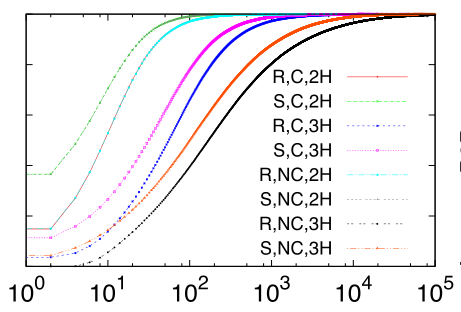 Caption: Comparison of message overhead between Social Mapping (SM) and Random Mapping (RM).
Critical Analysis & Conclusion
Takeaway: Prometheus proves that leveraging "social incentives"—the fact that we are more likely to provide resources for friends—creates a more robust and efficient distributed system than pure algorithmic randomness.
Limitations:
- Initial Bootstrapping: Setting up a "Trusted Peer Group" requires out-of-band key exchanges, which might be a barrier for non-technical users.
- Consistency: The append-only social data file ensures durability but may lead to transient inconsistencies during rapid updates.
Future Outlook: With the rise of Web3 and the Fediverse (e.g., Mastodon, BlueSky), the principles of Prometheus are more relevant than ever. This research provides a mathematical and systemic foundation for how we can scale decentralized social graphs to millions of users without sacrificing the complex "inferences" that make centralized social networks so powerful today.