
Statistical Twitter Spam Detection Demystified: Performance, Stability, and Scalability
SPECIAL SECTION ON BIG DATA ANALYTICS IN INTERNET OF THINGS AND CYBER-PHYSICAL SYSTEMS
This paper systematically evaluates the performance, stability, and scalability of 9 mainstream machine learning algorithms for Twitter spam detection using a massive ground truth dataset of 600 million tweets. It identifies Random Forest and C5.0 as the most effective models, while highlighting Deep Learning's unique ability to achieve superlinear speedup in parallel environments.
Executive Summary
TL;DR: This study provides a comprehensive benchmarking of machine learning algorithms for identifying Twitter spam. By testing 9 different models on a dataset of 30 million labeled tweets, the researchers pinpoint Random Forest as the accuracy champion and Deep Learning as the scalability winner. The work bridges the gap between theoretical algorithm performance and the practical, real-time demands of social network security.
Background: Within the academic coordinate system, this paper serves as an essential empirical benchmark. It moves away from "novel feature engineering" to focus on the systematic stress-testing of existing statistical methods under real-world conditions like extreme class imbalance and parallel hardware scaling.
The Core Problem: Accuracy vs. Real-Time Feasibility
Detecting spam on Twitter is a cat-and-mouse game. While social graph-based features (who follows whom) are robust, they are too slow for real-time streams. Conversely, content features are fast but easily faked. The authors identify a "missing manual" in the industry: which algorithm actually holds up when spams are only 5% of the traffic, and can any of them truly scale to utilize a 32-core server efficiently?
Methodology: Light-Weight Features and Parallel Architectures
The authors selected 13 "cheap" features (6 account-based like account_age and 7 content-based like no_retweets) that can be extracted via the Twitter API with zero latency.
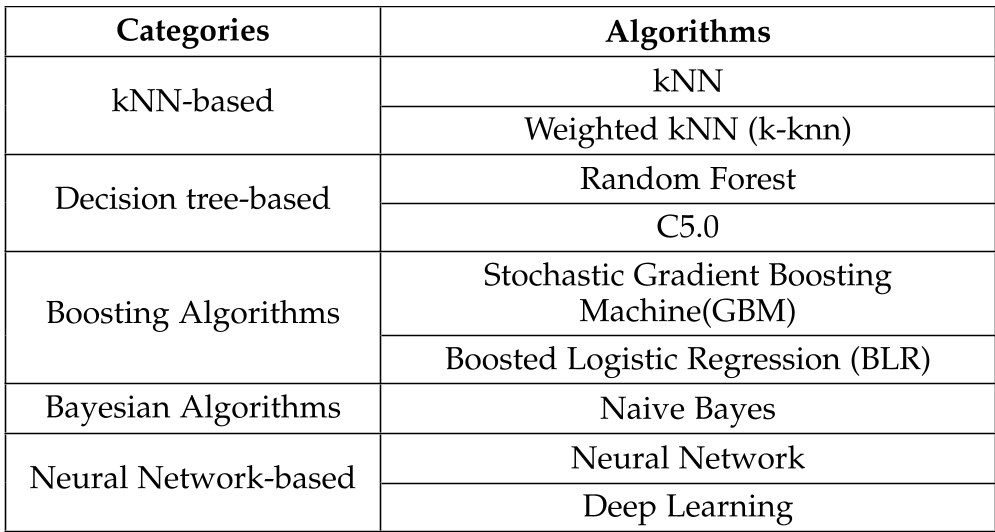
They categorized the models into five groups:
- kNN-based: kNN and Weighted k-kNN.
- Tree-based: Random Forest and C5.0.
- Boosting: GBM and Boosted Logistic Regression (BLR).
- Bayesian: Naive Bayes.
- Neural Networks: Standard MLP and Deep Learning (via H2O platform).
Experimental Insights: The Winner and the Scaling Surprise
1. The Accuracy Champions
When the data was evenly split, Random Forest and C5.0 dominated, maintaining >90% accuracy. However, when the researchers introduced a realistic 1:19 spam-to-legitimate ratio, most algorithms saw their F-measure (a balance of precision and recall) collapse. Random Forest proved the most resilient, though its precision still took a hit due to the overwhelming volume of non-spam data.
2. The Scalability Peak: Superlinear Speedup
The most striking finding was in Scalability. While most models (like C5.0 or kNN) saw diminishing returns after 8 or 16 CPU cores, Deep Learning achieved a "Superlinear Speedup." This means doubling the CPUs more than doubled the training speed.

Why did Deep Learning scale so well?
- Hardware Synergy: The Intel Xeon's shared L3 cache allowed logical cores to access memory faster than a single core could.
- Software Optimization: The H2O platform utilizes the "Hogwild!" lock-free parallelization scheme, allowing multiple processors to update the model simultaneously without wait-times or memory locks.
Critical Analysis & Conclusion
Takeaways
- Tree-based algorithms (Random Forest/C5.0) are your best bet for high-accuracy detection where training time is not the primary constraint.
- Deep Learning is the only architecture analyzed that truly "craves" more hardware. It is the most future-proof for real-time, massive-scale deployments.
Limitations
The study assumes all spam tweets contain URLs. Modern "influence operations" often use text-only or image-based spam to bypass URL blacklists, which these light-weight features might miss.
Future Outlook
The "Superlinear Speedup" observed in Deep Learning suggests that social media platforms should invest in lock-free parallel architectures rather than just deeper models. As spammers evolve, the ability to retrain a model in seconds rather than hours becomes the ultimate defensive advantage.