
StarRank: Uncovering Academic Rising Stars Through Social Network Dynamics
SPECIAL SECTION ON CYBER-PHYSICAL-SOCIAL COMPUTING AND NETWORKING
This paper introduces StarRank, an integrated framework for identifying "rising stars" in academic social networks using a combination of improved PageRank-based influence assessment, complex network propagation models, and neural networks for citation prediction.
TL;DR
Predicting which young researcher will become the next "Einstein" is a high-stakes challenge for funding agencies and universities. This paper presents StarRank, a system that models how academic influence "flows" through co-authorship and social interactions. By combining a modified PageRank algorithm with neural networks, it predicts future citation success more accurately than traditional machine learning models.
Background: The Seniority Bias in Academia
Most academic ranking systems are inherently "backward-looking." Metrics like the h-index reward years of accumulated citations, making it nearly impossible to identify a brilliant PhD student who has just published their first seminal work. This paper argues that potential—represented here as "Rising Stars"—is often hidden in the social topology of the researcher's network rather than just their current citation count.
Methodology: Mapping the Flow of Influence
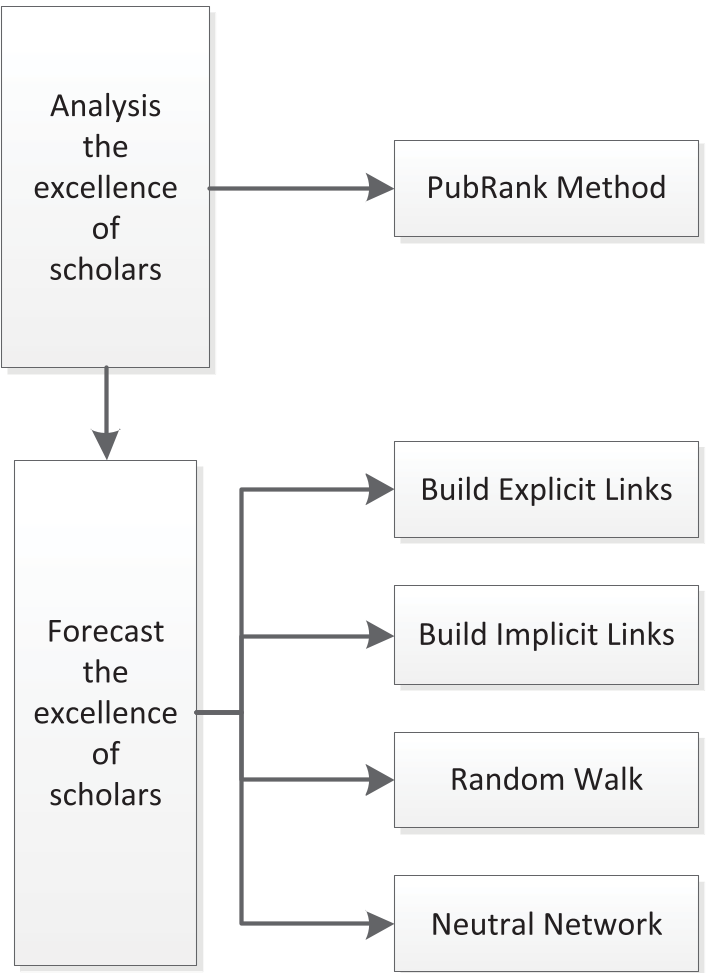
The authors suggest that academic excellence isn't just a static property; it's something that propagates. They break down the problem into three distinct phases:
1. Heterogeneous Impact Assessment
Instead of treating all journals as equal, the authors calculate paper rank based on a citation network. They then derive a "scholar publication level" () that uses an attenuation factor to balance the impact of multiple works.
2. Explicit vs. Implicit Links
This is the core innovation. The model doesn't just look at who you wrote a paper with (Explicit Link). It also looks at:
- Scholar Activity: Using the SIS (Susceptible-Infected-Susceptible) epidemic model to estimate how "active" a scholar is in the community.
- Homogeneity: How similar two scholars' research interests are.
- Ternary Relationships: The "friend of a friend" logic—if Scholar A works with B, and B works with C, there is a latent link between A and C.
3. Neural Network Prediction
Once the ranks are established via a random walk process, the ranks are combined with features like co-author counts and current citations into a 3-layer neural network to forecast future citation performance.
Experimental Results
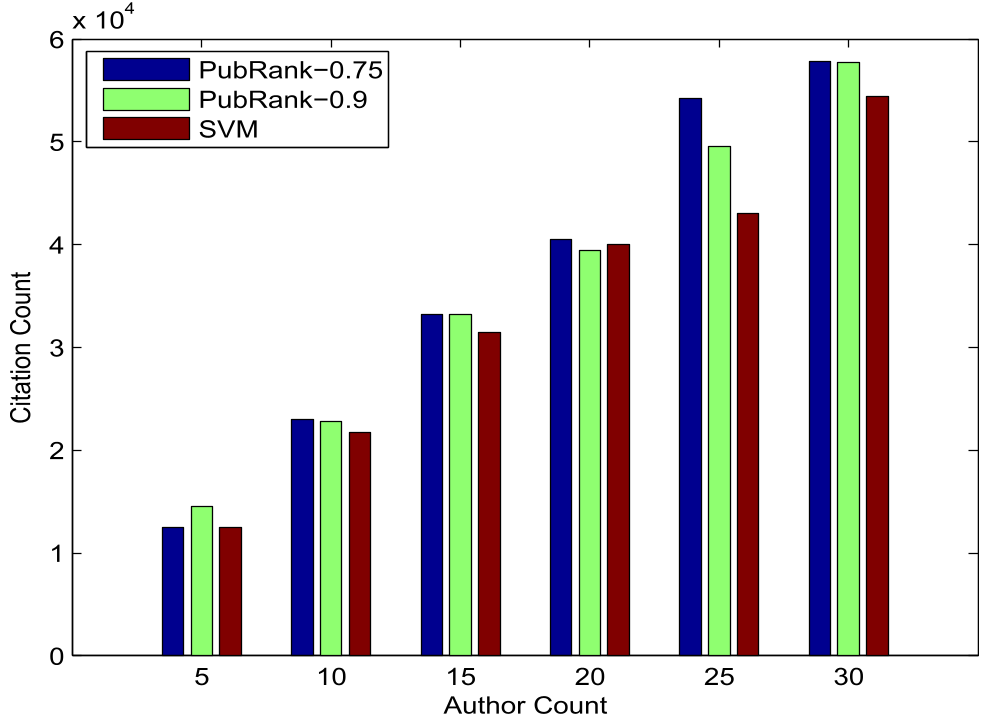
The model was tested using the American Physical Society (APS) dataset. The authors compared StarRank against a standard Support Vector Machine (SVM) regressor.
- Higher Precision: In the top 25% "Hit Rate" experiment, StarRank consistently identified more future high-impact authors than the baseline.
- Better Correlation: The Spearman correlation coefficient results indicate that the StarRank ordering much more closely resembles the actual future performance of these scholars.
Critical Insight: Why Does It Work?
The success of StarRank lies in its Inductive Bias regarding academic growth. By incorporating "Implicit Links," the model accounts for the social capital a young researcher gains at conferences and through mentorship. A student working with a high-activity "hub" in the network is mathematically treated as having a higher probability of "infecting" the network with their ideas, which mirrors the real-world visibility boost provided by elite labs.
Conclusion & Future Work
StarRank shifts the focus from "what have you done?" to "where are you positioned to go?" While the model is robust, the authors acknowledge that it could be further enhanced by quantifying the iteration times of the random walk more dynamically. For future research, integrating even more diverse data sources—such as social media engagement or grant funding amounts—could refine the "Implicit Link" accuracy further.
Takeaway for Institutions: When hiring, don't just look at the h-index. Look at the candidate's social activity and the latent connections they hold within the broader academic graph.