
WoC-CPSS: Architecting Swarm Intelligence for the Next-Gen Power Grid
SPECIAL SECTION ON CYBER-PHYSICAL-SOCIAL COMPUTING AND NETWORKING
This paper introduces a transformative framework for Web-of-Cells (WoC) dispatching and control, leveraging Cyber-Physical-Social Systems (CPSS) to enhance Collective Intelligent Decision-making (CID). By integrating Markov Switching Complex Dynamic Grids (MSCDG) and Parallel Machine Learning (PML), the authors establish a self-organizing architecture that achieves State-of-the-Art coordination in high-penetration renewable energy environments.
TL;DR
As we shift from massive coal plants to millions of intermittent solar panels and EVs, the traditional "top-down" control of the power grid is nearing a breaking point. This paper proposes a Web-of-Cells (WoC) framework that treats the grid as a biological-like self-organizing network. By merging Complex Network Theory, Game Theory, and Parallel Machine Learning (PML), the authors created a system where the grid "learns" to balance itself through the emergence of collective intelligence.
Background: The Death of Centralization
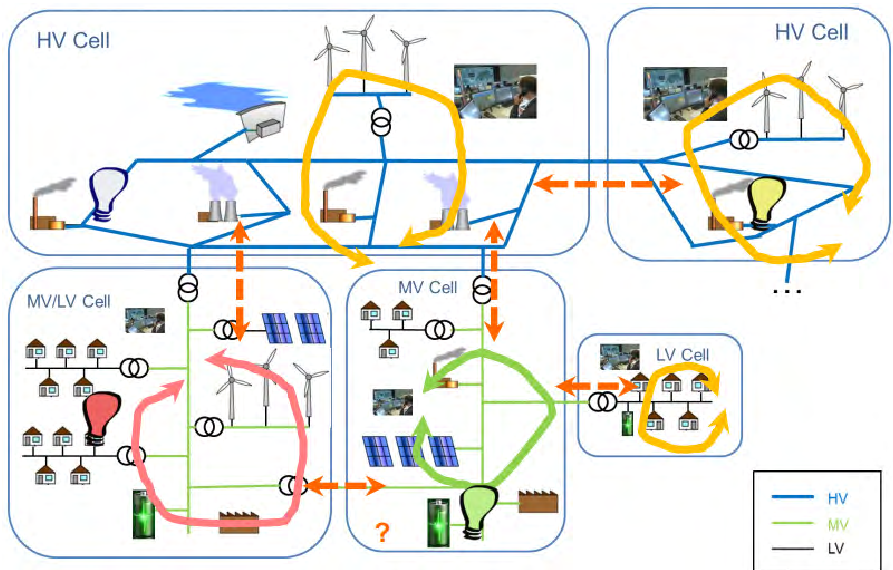
Current power systems are governed by a Transmission Operator (TSO) in a rigid hierarchy. This works when you have 50 large power plants. It fails when you have 500,000 distributed energy resources. The ELECTRA project proposed the WoC concept to solve this, but until now, the "how" remained theoretical. This paper adds the critical "Social" layer to the Cyber-Physical mix, forming a CPSS (Cyber-Physical-Social System).
Problem & Motivation: Why is the Grid "Social"?
Traditional models treat the grid as wires and sensors (Physical + Cyber). However, in a deregulated market, every "Cell" (a micro-grid entity) is a stakeholder with its own interests.
- The Pain Point: Centralized EMS cannot handle the "explosion" of decision-making variables.
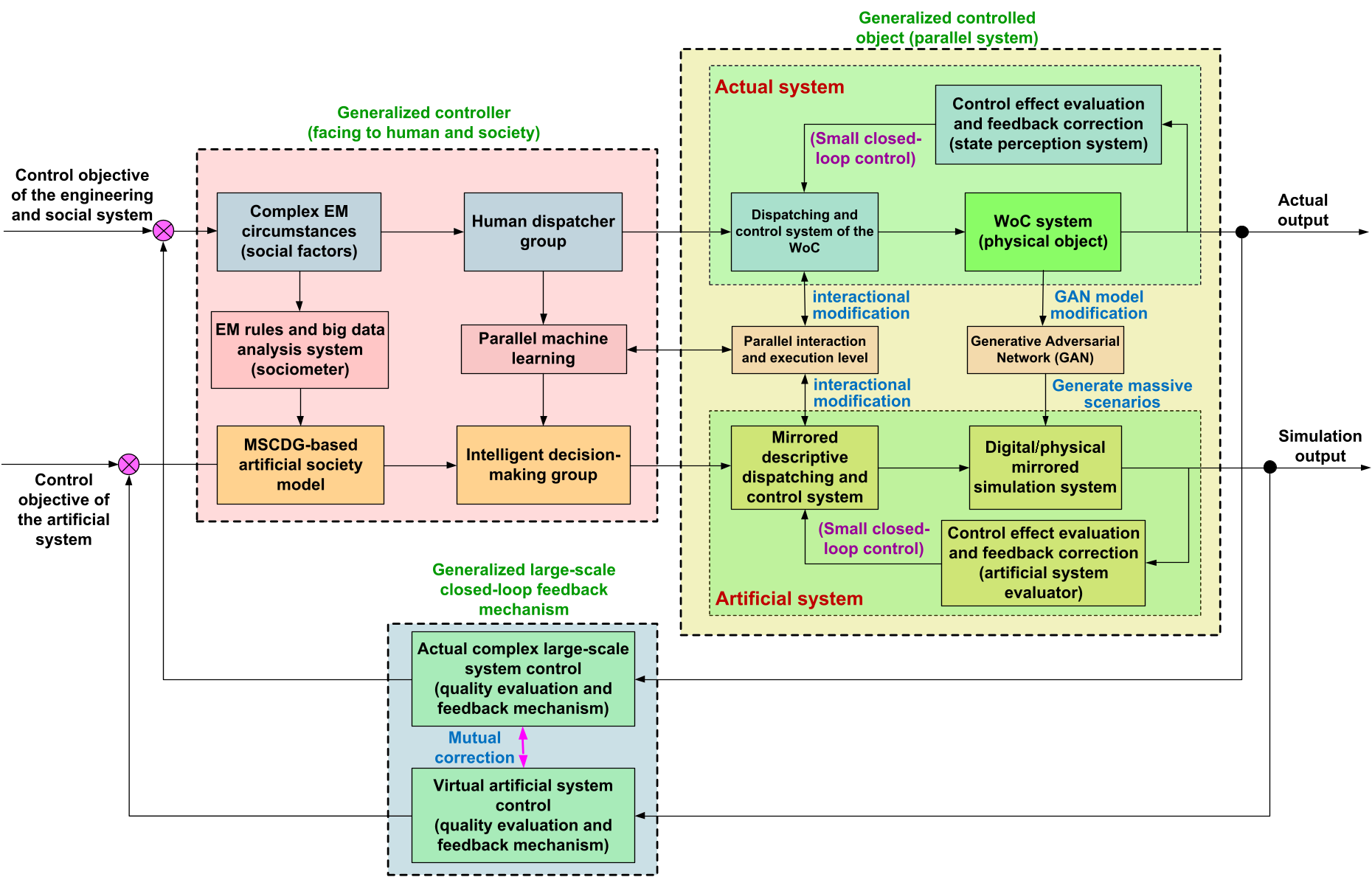
- The Insight: If we can model the grid as a social network of competing and cooperating agents, we can use New Knowledge Emergence—the phenomenon where simple local rules lead to complex, intelligent global behavior—to manage the grid.
Methodology: The Core Engine
The authors tackle this through a three-pronged mathematical approach:
1. MSCDG: Modeling the "Shape" of the Grid
The authors use Markov Switching Complex Dynamic Grids (MSCDG) to model a network whose connections (topology) are constantly flickering on and off due to market changes or failures.
2. GAN & Parallel Learning: Creating a "Virtual Mirror"
Since we can't crash a real power grid to learn from mistakes, the authors use Generative Adversarial Networks (GANs) to create thousands of "fake" disaster and high-stress scenarios. These form a Parallel System where AI agents (RoboECs) train at warp speed.
3. Game Theory: The Logic of Coordination
- Between Master and Slave: Using Stackelberg Games to coordinate high-voltage cells with low-voltage followers.
- Between Equals: Using Correlated Equilibrium (CE) and Nash-Q Learning to ensure cells don't "fight" over resources but converge to a win-win stability.
Experiments & Results: Real-World Testing
The researchers didn't just stay in the lab. They deployed this on a massive simulation scale and tested it against projects in the China Southern Power Grid.
- Scale: Over 70,000 distributed devices and 5,000 grid nodes.
- Performance: The Fast Stackelberg Equilibrium Learning (FSEL) converged significantly faster than standard reinforcement learning, proving that "Transfer Learning" (carrying knowledge from one cell to another) is viable for real-time frequency control.

Critical Analysis & Conclusion
The Takeaway
The "Web-of-Cells" is not just a structural change; it’s a cognitive shift. By treating every autonomous cell as an intelligent agent in a social game, we can unlock Swarm Intelligence for infrastructure.
Limitations & Future Work
While the math is robust, the "Social" modeling of human irrationality in markets is still early. Future versions will need to integrate deeper human-behavioral heuristics. However, as an architectural blueprint for Energy 5.0, this work is a landmark in moving from "Smart" grids to "Intelligent" grids.
Senior Editor's Note: This paper effectively bridges the gap between pure AI research and heavy electrical engineering. By using GANs for data augmentation in a field where data is traditionally scarce (fault data), the authors demonstrate a high degree of technical foresight.