
SERGE: Mastering the Timing of Event Recommendations through Graph Entropy
SPECIAL SECTION ON CYBER-PHYSICAL-SOCIAL COMPUTING AND NETWORKING
SERGE is a Successive Event Recommendation framework designed for Event-Based Social Networks (EBSNs) that utilizes Graph Entropy to weight multiple relational models. It employs Random Walk with Restart (RWR) on two distinct graph structures—Primary and Feedback Graphs—to achieve SOTA performance in addressing the new event cold-start problem.
TL;DR
Recommending a concert or a hiking trip is inherently different from recommending a book. Events are ephemeral, have strict deadlines, and suffer from a severe "cold-start" problem where no one has rated them yet. SERGE (Successive Event Recommendation Based on Graph Entropy) solves this by building two separate relational graphs—one for background context and one for real-time feedback—and blending them using a mathematically rigorous Graph Entropy approach.
The "Cold Start" and Asynchronous Feedback Dilemma
In Event-Based Social Networks (EBSN) like Meetup or Douban Event, developers face a unique challenge:
- New Event Cold Start: An upcoming event is a "black box" with no historical participation data.
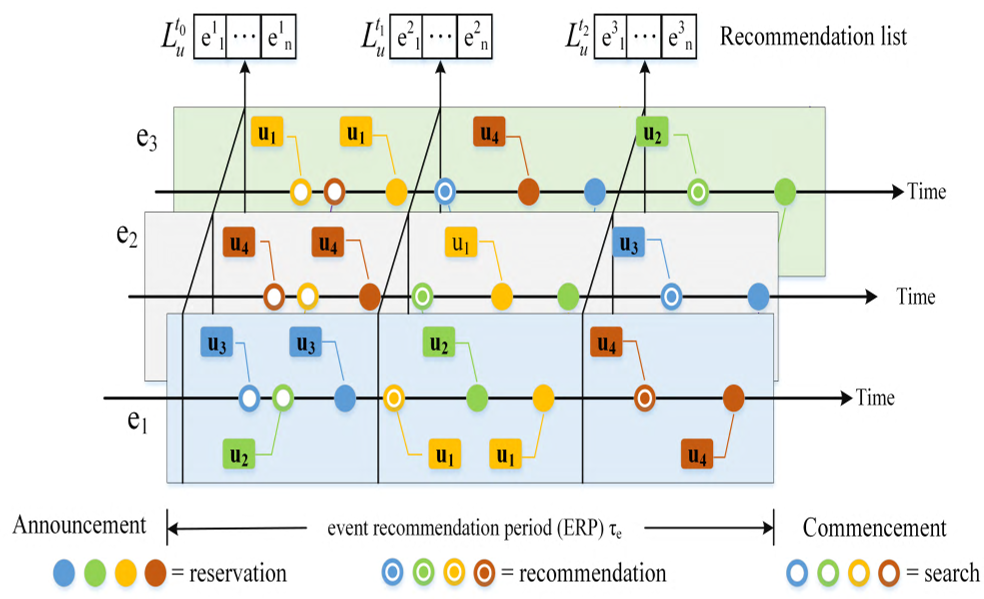
- Temporal Decay/Evolution: The value of a recommendation changes between an event's announcement and its commencement. As users RSVP, these asynchronous signals must be reflected in the system immediately.
Existing Collaborative Filtering (CF) models break down here because they rely on historical interaction matrices. Graph-based models are better, but reconstructing a massive graph every time a single user clicks "Join" is computationally prohibitive.
Methodology: The Power of Dual Graphs and Entropy
The core insight of SERGE is Structural Decoupling. Instead of one monolithic graph, it manages two:
1. The Primary Graph (PG)
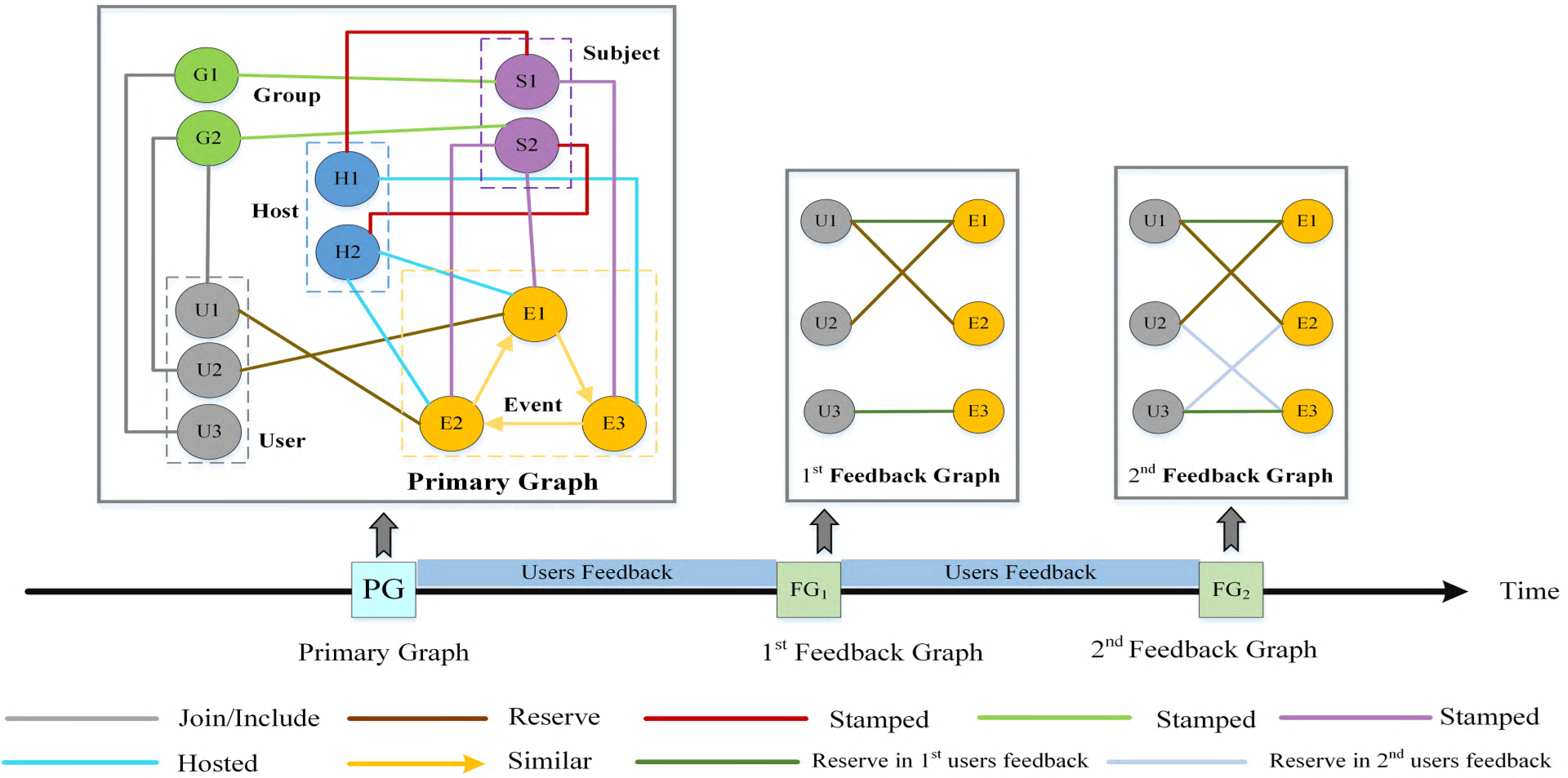
This graph captures the "Skeleton" of the social network. It includes users, online groups, hosts, and tag-based subjects. Interestingly, the authors convert event attributes (time, cost, location) into directed implicit edges between events based on cosine similarity, effectively allowing the "preference signal" to flow between similar events even without user ratings.
2. The Feedback Graph (FG)
This is a lightweight, dynamic graph focusing purely on User-Event edges. It updates as RSVPs trickle in.
The Secret Sauce: Graph Entropy Weighting
How do you merge the results from a "Deep/Slow" Primary Graph and a "Fast/Shallow" Feedback Graph? SERGE uses Graph Entropy. Under this framework, the weight () assigned to the Primary Graph decreases as the Feedback Graph grows in complexity (information quantity).
This ensures that when an event is new, we rely on social context (PG), but as the crowd starts joining, we shift focus to the actual crowd behavior (FG).
Experimental Performance
The researchers tested SERGE on real-world data from Beijing and Shanghai. The results confirmed a significant boost:
- Versus CB (Content-Based): SERGE wins by a landslide because it understands social structures (groups/hosts) that CB ignores.
- Versus AllPG (Single Large Graph): Surprisingly, SERGE often performs better. The authors suggest that by separating the feedback, the "noise" of historical data doesn't drown out the "signal" of current trends.
- City-Specific Insights: In Beijing, "Only Feedback" models performed well, suggesting a more gregarious, social-driven culture. In Shanghai, users cared more about the individual event attributes, making the Primary Graph more vital.

Critical Insight & Conclusion
The true brilliance of SERGE lies in its Heuristic Efficiency. By calculating RWR on the massive Primary Graph at a lower frequency (e.g., daily) and performing RWR on the tiny Feedback Graph at a high frequency, the system achieves near "real-time" responsiveness without a massive server bill.
Limitations: The model currently treats tags as discrete subjects. Future iterations could benefit from NLP and Semantic Embeddings (like BERT or LLM-based embeddings) to better understand the nuances of event descriptions, rather than relying on simple clustering.
Takeaway for Practitioners: When building recommendation engines for dynamic, time-sensitive items, don't just "re-train" the whole model. Use a multi-graph approach and let Information Theory (Entropy) decide which source to trust at any given moment.