
Fusion is Key: Elevating EEG Emotion Recognition via Deep Spatial-Temporal CNNs
SPECIAL SECTION ON NEW TRENDS IN BRAIN SIGNAL PROCESSING AND ANALYSIS
This paper proposes a deep learning framework for EEG-based emotion recognition using Convolutional Neural Networks (CNN) applied to temporal and frequency combined features. It achieves state-of-the-art results on the DEAP dataset, significantly outperforming traditional machine learning classifiers like SVM and Bagging Trees.
Executive Summary
TL;DR: Researchers have developed a robust framework using Deep Convolutional Neural Networks (CNNs) that achieves near-perfect emotion recognition by fusing time-domain and frequency-domain EEG features. By treating EEG signals as "images" of brain activity, the models outperform traditional methods like SVM and Bagging Trees by over 10% in accuracy on the standard DEAP dataset.
Academic Positioning: This work bridges the gap between signal processing and computer vision technique adaptation. It represents a significant "SOTA push" in the EEG-BCI (Brain-Computer Interface) field, emphasizing that feature fusion—rather than architecture complexity alone—is the catalyst for breakthrough accuracy.
Problem & Motivation: The Subjectivity of Human Emotion
Recognizing true human emotion is notoriously difficult. While facial expressions and voice can be masked or faked, Electroencephalogram (EEG) signals offer an objective "window" into the limbic system. However, EEG data is notoriously noisy and non-stationary.
The Limitation of Prior Work: Before this study, most researchers relied on "Hand-crafted Features." They would calculate Power Spectral Density (PSD) or statistical moments and feed them into Support Vector Machines (SVM). These methods are:
- Fragmented: They ignore either the global temporal flow or the local frequency shifts.
- Labor-intensive: They require significant domain expertise to select the "right" features.
The authors hypothesized that a deep "End-to-End" architecture could learn these relationships automatically if provided with a rich, combined feature space.
Methodology: Architects of Brain Dynamics
The core contribution is the transition from 1D signal processing to 2-dimensional feature mapping.
1. Combined Feature Engineering
Instead of picking one domain, the authors created FREQNORM and FREQRAW features. They took the 128Hz temporal signal and the 64-point Frequency PSD and concatenated them. This allows the CNN to "see" the relationship between rhythmic brain oscillations (frequency) and specific neural firing events (time).
2. CNN Architecture
The study compared three specialized architectures:
- CVCNN (Computer Vision CNN): Uses 5x5 kernels to find local patterns.
- GSCNN (Global Spatial CNN): Focuses on across-channel patterns.
- GSLTCNN (Global Spatial Local Temporal): Designed to capture broad brain region interactions over short time windows.
Experiments & Results: Crushing the Baselines
The models were tested on the DEAP dataset (32 subjects, 40 trials each). The results were definitive.
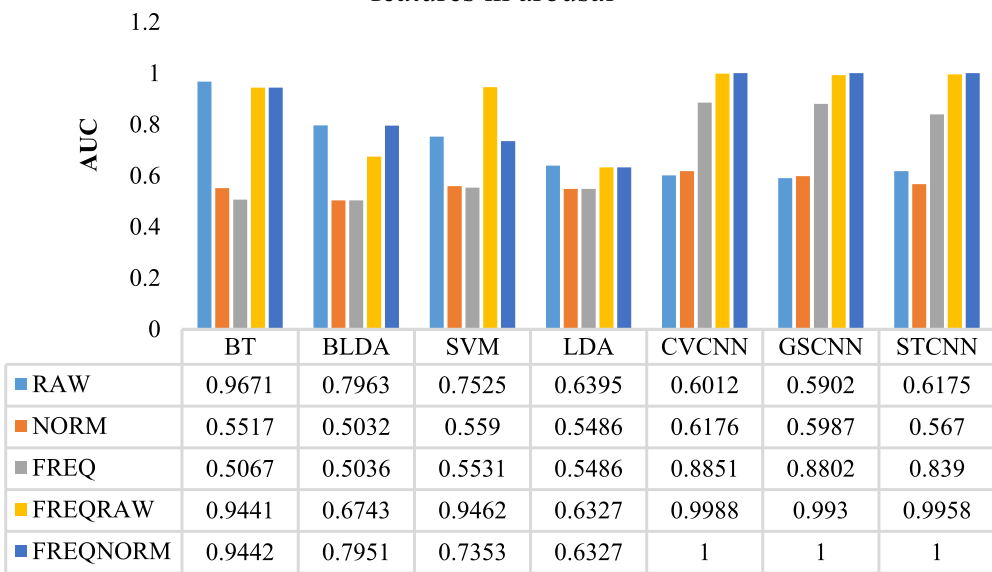
- Valence (Pleasure) Performance: The CVCNN reached an AUC nearly reaching 1.0 on combined features, outperforming the best shallow classifier (Bagging Tree) by 7.45%.
- Arousal (Intensity) Performance: Similar dominance was observed, with the CNNs maintaining stability where traditional models like Bagging Trees saw performance collapses on frequency-only features.
The "Black Box" Unveiled
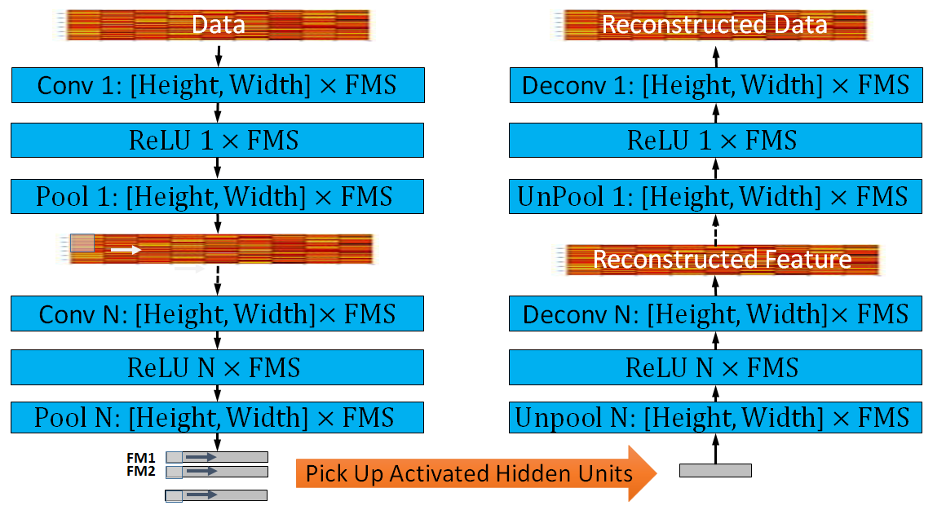
Using Deconvolutional Neural Networks, the team visualized what the CNN was actually looking at. Unlike raw EEG, the "reconstructed" signals showed clear, task-specific spikes (e.g., a specific highlighted feature at 800ms for High Arousal) that were invisible to the naked eye in average signal plots.
Critical Analysis & Conclusion
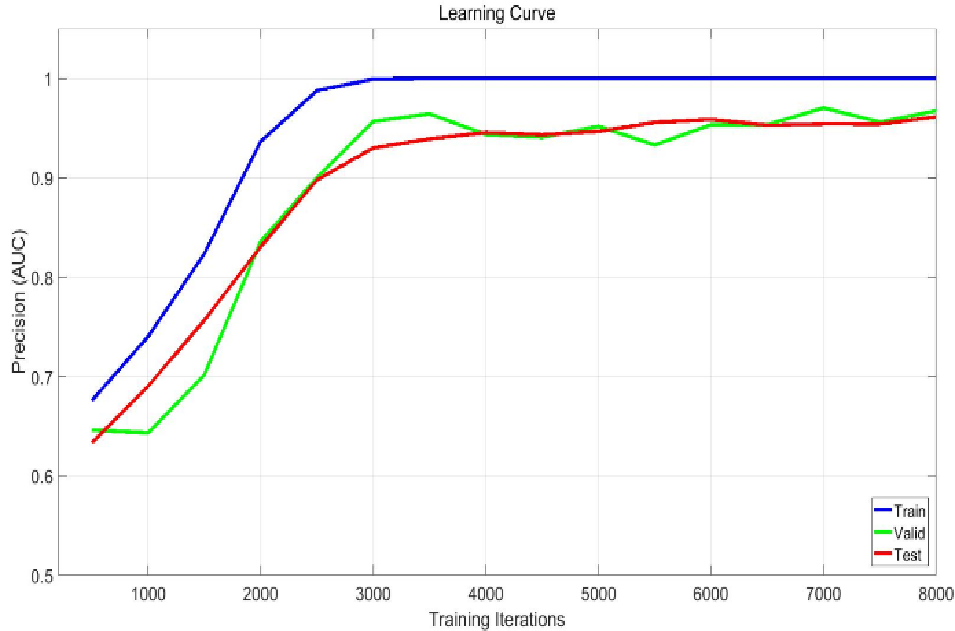
The Efficiency Gains: The most profound takeaway is that Convolution + Feature Fusion acts as a powerful regularizer. While deep models often overfit small datasets, the use of combined features provided enough "texture" for the CNN to converge effectively.
Limitations: Despite the high accuracy, this study focuses on within-subject classification (training and testing on the same person). The "Holy Grail" of EEG—cross-subject generalizability—remains a challenge because your "Happy" brainwaves likely look different from mine.
Future Outlook: This work sets the stage for real-time emotional AI. By replacing manual feature extraction with these learned spatial-temporal kernels, we are moving toward wearable BCI devices that can adjust your environment (music, lighting, or therapy) based on real-time neural feedback with unprecedented reliability.