
MSDC: Leveraging the "Social Brain" of Devices to Break the Backhaul Bottleneck
SPECIAL SECTION ON RECENT ADVANCES IN SOCIALLY-AWARE MOBILE NETWORKING
This paper introduces Mobile Social Device Caching (MSDC), a framework that leverages Device-to-Device (D2D) communication and social network characteristics to alleviate backhaul pressure in wireless networks. It proposes social-aware strategies for content placement, radio resource management, and routing to optimize the utilization of edge storage.
TL;DR
Mobile Social Device Caching (MSDC) transforms individual smartphones into a collaborative, "socially-aware" virtual cache. By utilizing social ties, community habits, and user centrality, the framework optimizes content placement and routing, achieving performance near "global knowledge" benchmarks while significantly reducing the load on cellular backhaul.
The Motivation: Why Your Phone Should Be Social
As mobile data traffic explodes, traditional backhaul—the link between base stations and the core network—has become a massive bottleneck. While "Femto-Caching" (putting storage in small base stations) helps, it lacks flexibility.
The authors argue that the solution lies in our pockets. However, Device-to-Device (D2D) caching isn't just a physical networking problem; it's a social one. Users aren't random moving particles; they have "friends" they meet often and "communities" with shared interests. Ignoring these social patterns leads to inefficient "selfish" caching where the collective potential of the network is wasted.
Methodology: The Two-Layer Architecture
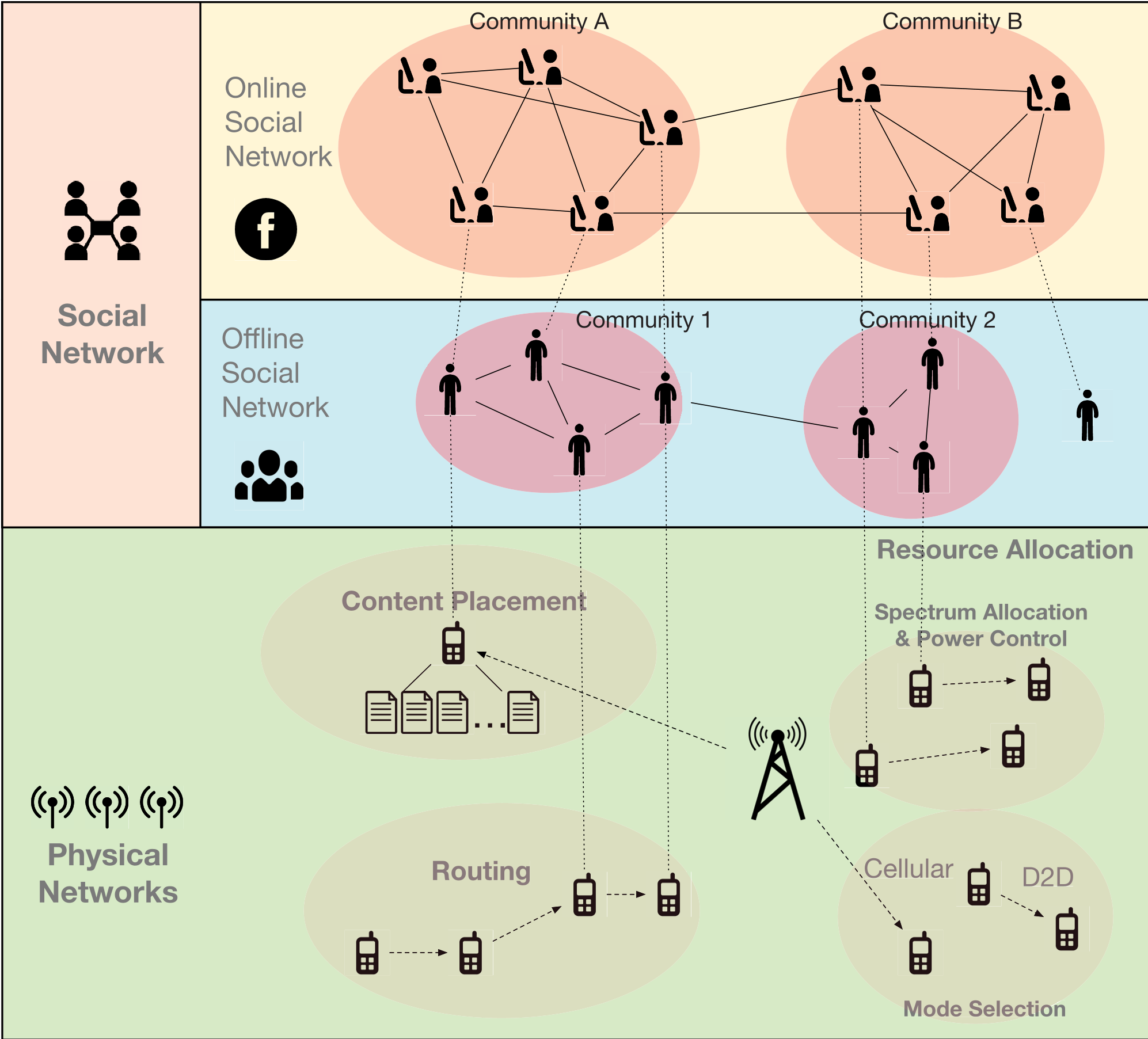
The paper proposes a structured approach by splitting the problem into two distinct but interacting layers:
- The Social Network Layer: Divided into Online (virtual interests/ties) and Offline (physical mobility/contact). Key metrics include Centrality (importance of a node) and Social Ties (strength of relationships).
- The Physical Network Layer: Handles the actual D2D and cellular links, storage constraints, and interference management.
The Core Insight: Social-Awareness
- Content Placement: Instead of random caching, files are proactively pushed to "Central" users during off-peak hours based on community interests.
- Resource Management: Spectrum is allocated preferentially to users with high social ties, ensuring that "friends" (who have longer contact durations) can complete large file transfers.
- Routing: Employs a "store-carry-forward" strategy where contents are routed through social "hubs" (high centrality nodes) to reach a target community.
Evaluation: Social vs. Individual Caching
The researchers compared four strategies: Global, Social-Aware, Individual, and Random. The results demonstrate a clear hierarchy of efficiency.
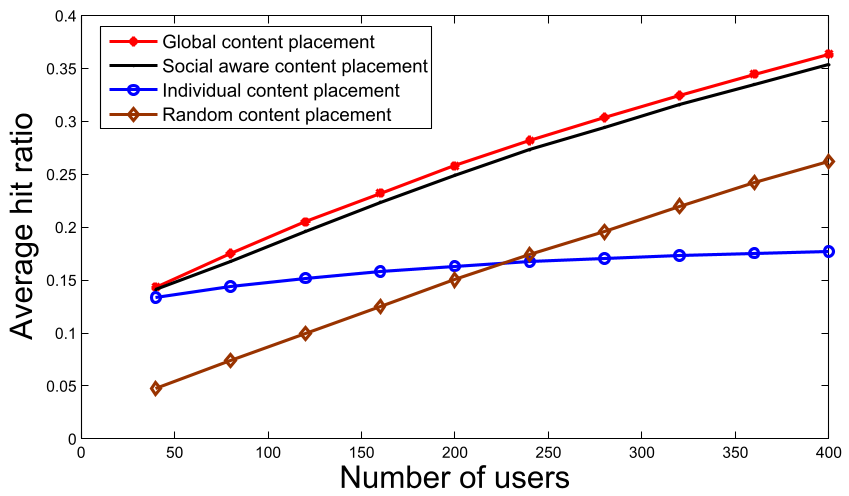
As shown in the experimental plots, Social-Aware Caching (which only uses local community info) performs almost as well as Global Caching (which requires perfect knowledge of every user). In contrast, "Individual" caching—where users only store what they personally like—fails to scale as the number of users increases.
A critical finding is the impact of the Zipf Parameter (). When content popularity is highly concentrated (), social-aware caching thrives by ensuring that the most popular "cultural" assets of a community are distributed efficiently across its members.
Critical Analysis & Future Outlook
The beauty of MSDC lies in its efficiency—it moves the computational burden from a central controller to the "community" level. However, two significant challenges remain:
- Variable Selfishness: A user might be "altruistic" when their battery is at 90% but "selfish" at 10%. Future models must dynamiclly account for battery and CPU state.
- Privacy: Social-aware routing requires sharing mobility and interest data. The tradeoff between "caching efficiency" and "user privacy" is the next major frontier for this research.
Takeaway
MSDC proves that the future of 5G/6G is not just about faster radios, but smarter, human-centric cooperation. By treating a crowd of mobile users as a socially-connected storage fabric, we can bypass the physical limits of backhaul infrastructure.