
You Can Act Locally: Reshaping Influence Landscapes in Mobile Social Networks
SPECIAL SECTION ON RECENT ADVANCES IN SOCIALLY-AWARE MOBILE NETWORKING
The paper introduces a distributed influential user identification scheme for Mobile Social Networks (MSNs) based on the "Information Potential" theory. It addresses dynamic topologies through a localized influence computation algorithm that converges to a stable state, complemented by an influence-ascent routing mechanism to reach target users.
TL;DR
Researchers have developed a distributed algorithm that allows mobile users to identify "influential peers" using only local interactions. By mapping local connectivity to a global "Information Potential," the system creates a navigation-friendly influence landscape. This localized intelligence can reduce cellular network congestion by up to 79.2% through strategic data offloading.
Problem & Motivation: The Stability Trap
In the world of social media, identifying influencers is easy—you just look at the global follower count. But in Mobile Social Networks (MSNs), where connections are formed via transient Bluetooth or WiFi handshakes, there is no "global view."
Previous works typically fall into two traps:
- Global Complexity: They require full network snapshots, which are impossible to maintain as people move.
- High Overhead: They use massive message flooding to track counters, killing the battery of mobile devices.
The authors' insight is grounded in physics-like intuition: influence can flow like a potential field. If every user acts as a local sensor, the aggregate "heat" of their interactions can pinpoint the most influential nodes without any single person knowing the whole map.
Methodology: The Information Potential Framework
The core of the method is a distributed iterative process. Each user calculates their influence using the following logic:
The "Inhibiting Factor" ()
This parameter is the most critical design choice. It acts as a "zoom lens":
- Low (Global View): Information diffuses widely; only the absolute global "super-influencers" appear as peaks.
- High (Local View): Information stays local; many "neighborhood heroes" appear.
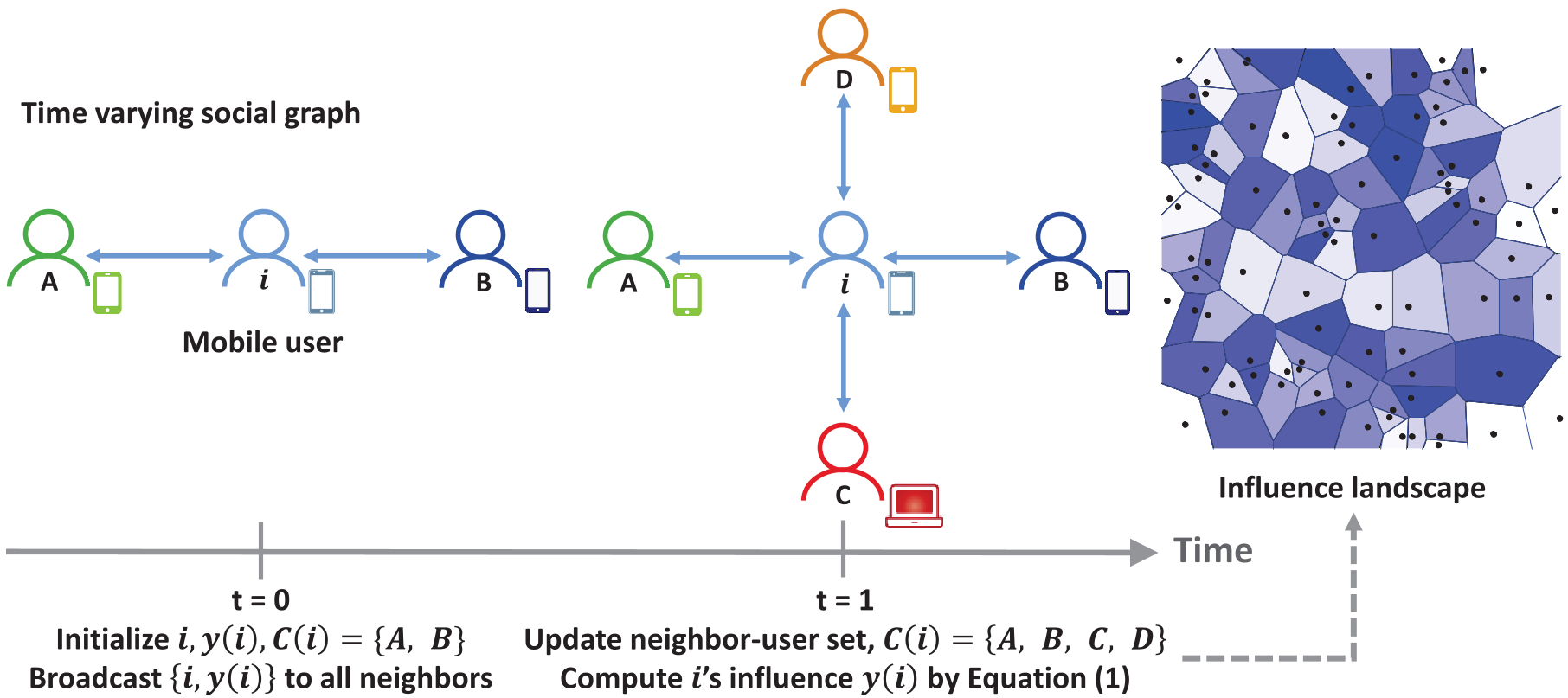 Figure 1: The Influence Landscape construction showing how local connectivity transforms into a converged potential field.
Influence-Ascent Routing
Once the landscape is formed, users don't need a map to find an influencer. They simply use Influence-Ascent, a localized "hill-climbing" algorithm. By checking which neighbor has the highest potential gradient, a user can navigate toward the local maximum—similar to how bacteria move toward higher concentrations of nutrients (Chemotaxis).
Experiments & Results: Real-World Validation
The authors tested their math against the Sassy dataset, which tracks 25 human-carried sensors.
Reshaping the Landscape
By adjusting the factor, the researchers proved they could "smooth" the network. In a high-speed mobility scenario, setting reduced the influencer set to a single, high-performing node, while identified a more robust cluster of three key users.
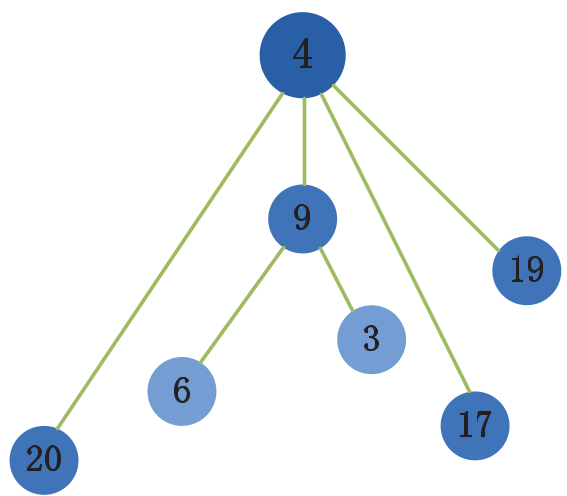 Figure 2: Changing the inhibiting factor allows the network to merge local peaks into a global maximum.
The Killer App: Mobile Data Offloading
The ultimate test was "Mobile Data Offloading." Instead of everyone downloading the same file over expensive 4G/5G, the system delivers the data to the top-K influential users identified by the algorithm. These users then spread the data locally via D2D (Device-to-Device) links.
The result? The proposed algorithm outclassed randomized selection and standard greedy algorithms, cutting 3G/4G traffic by nearly 80%.
Critical Analysis & Conclusion
This work provides a elegant bridge between spectral graph theory and practical mobile computing. By ensuring the algorithm is unimodal, the authors guarantee that users won't get "stuck" in global-local loops.
Limitations:
- Privacy: Exchanging influence values still reveals local density, which could be a privacy concern for some users.
- Incentives: Why should a "top influencer" use their battery to store and forward files for others? Future work must integrate incentive mechanisms (like micro-tokens) to ensure participation.
Despite these, the "Act Locally" approach is a blueprint for the next generation of decentralized social apps and smart-city crowd management.