
Social-Network-Based Wallet Management: Bridging the Gap Between Human Memory and Blockchain Complexity
SPECIAL SECTION ON RESEARCH CHALLENGES AND OPPORTUNITIES IN SECURITY AND PRIVACY OF BLOCKCHAIN TECHNOLOGIES
The paper introduces a social-network-based cryptocurrency wallet-management scheme that combines identity-based hierarchical key-insulated encryption (HIKE) with secret sharing. It achieves a secure, password-less authentication and recovery system that significantly outperforms traditional local or hosted storage in balancing safety and usability.
TL;DR
Managing cryptocurrency private keys is a nightmare for most users—one lost string of text means your money is gone forever. This paper proposes a revolutionary wallet management scheme that uses your social network for blind recovery and Key-Insulated Encryption for secure delegation. It removes the need for passwords while staying resilient against malware and physical theft.
Background Positioning
In the world of Web3, the mantra "Not your keys, not your coins" highlights the risk of centralized exchanges. However, "Your keys, your problem" is equally terrifying for non-technical users. This work acts as a structural evolution in key management, moving away from "Master Passwords" toward a distributed, identity-linked management model.
Problem & Motivation: The Usability Trap
Existing solutions like Brainwallets (memorable passwords) are weak to brute-force attacks, while Offline Wallets (QR codes) are easily lost. Hosted software like Blockchain.info bridges the gap but introduces a centralized point of failure. The authors identified a core insight: Social Trust can substitute for Technical Perfection. If you lose your device, your trusted circle of friends (social nodes) can help you recover your digital identity without any of them ever seeing your actual private keys.
Methodology: The Core Mechanism
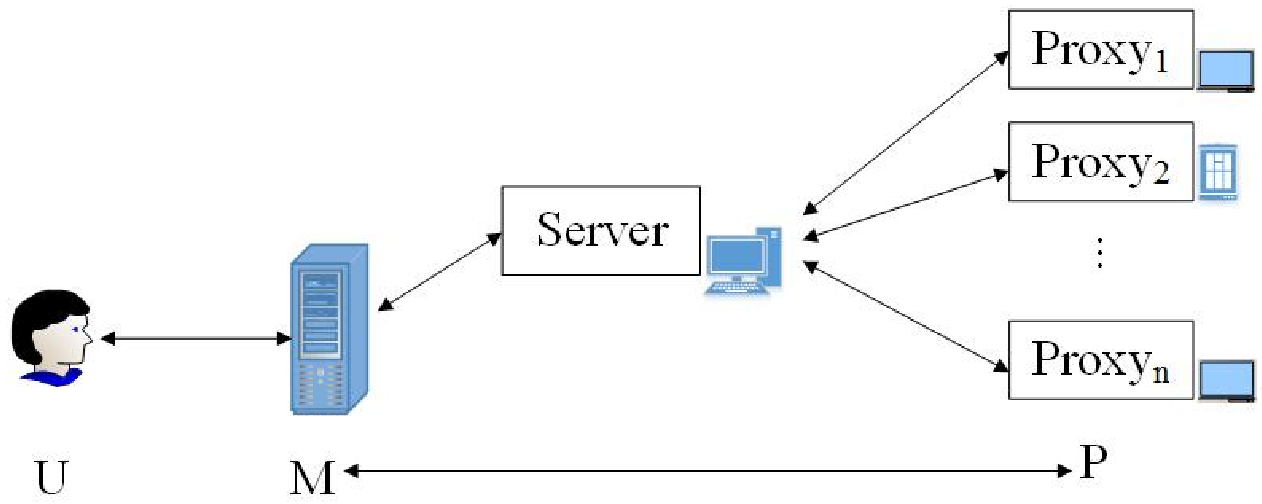
The system architecture utilizes four primary entities: the User (U), the Management Device (M) (e.g., a smartphone used as a root of trust), a Proxy (P) (the device doing the transaction), and a Central Server (C).
1. Hierarchical Key-Insulated Encryption (HIKE)
Traditional encryption is "all or nothing." If a key leaks, everything is compromised. HIKE introduces time-sharing authorization. The Management Device provides a "helper key" to a Proxy device that is only valid for a specific window. This limits the "blast radius" of a malware attack.
2. Social-Network-Based Recovery
Instead of a "Forgot Password" button that relies on an email server, the system uses Shamir's Secret Sharing. The master key is split into shares:
- One share is kept by the Central Server.
- Multiple shares are distributed to "Friends" in the social network.
- To recover the wallet, the user must gather shares. Crucially, the process is "blind"—neither the friends nor the server can piece together the user's secret individually.
Experiments & Results: Security Meets Speed
The authors conducted a comparative analysis of their scheme against industry standards like Bitcoin Core, MultiBit, and Brainwallet.
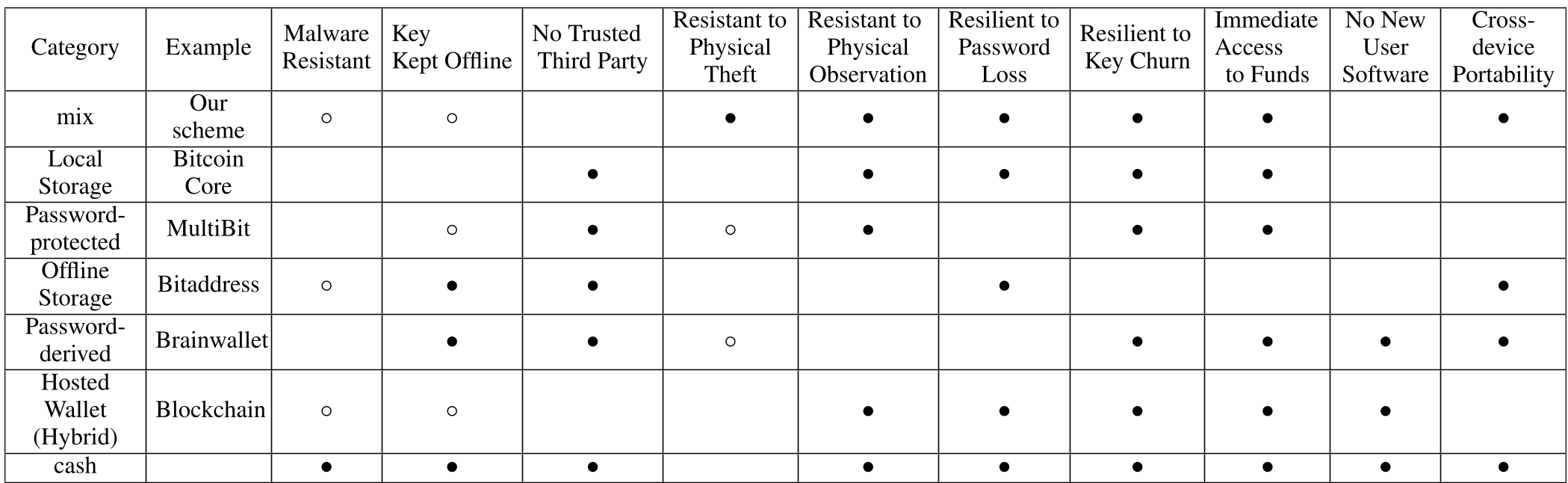
As shown in the evaluation, this scheme is the only one to achieve a "Full Dot" in Resilience to Password Loss and Cross-device Portability simultaneously without relying on a fully trusted third party.
Performance Overhead
Efficiency is critical for mobile adoption. Using the JPBC library on a standard CPU, the computational costs were negligible:
- Encryption: ~71.9 ms
- Decryption: ~60.7 ms
- Key Update (DkUp): < 1 ms

Critical Analysis & Conclusion
Takeaway
The paper successfully demonstrates that cryptocurrency management doesn't have to be a choice between "centralized risk" and "user anxiety." By utilizing HIKE and social recovery, we can create a "Human-centric" security model.
Limitations
The scheme assumes a semi-trusted social network. In reality, "social engineering" attacks could target a user's friend circle to gather enough shares for an unauthorized recovery. Additionally, the reliance on a Central Server for message forwarding remains a potential (though mitigated) bottleneck.
Future Outlook
This work paves the way for "Threshold Wallets" that are now becoming popular in MPC (Multi-Party Computation) circles, proving that the future of finance is not just decentralized, but socially collaborative.