
Tracing the Spark: Locating Sources of Asynchronous Diffusion in Social Networks
SPECIAL SECTION ON SOCIAL COMPUTING APPLICATIONS FOR SMART CITIES
This paper introduces a novel source locating method for asynchronous and stochastic information diffusion in social networks. It combines a correlation coefficient estimator (CC) with a Minimum Hops Path Weighted Length (MHPWL) matrix to outperform the state-of-the-art TRBS method across various network topologies.
TL;DR
Locating the origin of a rumor or a virus in a massive social network is like trying to find where a fire started by looking at a few scorched trees. This paper introduces a Correlation Coefficient (CC) Estimator paired with a Minimum Hops Path Weighted Length (MHPWL) algorithm. Unlike previous models that assume everyone "forwards" information instantly or synchronously, this method thrives in the messy, asynchronous, and stochastic reality of the modern internet.
The Problem: The Chaos of Asynchrony
Most classical models assume a "Global Clock" where information jumps from node to node in discrete steps. In reality, you might see a post and forward it hours later, or not at all (Forwarding Probability ). Existing methods like TRBS (Time-Reversal Backward Spreading) rely on the shortest path. However, in a network where forwarding isn't guaranteed, the "shortest" weighted path isn't necessarily the path the information actually took. If is low, information is far more likely to follow a path with fewer hops, even if those hops are "longer" in time.
Methodology: Distance as a Correlation
The authors' core insight is that for the true source node, the activation time of distant monitors should be highly correlated with their diffusion delay from that source.
1. The Correlation Coefficient Estimator
If is the source, then . By calculating the correlation coefficient between observed arrival times and estimated delays for every node in the network, the "true" source should emerge as the one with the highest positive score.
2. MHPWL: Why Minimum Hops Matter
The authors argue that when forwarding is uncertain (), the probability of a message reaching a destination across hops is . Therefore, information usually travels via the path with the minimum number of hops. They developed Algorithm 1, a modified Batch-BFS, to calculate these paths efficiently.
 Figure: The conceptual challenge of locating sources in complex graphs with limited observers.
Experiments and Results
The method was tested on Watts-Strogatz (Small-World), Barabási-Albert (Scale-Free), and real-world Facebook data.
- The Winner: The combination of CC + Q' (Correlation + Minimum Hops) consistently beat TRBS in success rate and rank percentage.
- Robustness: Even when only 10% of nodes were monitored (), the accuracy remained stable, suggesting you don't need a total surveillance state to find the source.
- Network Impact: Success was highest in small-world networks where nodes have similar degrees, and lowest in scale-free networks where "hubs" (high-degree nodes) can distort path estimates.
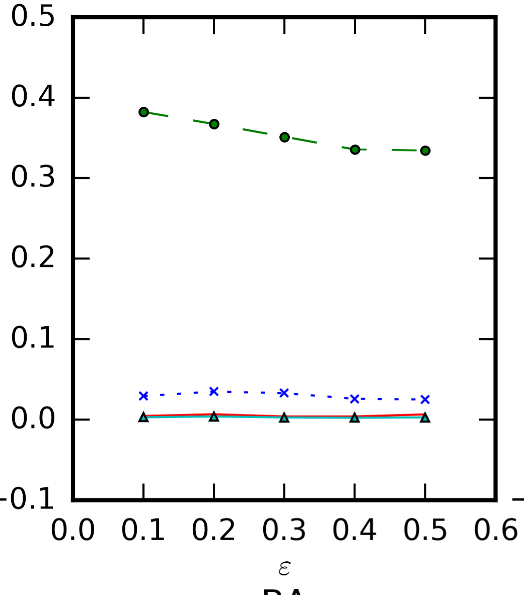 Figure: Average Rank Percentage across different networks; lower values indicate higher accuracy.
Case Study: Weibo Rumors
The researchers applied their model to real 2017 Weibo data (e.g., rumors about the "Gaokao" exam and celebrity relationship reveals). They found that for highly influential sources, their method could pinpoint the exact node (Zero error hops) or a very close neighbor, even in complex real-world interactions.
Critical Insight & Conclusion
The true value of this paper lies in moving away from the "Shortest Path" dogma. By utilizing the MHPWL logic, the authors acknowledge that in any stochastic process, the path of least resistance (fewest nodes) is often more important than the path of least time.
Future Outlook: While powerful, the method struggles when forwarding probability is extremely low (), as the diffusion becomes too "chancy." Future work integrating user sentiment or profile metadata could further sharpen the search for the source of digital wildfires.