
Mobile Social Networking Under Side-Channel Attacks: The $20 Threat to Your Privacy
SPECIAL SECTION ON SOCIALLY ENABLED NETWORKING AND COMPUTING
This paper investigates the vulnerability of Mobile Social Networking (MSN) users to Side-Channel Attacks (SCAs) leveraging inexpensive, off-the-shelf equipment. It specifically demonstrates the feasibility of extracting cryptographic traces from smartphones using standard audio cards and proposes an analytical framework enhanced by Convolutional Neural Networks (CNN) to recover sensitive information.
TL;DR
Mobile Social Networks (MSNs) rely heavily on trust and proximity, but this closeness opens a door for Side-Channel Attacks (SCAs). This paper demonstrates that an attacker doesn't need a million-dollar lab to steal your data—an inexpensive sound card and a laptop in a public cafe can be enough to "listen" to your phone's processor as it encrypts sensitive information. By using the right signal processing and Neural Networks, the authors prove that physical leakages are a growing practical threat to mobile security.
Problem & Motivation: The Invisible Leakage
Mobile Social Networks rely on Device-to-Device (D2D) communications to offload traffic. However, every time your phone performs a cryptographic handshake, its hardware consumes power and emits electromagnetic radiation.
Traditional security models assume the "math" of the encryption is the only target. In reality, the physical implementation of the algorithm is the bottleneck. The authors argue that while MSNs prioritize lower delay and higher data rates, the security of the handheld devices themselves remains a weak link, especially against SCAs that capture "parasitic signals."
Methodology: Turning Noise into Information
The researchers built a custom "sandbox" application to act as a controlled environment for testing.
The Setup
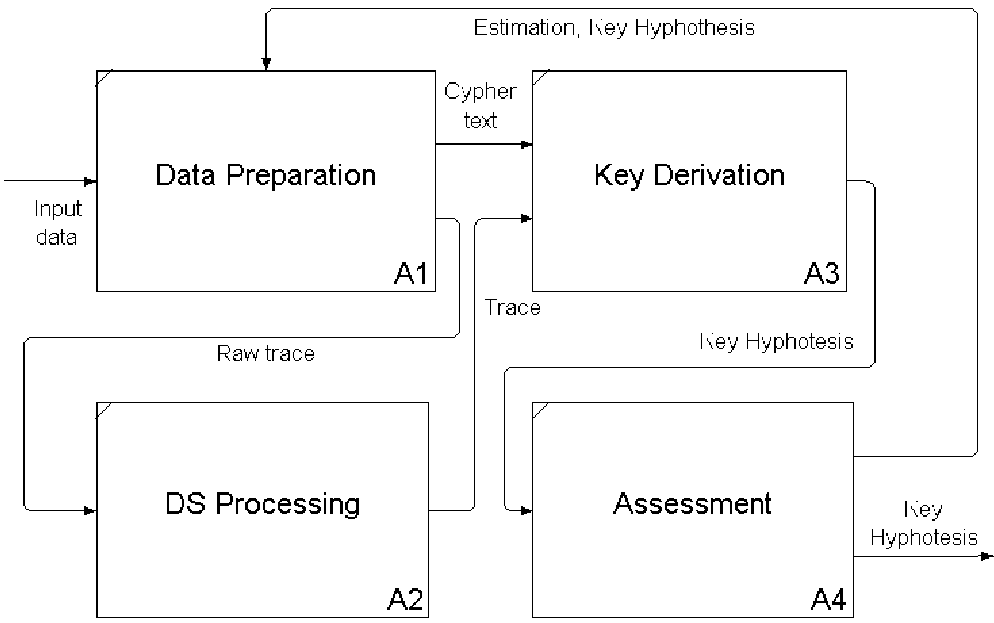
As shown in the architecture below, the attack consists of an inexpensive external sound card used to register the electromagnetic emanations (traces) of a smartphone while it performs encryption.

Signal Synchronization and Parsing
The biggest challenge is the sampling gap: the phone's CPU runs at MHz frequencies, while the sound card samples at only 44.1 kHz. To bridge this gap, the authors developed two convolution-based parsing methods:
- Direct Convolution: Comparing the entire trace against a hypothesis signature to find peaks.
- Lattice-based Detection: Using timestamps from the application logs to align signatures within a specific neighborhood.
Enhanced Analysis: The Role of Neural Networks
Because the traces captured by cheap equipment are "low-informative" and noisy, the authors propose a Convolutional Neural Network (CNN) approach. Unlike simple perceptrons, CNNs excel at recognizing patterns (feature maps) that correspond to specific bits of the encryption key.
The model focuses on:
- Bit-wise Probability: Neurons estimate the likelihood of a bit being 0 or 1.
- NICV Method: Using Normalized Inter-Class Variance to filter out 99% of useless noise and focus on the "leakiest" parts of the signal.
Experimental Results: Device Matters
The study tested two devices: the Alcatel POP3 and the Sony Xperia M2.
- Alcatel POP3: Showed clear, repeatable traces of encryption operations even in the presence of Wi-Fi and Bluetooth noise.
- Sony Xperia M2: Traces were nearly empty, likely due to superior hardware-level electromagnetic shielding.
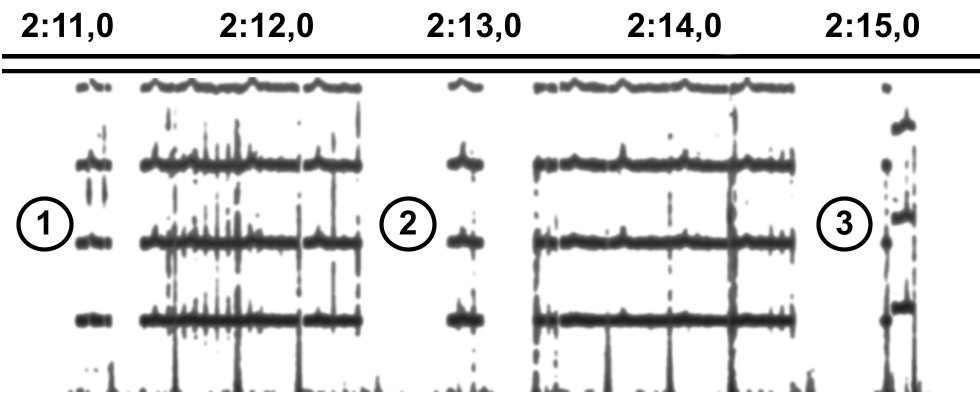
This result highlights a critical takeaway: Hardware design is a security feature. Cheaply made devices are significantly more vulnerable to side-channel eavesdropping than premium devices with better shielding.
Critical Insight & Conclusion
While the paper shows that $20 equipment faces significant limitations in detail, the arrival of AI-driven cryptanalysis means that even "fuzzy" data can be reconstructed given enough training samples.
Recommendations for the Future:
- For Developers: Implement Power Randomization and Data Masking. If the power signature doesn't correlate with the secret key, the attacker sees only random noise.
- For Users: Be wary of public charging stations or unknown peripherals (power banks, speakers). These can serve as conduits for capturing the high-frequency "sounds" of your processor at work.
In the era of MSNs, your social proximity might be your greatest security risk. This research serves as a wake-up call that physical security is just as important as the strength of the cipher itself.