
Osmotic Computing: A New Frontier for Scalable Trust in Pervasive Social Networks
SPECIAL SECTION ON TRUST MANAGEMENT IN PERVASIVE SOCIAL NETWORKING (TRUPSN)
This paper introduces a pervasive trust management framework for Pervasive Online Social Networks (POSNs) that leverages "Osmotic Computing" to offload trust evaluation tasks. The method combines a Flexible Mixture Model (FMM) with bio-inspired optimization (ACO/ABC) to achieve efficient trust visualization and SOTA prediction accuracy (error rate < 2%).
TL;DR
Managing trust in Pervasive Online Social Networks (POSNs) is notoriously resource-heavy. This paper proposes a breakthrough framework that uses Osmotic Computing to offload trust computations from the cloud to edge servers. By utilizing a Flexible Mixture Model (FMM) and bio-inspired algorithms (ACO/ABC), the system predicts user trust with over 98% accuracy while drastically reducing the cost of monitoring.
The Problem: The "Context-Rich, Resource-Poor" Paradox
In the era of 5G and ubiquitous connectivity, POSNs connect users across hybrid platforms (gaming, chat, storage). However, trust management—ensuring users aren't malicious—typically requires massive CPU cycles for pattern analysis.
Current SOTA methods are often:
- Application-Specific: They don't scale across heterogeneous POSN environments.
- Centralized: They overwhelm primary servers, leading to high latency.
- Static: They fail to visualize how trust evolves over time.
The "Osmotic" Insight: Balancing the Network Concentration
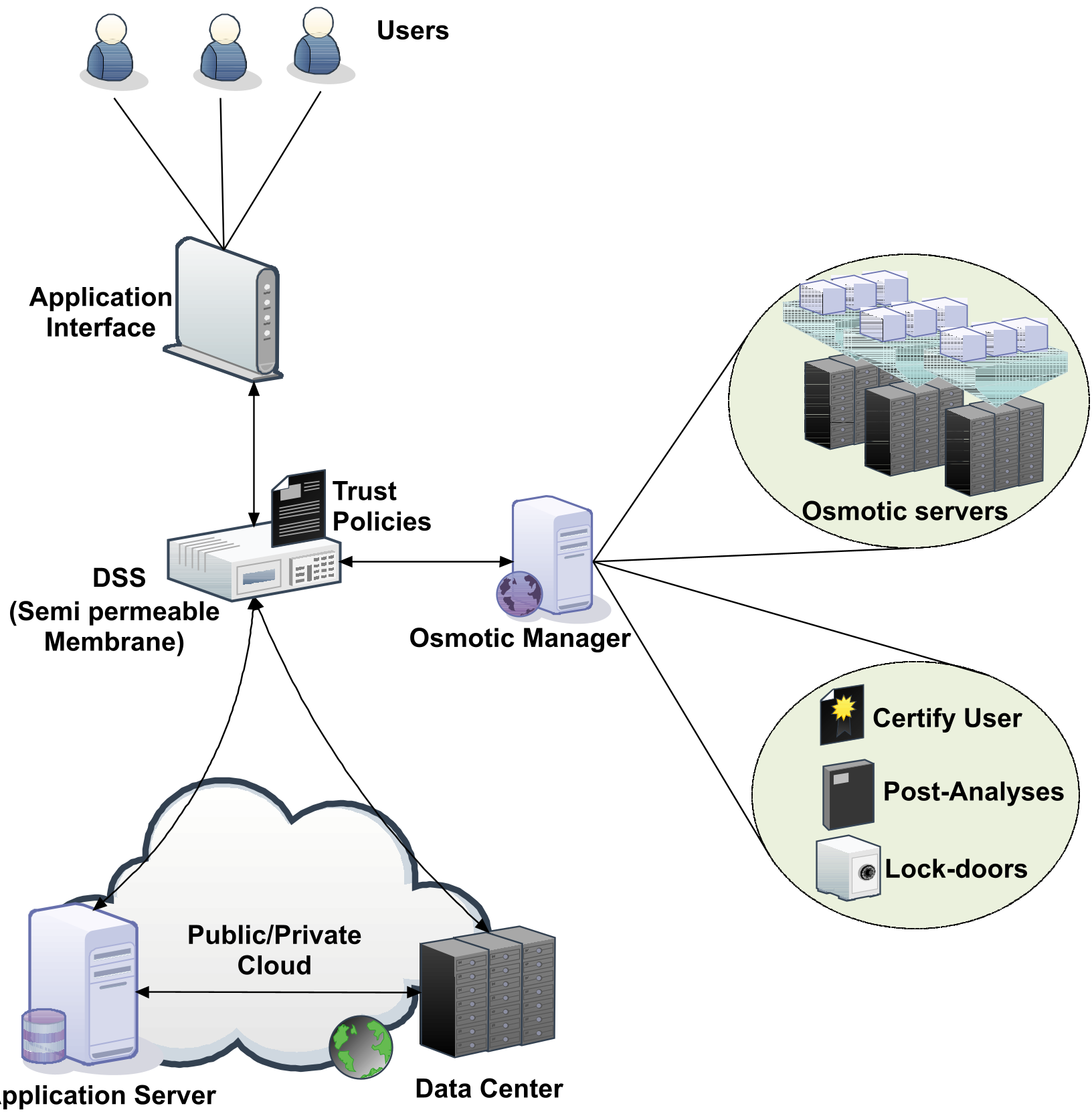
The authors borrow a concept from chemistry: Osmosis. In this framework, "Trust" is managed by moving "problematic" users (the solvent) across a semi-permeable membrane (a Decision Support System) to "Osmotic Servers" (the solute).
Core Methodology
The framework architecture (see below) relies on three distinct layers:
- Cloud Layer: Handles core services.
- Osmotic Layer: Acts as a "watchdog" for flagged users.
- Decision Support System (DSS): The "membrane" that decides when a user's behavior warrants offloading.
The authors use six properties to define Relation Cost (Rc):
- Degree of Connectivity ()
- Depth of Connectivity ()
- Level of Osmotic Shifts ()
- Trust Violations ()
- Computational Cycles ()
- Memory Utilization ()
Moving Users: Bio-Inspired Intelligence
How does the system decide which server handles which user? The paper evaluates three strategies:
- ACO (Ant Colony Optimization): Uses "pheromone" levels (server trust) to guide user movement.
- ABC (Artificial Bee Colony): Categorizes users into "Scout," "Onlooker," and "Employee" bees to optimize resource search.
- Threshold-Based: A faster but less accurate "if-then" logic.
Experimental Results: Precision at Scale
The framework was tested on a simulation dataset of 1,000 users.
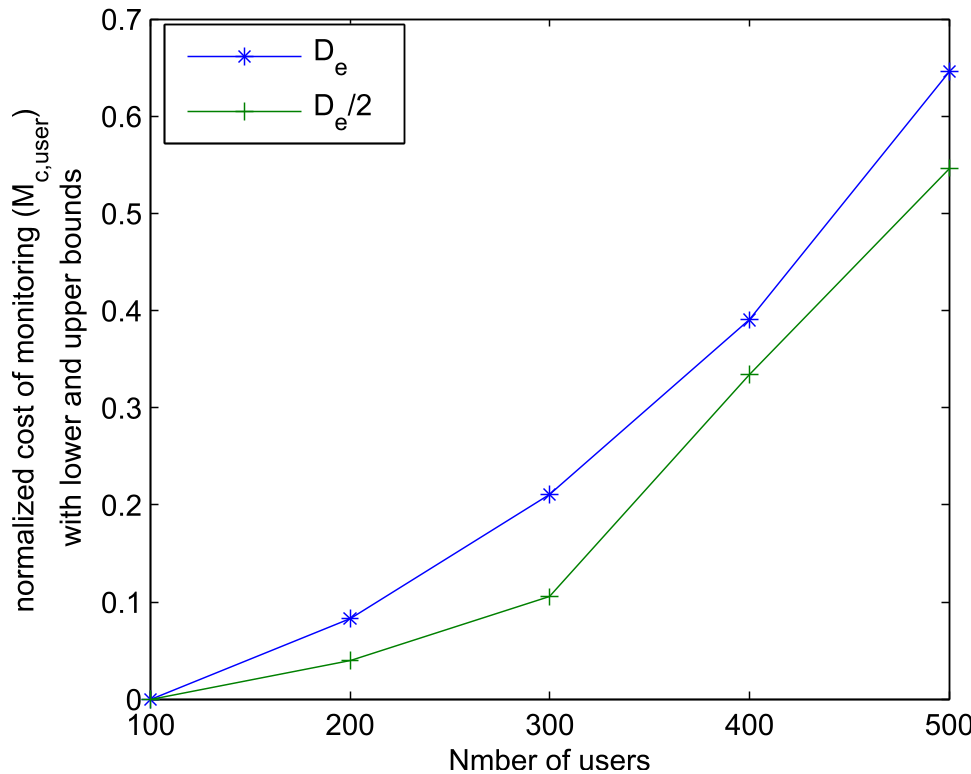
- Prediction Accuracy: The FMM-based entropy model predicted trust ratings with a mere ±1.2% to ±2% error range, outperforming standard probabilistic models.
- Offloading Efficiency: ACO and ABC algorithms converged quickly. While ACO was more "optimal" in finding the best server, ABC proved more efficient for CPU-constrained environments.
Trust Visualization: The Hexagonal Map
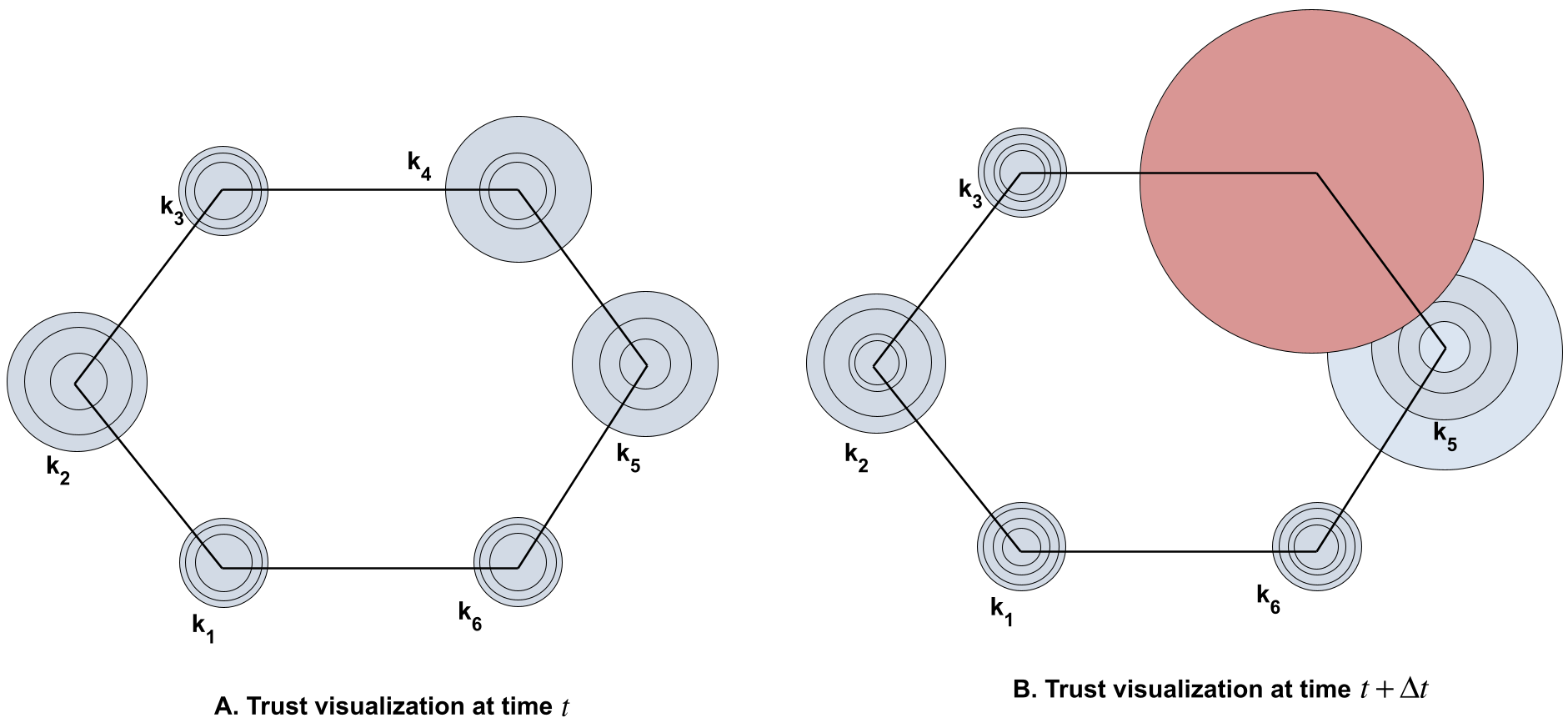
One of the paper's unique contributions is the Intermediate State Management Procedure (ISMP). It maps the six trust properties onto a regular hexagon. This allows administrators to see at a glance why a user is untrustworthy (e.g., if the vertex is dominating the polygon).
Critical Insight & Conclusion
This work represents a significant shift from "Security as a Wall" to "Security as a Flow." By treating trust management as a dynamic offloading task, the authors solve the scalability bottleneck of POSNs.
Takeaway for Practitioners: If you are building high-traffic social platforms, look beyond centralized moderation. "Osmotic" strategies—offloading behavioral analysis to edge nodes—enable deep monitoring without sacrificing primary application performance.
Limitations: The paper primarily utilizes simulation data. Real-world "lock-door" scenarios with adversarial attackers (trying to spoof entropy) remain a fertile ground for future research.