
Trust Without Identity: Optimizing Anonymous Authentication in Pervasive Social Networks
SPECIAL SECTION ON TRUST MANAGEMENT IN PERVASIVE SOCIAL NETWORKING (TRUPSN)
This paper proposes a novel anonymous authentication scheme for Pervasive Social Networking (PSN) based on group signatures. The method authenticates nodes' trust levels rather than their real identities, achieving state-of-the-art efficiency in signature verification and privacy preservation.
Executive Summary
TL;DR: This paper introduces an efficient anonymous authentication scheme for Pervasive Social Networking (PSN) that uses group signatures to verify "Trust Levels" instead of personal identities. By integrating a dynamic revocation list and a trust decay function, the authors solve the dual challenge of privacy preservation and high-speed verification on mobile devices.
The work acts as a significant SOTA (State-of-the-Art) optimization in the field of trustworthy networking, specifically improving upon previous pseudonym-based systems by drastically reducing the computational and communication overhead for high-density social interactions.
Problem & Motivation: The PSN Privacy Paradox
In Pervasive Social Networking (PSN), users interact with strangers nearby for services like car-sharing or collaborative shopping. This environment creates a paradox:
- Security Requirement: You need to know if a stranger is "trustworthy" before interacting.
- Privacy Requirement: You don't want to reveal your real identity or location history to that stranger.
Prior works often used pseudonyms, but frequently changing them leads to heavy authentication loads. Others used Public Key Certificates, but checking a Certificate Revocation List (CRL) is too slow for mobile devices with limited battery and processing power. The authors identified that simply knowing a node's trust level is often sufficient for most social transactions, provided the anonymity of the node is maintained.
Methodology: The Core Mechanism
The proposed architecture relies on a Trusted Authority (TA) that manages identities offline but stays out of the direct communication path between nodes.
1. Group Signature with Trust Encoding
Unlike standard group signatures that only prove membership, this scheme incorporates a Trust Value (TV) and Expiry Time into the group private key generation. When a node signs a message, it proves it belongs to a specific trust tier without revealing who it is.
2. Trust Decay Function
A critical innovation is the handling of TA-unavailability. If a node cannot reach the TA to renew its key, its trust is not immediately revoked. Instead, a decay function reduces the claimed trust value over time:
ftvconvert(TV, Texpire, Tcurrent) = TV / 2^(1 + (Tcurrent - Texpire)/Tvalid)
This ensures system reliability even in intermittent connectivity scenarios.
3. Architecture Overview
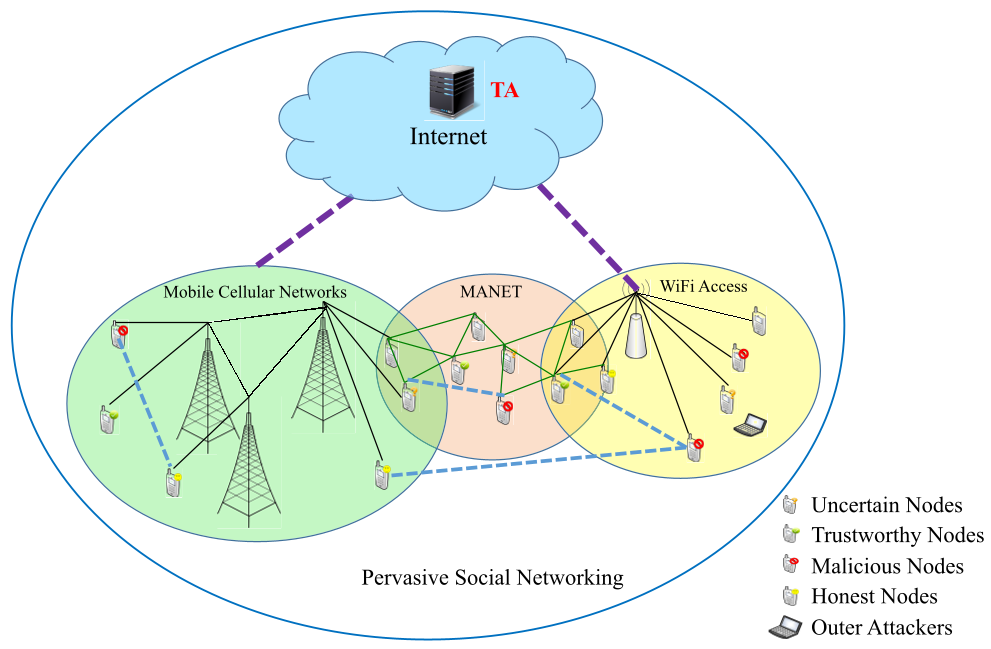 The model separates identity management (TA) from real-time social interaction (Nodes), using trust evaluators to bridge the gap.
Experiments & Results: Efficiency Gains
The authors implemented the scheme in C++ using the PBC (Pairing-Based Cryptography) library.
Performance Highlights:
- Batch Verification: Instead of verifying signatures one-by-one, the system aggregates them. The cost per signature drops to 4.978ms when processing 1500 messages, a massive lead over traditional verification methods.
- Communication Cost: The signature size is a lean 248 bytes.
- Revocation Scalability: By using a Revocation User List (RUL) focused only on unexpired malicious keys, the list size remains manageable compared to standard "total-node" revocation lists.
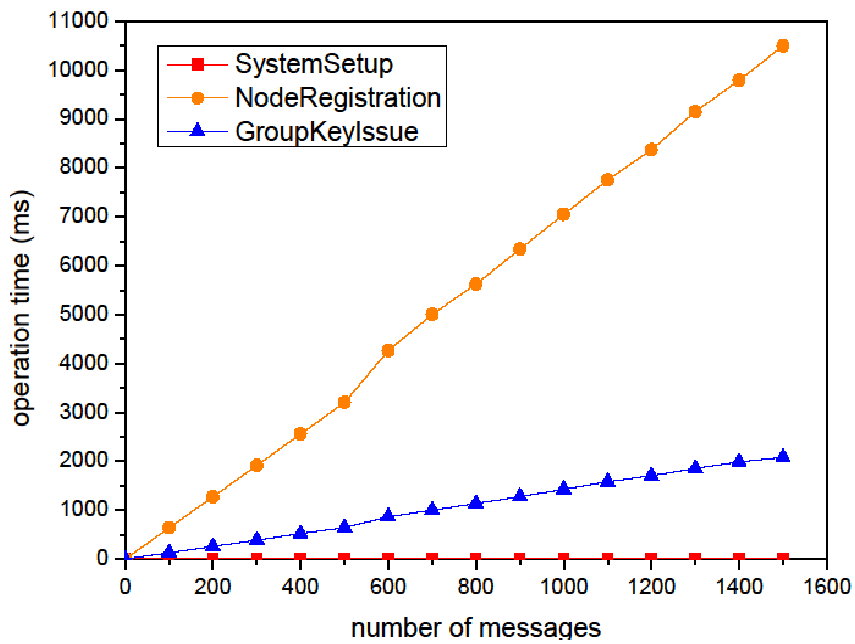 Figure 5 illustrates the efficiency of Batch Verification (Red) compared to standard Verification (Blue) as message count grows.
Comparative Analysis
As shown in the table below, the current scheme outperforms previous trust-based models (Yan et al., 2016) in almost every critical metric, particularly in signing key generation speed.
| Metric | Current Scheme | Previous Work [18] |
|---|---|---|
| Key Issue Time | 1.39ms | 14.42ms |
| Batch Verification | 4.978ms | 23.86ms |
| Message Size | 248 bytes | 276 bytes |
Critical Analysis & Conclusion
Takeaway
The genius of this work lies in the Inductive Bias that identity is a liability in social networking. By shifting the focus to authenticating attributes (Trust) rather than entities, they achieve superior performance and privacy.
Limitations
- Centralization: Despite the decay function, the system still depends on a centralized TA for initial registration and periodic key updates.
- Computation on Mobile: While 27ms for a single verification is fast for a PC, it may still be taxing for lower-end IoT devices if multiple signatures arrive simultaneously without batching.
Future Outlook
This framework could easily be extended to Vehicular Networks (VANETs) or Smart City environments where privacy and rapid trust-assessment (e.g., "is this traffic alert from a trusted car?") are paramount.