
SATA: Rethinking Fair and Efficient Task Assignment in Specialty-Aware Crowdsourcing
Specialty-Aware Task Assignment in Spatial Crowdsourcing
This paper introduces the Specialty-Aware Task Assignment (SATA) problem in spatial crowdsourcing, where complex tasks require workers with diverse skill sets. To address the lack of practical pricing models, the authors propose a fine-grained charge mechanism for individual skills and develop two heuristic algorithms, TBA and ABA, to maximize total task utility under budget and skill constraints.
TL;DR
Spatial crowdsourcing is evolving from simple micro-tasks (like taking photos) to complex "specialty-aware" tasks (like organizing events). Current systems oversimplify worker payments with flat fees. This paper introduces SATA (Specialty-Aware Task Assignment), a framework where workers charge per skill used. The authors prove this problem is NP-hard and introduce two high-performance heuristics—TBA and ABA—that maximize platform utility while respecting budgets and worker locations.
Background: Beyond the Micro-Task
Most spatial crowdsourcing (SC) research focuses on micro-tasks that a single individual can complete. However, real-world services like TaskRabbit or Gigwalk often require teams. For instance, repairing a house requires plumbing, electrical work, and carpentry.
The fatal flaw in existing research is the Unified Fee Assumption. If a worker is paid $50 regardless of whether they perform one skill or five, the system creates "free-rider" problems and lacks transparency. This paper argues for fine-grained charging, making the payment proportional to the actual labor and expertise provided.
The SATA Problem & Motivation
The authors define the utility of a task as its total budget minus the rewards paid to workers (labor fees + transportation fees).
The objective: Maximize the sum of utilities for all completed tasks.
This is complex because:
- Specialty Constraint: A task is only "complete" when all required skills are covered.
- Budget Constraint: Total payment cannot exceed the task's financial limit.
- NP-Hardness: The authors prove that SATA is a variation of the Set Cover problem, making it computationally expensive to find an absolute optimal solution.
Methodology: Greedy Heuristics
Since finding an optimal solution is impractical for thousands of workers, the authors propose two greedy strategies:
1. Total Budget Based Algorithm (TBA)
- Logic: Sort tasks by their total budget in descending order.
- Execution: For the task with the highest budget, greedily pick workers who provide the most "skill coverage" for the lowest cost (including transportation).
- Insight: High-budget tasks are more likely to be completed, thus securing utility early.
2. Average Budget Based Algorithm (ABA)
- Logic: Sort tasks by budget per skill (Total Budget / Number of Required Skills).
- Execution: Similar greedy worker selection.
- Insight: A task with a small total budget but few required skills might actually be more "profitable" than a massive task that consumes too many resources.
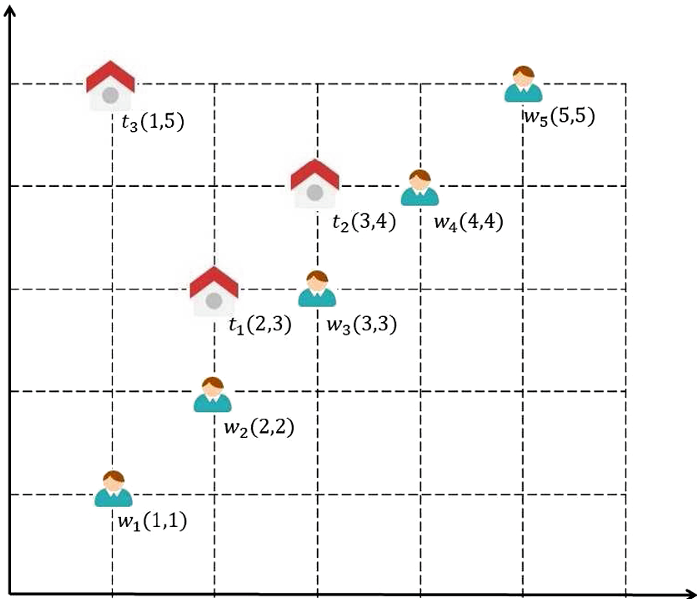 Figure: The spatial distribution of tasks (t) and workers (w) with various skills and locations.
Experimental Insights
The researchers tested their algorithms using synthetic data and real-world traces from the CSTO outsourcing platform.
Key Findings:
- Utility Performance: TBA generally outperformed ABA, suggesting that prioritizing high-resource tasks leads to better total platform utility.
- Scalability: Both algorithms scale well. As the number of workers (|W|) increases, the utility grows because the system has a larger "pool" of economic options to choose from.
- Impact of Transportation (γ): As the unit transportation fee rises, utility drops sharply because workers become "too expensive" once travel costs are added to their skill fees.
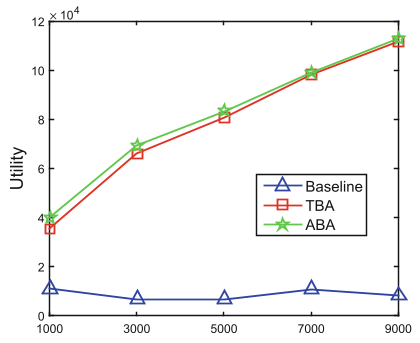 Figure: Comparative analysis showing Utility (Cardinality), Running Time, and Memory usage as the number of tasks increases.
Critical Analysis & Conclusion
The SATA framework is a significant step toward making crowdsourcing more professional. By moving to a skill-based pricing model, the authors align platform incentives with worker expertise.
Takeaway: If you are building a platform for complex manual labor or professional services, sorting your task queue by total budget and using greedy cost-per-skill matching provides a near-optimal balance between speed and profit.
Limitations: The current model is offline, meaning it assumes all tasks and workers are known upfront. Future research should address the online scenario, where tasks appear dynamically and must be assigned within seconds. Additionally, the model does not yet account for worker reputation or the quality of the skills provided.