
Social Web Services: Beyond Black Boxes with Commitment-Based Governance
Specifying and implementing social Web services operation using commitments
This paper introduces a framework for Social Web Services using a Commitment-Based approach to regulate interactions within service-oriented social networks. By categorizing commitments into social and business types, the authors provide a formal mechanism to ensure compliance with network regulations, achieving more flexible and responsible service composition and discovery.
TL;DR
This research moves Web Services from isolated "black boxes" to active "social citizens." By applying Commitment Theory from multi-agent systems, the authors create a framework where services are held accountable for their actions within social networks (Collaboration, Substitution, and Competition), effectively automating trust and responsibility in service-oriented architectures.
Background: The Limits of Traditional Web Services
In the traditional paradigm, Web Services are passive. They don't know their peers, can't voluntarily cooperate, and ignore external context like past user interactions. This "stateless" and "antisocial" nature makes complex tasks—like finding a replacement (substitution) or forming a long-term group (collaboration)—manually intensive and prone to failure.
The authors argue that for Web Services to reach their potential, they must "weave" social network principles into their DNA, becoming Social Web Services (SWS).
Methodology: The Commitment-Based Engine
The core innovation lies in using Commitments instead of simple bindings. A commitment is a contract between a debtor (the service) and a creditor (the network authority or another service).
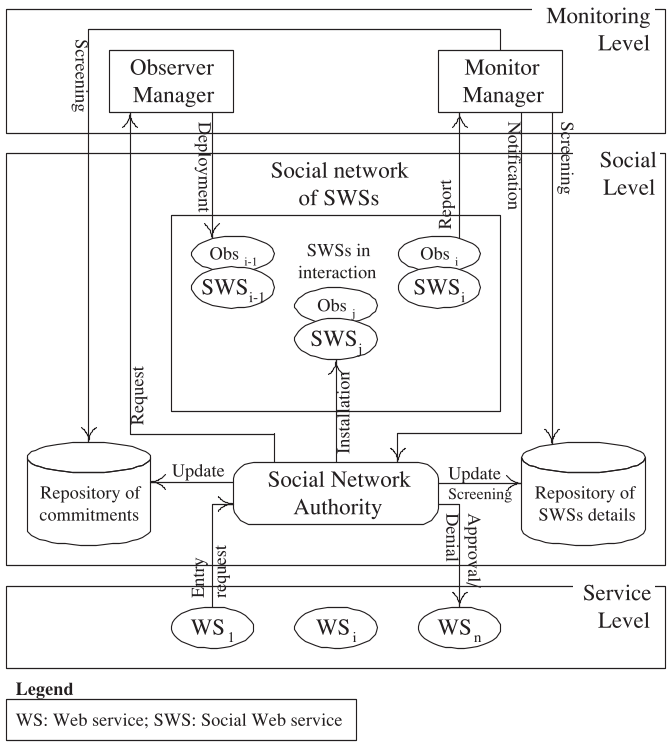
1. The Architecture
The system is divided into two "worlds":
- Computational World: Where services sign up for social networks and manage social commitments.
- Operational World: Where actual user requests are fulfilled via business commitments.
2. Commitment Lifecycle
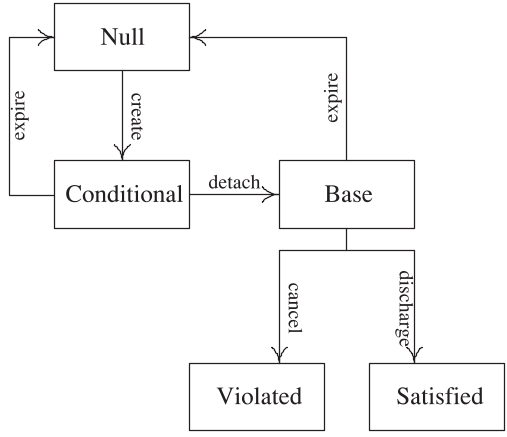
Unlike a standard function call, a commitment has a state. It can be conditional, active (base), satisfied, or violated. This allows the system to track progress and intervene if a service fails to fulfill its "social responsibilities," such as protecting privacy or providing truthful metadata.
Violation and Monitoring
To ensure services don't turn "malicious," the architecture includes:
- Observers: Deployed to track service actions.
- Monitors: Comparing tracked actions against stored commitments to flag violations.
- Sanctions: If a service violates a commitment (e.g., revealing private data), the authority can decrement its trust level or eject it from the network.
Experimental Validation: The Travel Agency Scenario
The authors validated their approach using a travel-agency composition (Flight + Hotel + Car). When the flight booking service failed, the Substitution Network kicked in.
- Success: Potential substitutes provided pricing data for the specific purpose of substitution.
- Failure Detection: The system successfully flagged a service that attempted to collect "private" details, marking a Prohibition violation. This proves the system can enforce fine-grained access control through a social lens.
Critical Insight & Future Outlook
This work provides a robust theoretical foundation for Autonomous Service Governance. While traditional SLAs (Service Level Agreements) handle technical performance, this commitment-based model handles behavioral integrity.
Limitations: The current proof-of-concept is centralized through a "Social Network Authority." In a truly global Web Service environment, this authority would likely need to be decentralized (perhaps via a DAO or Blockchain) to avoid single points of failure.
Takeaway: The future of the Web isn't just about "connecting" services; it's about holding them to a "social contract." This paper is a significant step toward making that digital accountability a reality.