
Beyond Intelligibility: Adaptive Noise Reduction for Speech Emotion Recognition
Spectral and Cepstral Audio Noise Reduction Techniques in Speech Emotion Recognition
This paper introduces adaptive noise reduction techniques specifically optimized for Speech Emotion Recognition (SER), operating in the log-spectral and cepstral domains. The authors demonstrate that their proposed methods, which utilize energy-based clustering and Gaussian similarity adaptation, outperform standard spectral subtraction and MMSE-based baselines in predicting continuous arousal and valence dimensions.
TL;DR
While most noise reduction algorithms focus on making speech clearer for humans, this paper shifts the focus to making it "clearer" for machines to recognize emotions. By proposing adaptive denoising in the cepstral and log-spectral domains, the researchers achieved significant improvements in predicting emotional arousal and valence under harsh, real-world noise conditions (like trains and public spaces), outperforming industry-standard baselines.
Background: The Hidden Enemy of AI Emotion Recognition
Most speech enhancement research aims to improve intelligibility (can we understand the words?) or quality (does it sound pleasant?). However, Speech Emotion Recognition (SER) relies on subtle paralinguistic cues—the "how" rather than the "what." Traditional methods like Spectral Subtraction often introduce "musical noise" or artifacts that destroy these delicate emotional signatures. As AI moves into smartphones and call centers, the mismatch between clean training data and noisy real-world testing (non-stationary noise) has become a primary bottleneck.
Methodology: Adaptive Smoothing in Spectral Domains
The authors suggest that instead of a one-size-fits-all filter, we need a system that adapts to the noise characteristics of the environment.
1. The Architecture
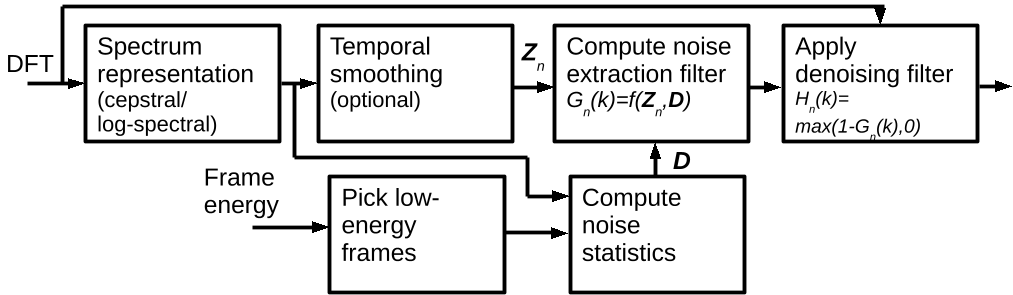
The framework (see below) operates by converting audio into either a logarithmic magnitude spectrum or a truncated cepstrum. The choice of domain matters: the cepstrum naturally provides a smoothed version of the log-spectrum, which acts as a form of "spectral regularization."
2. The Dynamic Adaptation Logic
- Noise Modeling: Instead of assuming noise is static, the system uses k-means clustering to identify "silent" (low-energy) frames and build an initial noise profile.
- Temporal Smoothing: A parameter controls the "memory" of the integrator. A larger ignores sudden spikes (better for steady noise), while a smaller tracks fast-changing noise.
- Gaussian Similarity: The noise model adapts only when the current frame mimics the initial noise profile, preventing the algorithm from accidentally "denoising" the emotional speech itself.
Experiments: Real-World Scenarios
The team used the RECOLA corpus, simulating smartphone recordings in living rooms (CHiME) and train stations. They tested two primary emotional dimensions:
- Arousal: Intensity of the emotion.
- Valence: Positivity vs. negativity.
Key Results
The findings were striking. In high-noise environments (0 dB SNR in a train station), standard methods like MMSE often struggled, whereas the proposed LNR (20, 1.0) method maintained much higher correlation with human labels.
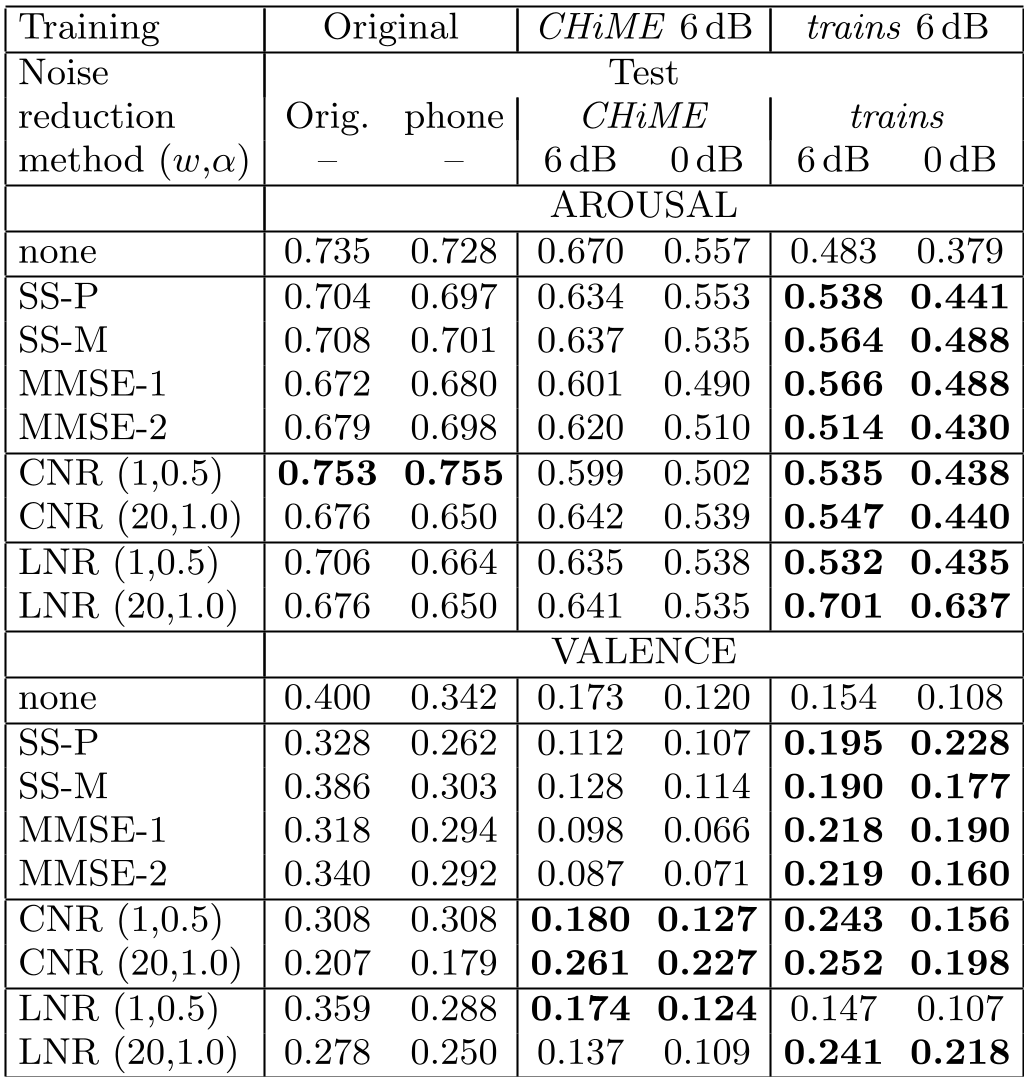 Table 1: Performance (CCC) across different noise types. Note the bold values indicating cases where denoising significantly improved the results over the baseline (None).
Critical Insight: Arousal vs. Valence
One of the most profound takeaways is that Arousal and Valence react differently to denoising.
- Arousal is highly sensitive to energy trajectories. In non-stationary noise (CHiME), almost all denoising methods struggled because the residual noise corrupted the energy spikes that signify high arousal.
- Valence is much more subtle. The study found that temporal smoothing was crucial here to prevent signal distortion from ruining the delicate spectral balance required to distinguish between "happy" and "angry" at similar volume levels.
Summary & Limitations
This work demonstrates that for paralinguistic AI, domain-specific tuning is non-negotiable. While the proposed CNR/LNR methods are powerful, they aren't magic: the study admits that denoising clean speech still tends to hurt performance, likely by stripping away high-frequency emotional nuances.
For future developers, the lesson is clear: if you are building an emotion-aware AI, don't just grab a standard off-the-shelf noise suppressor. Look to cepstral domain adaptation to preserve the spectral "shape" that describes the human heart, not just the human voice.