
Spectrum Matching: Why the "Sound" of Your Latent Space Determines Diffusion Quality
Spectrum Matching: a Unified Perspective for Superior Diffusability in Latent Diffusion
The paper introduces "Spectrum Matching," a unified theoretical framework to improve the learnability (diffusability) of VAE latents in latent diffusion models. By matching latent spectra to a flattened power-law distribution (ESM) and ensuring frequency-aligned decoding (DSM), the authors achieve superior image generation on CelebA and ImageNet, outperforming standard VAEs and prior regularization methods.
TL;DR
Reconstituting a perfect image isn't enough for a VAE to be useful in a Latent Diffusion Model (LDM). This paper argues that the spectral signature of the latent space is what truly dictates "diffusability." By introducing Encoding Spectrum Matching (ESM) and Decoding Spectrum Matching (DSM), the authors align the latent space with the natural low-frequency bias of diffusion models, resulting in significantly faster training and higher-quality image generation.
Problem & Motivation: The Reconstruction Paradox
In the world of LDMs (like Stable Diffusion), we use a two-stage approach: a VAE compresses an image into a latent, and a Diffusion model learns the latent. However, a "stronger" VAE with a lower reconstruction error often fails to improve — or even harms — the final generated image quality.
The authors identify two main culprits:
- Over-noisy Latents: Standard VAEs often "cram" information into high-frequency bands to minimize MSE, making the latent space look like white noise to a diffusion model.
- Spectral Mismatch: Diffusion models trained with MSE naturally focus on low-to-mid frequencies. If the VAE doesn't preserve this structure, the diffusion model wastes capacity trying to learn unlearnable high-frequency details.
Methodology: The Spectrum Matching Hypothesis
The core insight is Proposition 3.1: MSE-based diffusion is inherently biased toward learning low frequencies because the signal-to-noise ratio (SNR) decays rapidly as frequency increases in natural images.
To harmonize the VAE with this bias, the authors propose two mechanisms:
1. Encoding Spectrum Matching (ESM)
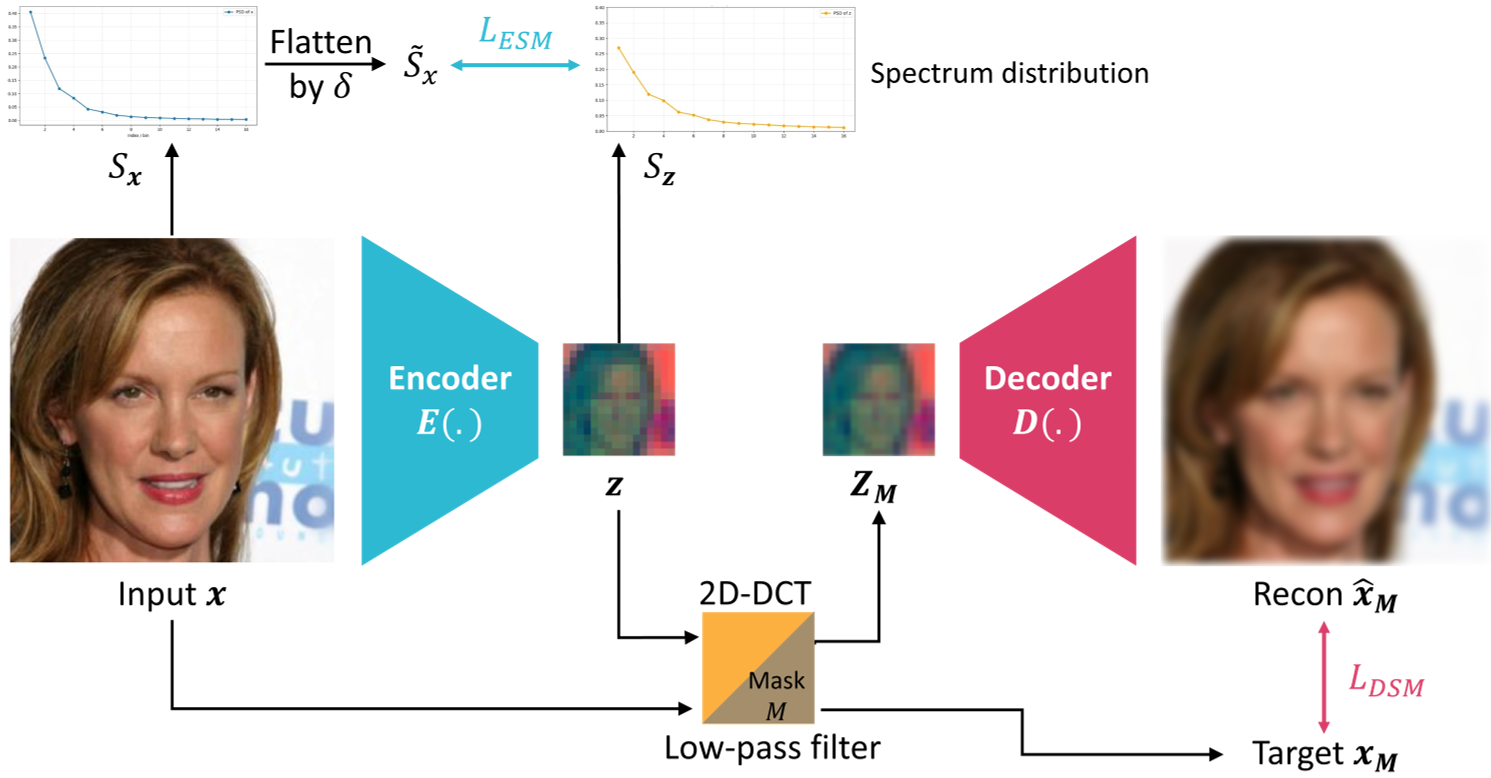
ESM forces the encoder to produce a latent space that follows a flattened power-law PSD. Instead of the latent appearing as pure noise (flat spectrum) or too smooth, it mirrors the energy distribution of natural images but with a "flattening" factor () that maximizes information entropy.
2. Decoding Spectrum Matching (DSM)
DSM ensures that a specific frequency in the latent space maps to the same frequency in the final image. It uses shared spectral masking:
- Apply a low-pass filter to both the input image and the latent.
- Force the decoder to reconstruct the masked image from the masked latent. This prevents "semantic drift" where low-frequency concepts might be hidden in high-frequency latent dimensions.
Experiments & Results: Quantitative Superiority
The results across CelebA and ImageNet confirm that "diffusability" trumps pure reconstruction.
- CelebA Results: DSM-AE achieved a gFID of 4.44, a massive improvement over the standard SD-VAE baseline of 6.63.
- ImageNet Results: Even with a slightly worse reconstruction PSNR, the DSM-AE latent was much easier for the Diffusion Transformer (SiT) to model, leading to better generation metrics faster.
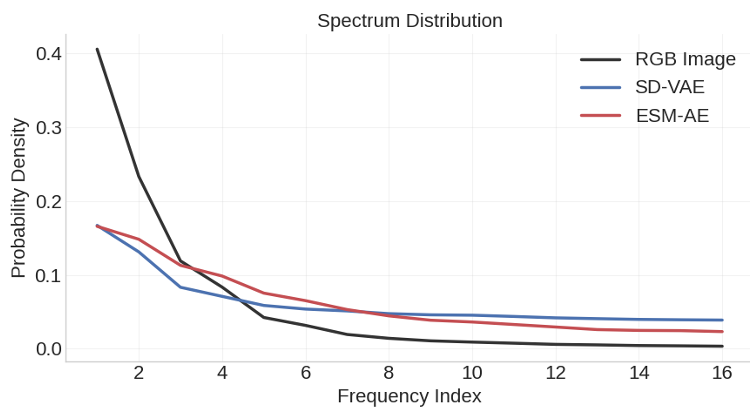 Figure 3: PCA visualization shows that ESM and DSM produce much "smoother" and semantically organized latent spaces compared to the noisy SD-VAE.
Beyond VAEs: The REPA-DoG Extension
The authors also improved REPA (Representation Alignment) by introducing a Difference-of-Gaussians (DoG) filter. They proved that spatial contrast in target features is actually equivalent to directional spectral energy. By using a band-pass filter (DoG), they achieved a SOTA gFID of 4.98 on ImageNet.
Critical Analysis & Conclusion
Takeaway
The paper provides a beautiful unification of various recent heuristics (like VA-VAE or EQ-VAE) under a single mathematical umbrella: matching the power spectral density. It proves that for diffusion, the structure of the latent space matters more than the precision of the reconstruction.
Limitations
A notable limitation is the focus on spatial frequencies. As the authors admit, video diffusion models introduce temporal frequencies. Whether the Spectrum Matching Hypothesis holds for the "flicker" and "motion" spectra of video latents remains an open question for future research.
Future Outlook
This work likely opens the door for dedicated "spectral tokenizers" where VAEs are no longer trained just by looking at pixels, but by listening to the "harmony" of the frequency domain.