
Spectrum Privacy in Social Networks: Breaking the Utility-Security Tradeoff with Personalized DP
Spectrum Privacy Preserving for Social Networks: A Personalized Differential Privacy Approach
The paper introduces a personalized differential privacy (PDP) approach for spectrum queries in social networks, specifically targeting weighted graphs. By integrating a sampling mechanism with Laplacian noise perturbation of singular values and vectors, it achieves State-of-the-Art (SOTA) data utility compared to traditional uniform Differential Privacy (DP).
TL;DR
Preserving privacy in social networks often feels like a zero-sum game: the more protection you provide, the noisier and more useless the data becomes. This paper presents a breakthrough by applying Personalized Differential Privacy (PDP) to spectrum queries. By allowing users to define their own privacy budgets and using a clever edge-sampling mechanism before spectral decomposition, the authors significantly reduce error (RMSE) compared to traditional, "one-size-fits-all" Differential Privacy (DP).
The Problem: The High Cost of Uniformity
In social network analysis, the spectrum (eigenvalues and eigenvectors of the adjacency matrix) is vital for understanding network structure, such as connectivity and robustness. However, releasing this data can leak sensitive relationship information.
Current solutions face a "Uniformity Trap":
- Standard DP: Assumes everyone wants the same high level of privacy. This forces the system to add enough noise to satisfy the most paranoid user, ruining the data for everyone else.
- Existing Spectral Methods: Often lack a rigorous security model and are vulnerable to reconstruction attacks where an adversary can "guess" the original graph from noisy singular values.
The core insight of this paper is that not all users are equally sensitive. By respecting individual privacy preferences, we can sample the network more intelligently and add less noise overall.
Methodology: Sampling Meets Spectrum Perturbation
The authors propose a two-stage algorithm to protect spectral information while maximizing utility.
1. The Sampling Mechanism
Instead of perturbing the final result alone, the paper introduces a sampling layer. Each edge in the weighted graph is sampled with a probability determined by the nodes' privacy preferences .
- If users have high privacy requirements (low ), the edge is more likely to be sampled/perturbed.
- If users are "liberal" with their data, the edge stays intact.
The authors use an aggregation strategy and a quality function (Algorithm 1) to find the optimal threshold that balances sampling error against the noise required by the DP mechanism.
2. Spectral Sensitivity & Perturbation
To satisfy Differential Privacy formally, noise must be proportional to the Global Sensitivity of the query. The paper provides rigorous proofs for the sensitivity of spectral components:
- Singular Values (): Proven to have a sensitivity of .
- Singular Vectors (): Sensitivity is linked to the "spectral gap" (the distance between adjacent eigenvalues), which captures how much a single edge change can swing the direction of a vector.
Note: The algorithm workflow involves: 1) Determining the Sampling Threshold, 2) Drawing a sampled Graph G', 3) Performing SVD, 4) Adding Laplace noise to singular values/vectors, 5) Re-orthogonalization.
Experiments: Real-World Performance
The researchers tested their approach on BA (Scale-free) and ER (Random) networks, as well as real datasets from Facebook and Wiki-Vote.
Key Findings:
- Massive Error Reduction: In heterogeneous networks, the PDP approach consistently outperformed standard DP. For a BA network with 100 nodes, the RMSE dropped from 1.25 (DP) to 0.51 (PDP).
- Network Density Stability: The method remains effective even as the network becomes more complex (higher edge-to-node ratio).
- Comparison with TGDP: Compared to the "Trust-grained" PDP (TGDP), this algorithm performs better when privacy preferences are low (strict privacy), which is exactly where most mechanisms fail.
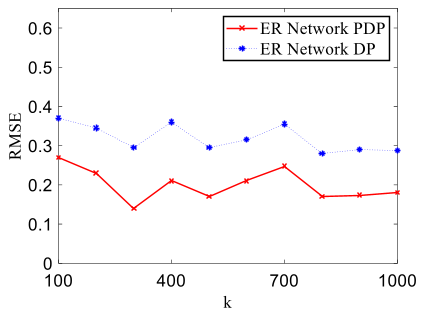 Figure 1: Comparison of RMSE across different network types. Lower values indicate higher data utility.
Critical Analysis & Conclusion
The value of this work lies in its pragmatism. By acknowledging that "privacy" is subjective, it allows for a more efficient allocation of the "noise budget."
Takeaways:
- Context Matters: In social networks, the identity of the nodes involved in an edge dictates its sensitivity.
- Spectrum Protection: The derivation of singular vector sensitivity is a vital contribution for any researcher looking into private low-rank approximations.
Limitations: One potential bottleneck is the Aggregation Strategy. Finding the "optimal" threshold requires looking at the data, which itself might leak info if not handled carefully (though the authors suggest using prior literature to mitigate this). Furthermore, computational complexity for SVD on extremely large graphs remains a challenge for real-time applications.
Future Outlook: This framework could theoretically be extended to other graph-based queries, such as PageRank or graph embeddings, where user-level privacy preferences are currently ignored.