
Speculative Thinking: Boosting SLM Reasoning by Fixing the "Over-Thinking" Trap
Speculative Thinking: Enhancing Small-Model Reasoning with Large Model Guidance at Inference Time
Speculative Thinking is a training-free framework that enhances the reasoning capabilities of small language models (SLMs) by delegating critical "reflective" steps to a larger model during inference. Unlike traditional speculative decoding that works at the token level, this method operates at the reasoning level, enabling models like Qwen-2.5-1.5B to achieve SOTA-level accuracy improvements (e.g., +6.2% on MATH500) while reducing output length.
TL;DR
Recent advancements in Large Language Models (LLMs) have shifted focus toward "reasoning" models like DeepSeek-R1 and OpenAI's o1. However, smaller models (SLMs) often fail in these tasks, getting trapped in endless, verbose loops of "waiting" and "reflecting" without reaching a solution. Speculative Thinking is a new, training-free framework that solves this by allowing a small model to do the heavy lifting while a larger model "intervenes" at critical structural points (like paragraph breaks). The result? A 1.5B model outperforming its base version by over 6% while producing 15% fewer tokens.
The Problem: The "Over-Thinking" Paradox of Small Models
In the world of reasoning models, bigger is usually better—not just in accuracy, but in conciseness. The authors observed a fascinating paradox: when a small reasoning model fails, it doesn't just stop; it produces extraordinarily long outputs.
Small models tend to get lost in "backtracking loops." They frequently use words like "wait," "hmm," or "alternatively," but they lack the cognitive capacity to actually correct their path. This results in "inefficient exploration"—the model thinks it’s reflecting, but it’s actually just spinning its wheels.
The Insight: Structural Cues as Decision Hubs
The researchers discovered that the delimiter `
` (double newline) serves as a critical neurological signal for LLMs. Over 80% of reflective tokens like "wait" follow this specific delimiter.
Instead of checking every single token (as in Speculative Decoding), Speculative Thinking treats the `
` boundary as a "control point." By monitoring what follows this delimiter, the framework can decide whether the small model is entering a dangerous reflection loop and needs a "nudge" from a larger mentor.
Methodology: Three Ways to Intervene
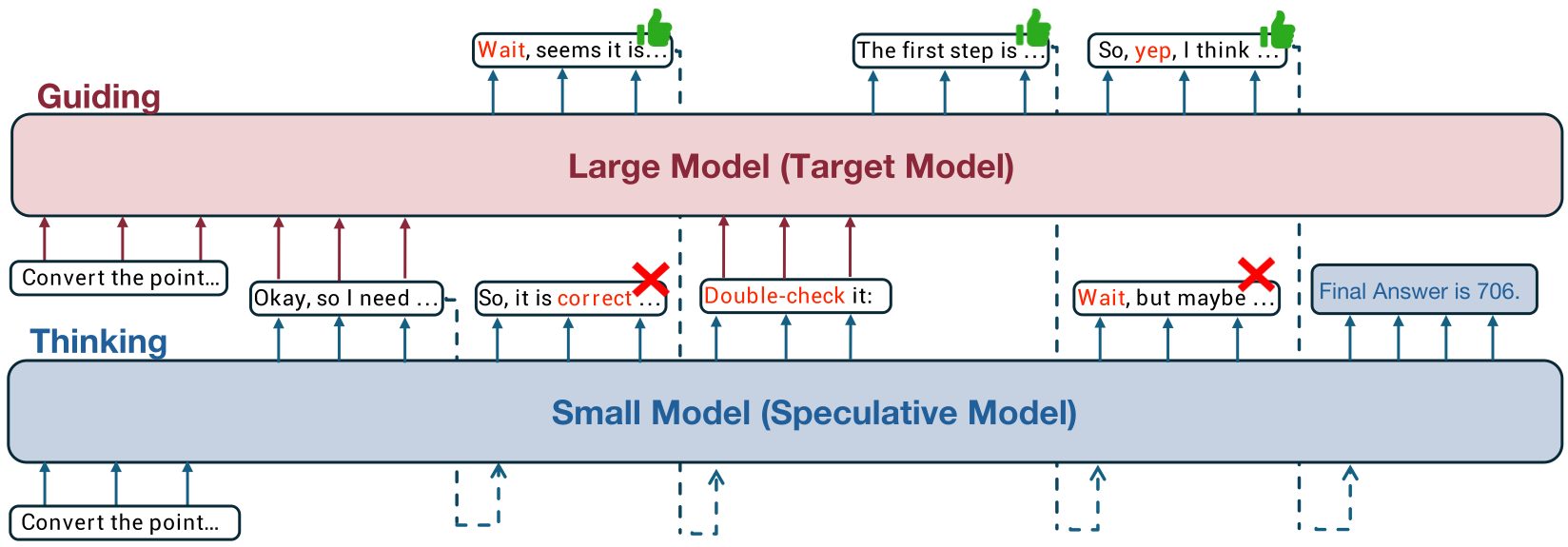
The framework employs a "Target Model" (e.g., 32B) to guide a "Speculative Model" (e.g., 1.5B) using three distinct strategies:
- Affirmation/Reflection Takeover: When the SLM starts a sentence with a reflective cue (e.g., "Wait...") after a break, the target model takes over for the next 20 tokens to ensure the reflection is actually productive.
- Verification Takeover: If the model mentions "verifying" or "checking," the target model steps in to perform the math/logic verification, preventing the SLM from hallucinating a "correct" check.
- Excessive Reflection Takeover: If the SLM negates itself too many times (tracked via a negativity counter), the framework forces an intervention to "reorient" the model and exit the loop.
Experimental Results: Faster, Shorter, Smarter
The results across benchmarks like MATH500 and GPQA demonstrate a rare "triple win": improved accuracy, reduced latency, and shorter outputs.
- Accuracy Jump: A 1.5B model assisted by a 32B model improved from 83.2% to 89.4% on MATH500.
- Conciseness: On AMC23, the output length dropped by 16.9%, proving that the large model helps the small model "get to the point."
- Efficiency: Because the target model only modifies ~20% of the output, the system remains significantly faster than running a standalone 32B model.

Critical Analysis: Why This Matters
Traditional Speculative Decoding (token-level) often fails in reasoning because the "draft" and "target" models have different internal logic, leading to high rejection rates. Speculative Thinking operations at the reasoning level, making it robust across different model families (e.g., a Qwen model can guide a Phi model).
Limitations: The system relies on specific keywords and patterns (like `
`). If a model is trained with a completely different thinking format (e.g., using XML tags only), these heuristics might need recalibration. However, as "Chain of Thought" becomes the standard, these structural patterns are likely to remain consistent.
Conclusion
Speculative Thinking proves that we don't always need to fine-tune a model to make it smarter. By understanding the "discourse markers" of machine thought, we can orchestrate small and large models to achieve high-tier reasoning on edge devices and low-cost deployments. It effectively turns the large model into a "Reasoning Supervisor" that only speaks when it truly matters.