
Spee-Navi: Turning Supermarket Chatter into a High-Precision Indoor GPS
Spee-Navi: An Indoor Navigation System via Speech Crowdsourcing
Spee-Navi is a speech crowdsourcing-based indoor navigation system designed for complex environments like supermarkets. It leverages Automatic Speech Recognition (ASR) to extract location semantics from ambient conversations and utilizes reversed Dead Reckoning and Wi-Fi fingerprinting to guide users without requiring floor plans or pre-installed infrastructure.
TL;DR
Spee-Navi is an innovative indoor navigation system that bypasses the need for floor plans and expensive beacons. By "overhearing" ambient conversations in a supermarket using Automatic Speech Recognition (ASR), it identifies semantic landmarks (e.g., the "fruit section") and matches Wi-Fi signal sequences to guide newcomers along paths previously walked by other shoppers. It achieves sub-meter localization accuracy (average 0.32m) purely through crowdsourced mobile data.
Background: The Indoor Navigation Dilemma
Outside, GPS is king. Inside, we are blind. Current solutions generally fall into two categories: high-effort (site surveys, manual Wi-Fi fingerprinting) or high-resource (VSLAM using cameras). Spee-Navi positions itself as a passive, low-cost alternative that thrives in dynamic environments—specifically supermarkets—where the "noise" of human activity is actually a treasure trove of data.
The Core Insight: Speech as a Semantic Anchor
The "Aha!" moment of this research is the realization that location and conversation are deeply linked in retail.
- Hotspots: Areas where customers linger and talk about products (e.g., mentioning "grapes" at the fruit stand).
- ASR Crowdsourcing: Instead of manual tagging, the system uses guiders' microphones to capture these keywords, creating a semantic map of the store.
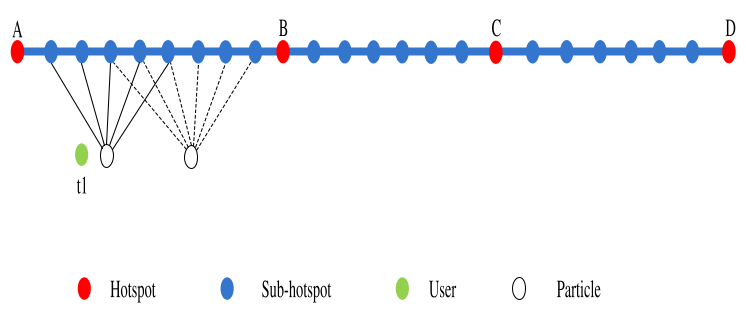
- Sub-hotspots: These are the breadcrumbs of sensor data (Wi-Fi, accelerometer) collected between the semantic hotspots.
Methodology: The Guiding Engine
Spee-Navi operates on a "Guider-Follower" model.
1. Architecture Overview
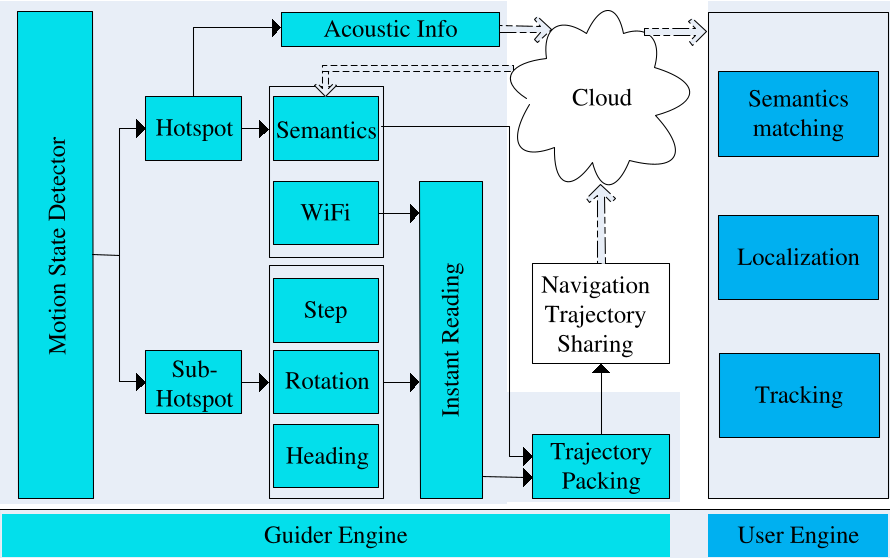
The system consists of a cloud server that stores trajectory segments. When a guider uploads a path, the server breaks it into segments anchored by semantic hotspots.
2. The "Lock-on" Mechanism
A major challenge in crowdsourced navigation is knowing where on a previous path a new user is starting. Spee-Navi solves this with a Range Estimation Algorithm (Algorithm 1) and a sequence-matching technique. It doesn't just look at a single Wi-Fi signal; it looks at the sequence of signal changes as the user moves, making it far more robust against signal fluctuations.
3. Tracking and Calibration
Once locked onto a path, the "Follower" is guided using the guider’s recorded trajectory. Spee-Navi uses a Particle Filter to combine inertial sensor data (steps/direction) with Wi-Fi fingerprints, effectively correcting the "drift" that usually plagues dead reckoning.
Experiments: Real-World Performance
The authors tested the system in a 1500㎡ supermarket during peak and off-peak hours.
- Semantic Accuracy: By using a weighted system and local dictionaries, the system successfully filtered out background noise to identify product-related keywords.
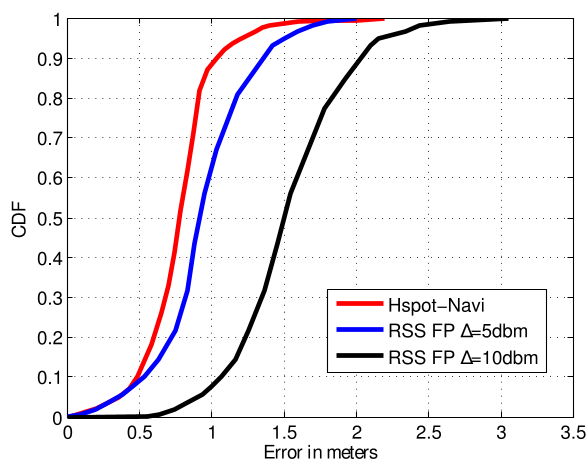
- Precision: In off-peak hours, 80% of localization errors were under 0.5m. Even in crowded peak hours with significant signal "occlusion" (people blocking Wi-Fi signals), the average error remained at a respectable 0.6m.
- Sample Rate Sensitivity: The research found a 2-second sampling delay for Wi-Fi fingerprints to be the "sweet spot" between battery saving and navigation accuracy.
Critical Insight & Future Outlook
Takeaway: Spee-Navi's genius lies in its Semantic Partitioning. By using speech to label the world, it solves the "Where am I?" problem without needing a map.
Limitations:
- Privacy: Recording ambient speech, even for ASR, raises significant privacy concerns that weren't fully addressed.
- Language Dependence: The current system relies on a keyword dictionary; moving this to a multi-lingual or intent-based model would be necessary for global scale.
Future Work: This framework could potentially move beyond speech to other ambient signals like lighting patterns or magnetic fields, further reducing the reliance on active user participation.