
Decoding the Sound of Soul: Hybrid Neural Architectures for Speech Emotion Recognition
8149_Speech emotion recognition using auditory cortex.
This paper presents a speech emotion recognition (SER) framework utilizing Mel-Frequency Cepstral Coefficients (MFCC) and neuro-psychologically inspired neural architectures. It evaluates and compares the performance of Generalized Radial Basis Function (GRBF) networks and Evolving Fuzzy Neural Networks (EFuNN) in identifying cross-cultural emotions like happiness and anger.
TL;DR
Recognizing human emotion from speech is a cornerstone of next-gen Human-Computer Interaction (HCI). This research explores a neuro-psychologically inspired approach using Mel-Frequency Cepstral Coefficients (MFCC) coupled with Generalized Radial Basis Function (GRBF) networks. By moving away from superficial features like pitch and focusing on human-auditory-mimicking cepstral coefficients, the authors achieved an impressive 98%+ accuracy (1.87% FRR) in distinguishing happiness from anger.
Problem & Motivation: Beyond the Pitch
Historically, researchers have looked at Pitch and Formants to identify emotion. However, this paper challenges that intuition. The authors observe that pitch is fundamentally speech-dependent (linked to the specific vowels/consonants uttered) and culturally colored, rather than being a pure indicator of emotion.
The challenge lies in the "ambiguous nature of real-life data." Emotions aren't just logic gates; they are psychological states that trigger physiological changes. Traditional ML models often struggle with:
- Dimensionality Curse: Too many features lead to overgeneralization.
- Training Latency: Standard MLPs take too long to converge on noisy audio data.
- Data Authenticity: Laboratory-recorded "acted" emotions often fail to represent real-life emotional triggers.
Methodology: The Neuro-Inspired Core
1. Feature Engineering: The MFCC Superiority
The authors argue that MFCCs are superior because they are positioned on the Mel scale, which approximates the human auditory system's non-linear response.
The extraction process follows: The team extracted the first 40 coefficients but used Pearson Correlation to distill them into a 10-feature vector for optimal network performance.
2. Architecture: GRBF vs. EFuNN
The research pits two heavyweights against each other:
- GRBF (Generalized Radial Basis Function): Uses an Expectation-Maximization (EM) algorithm. It excels because it partitions the input space into local mappings, making it highly interpretable and resistant to dimensionality issues.
- EFuNN (Evolving Fuzzy Neural Network): A 5-layer connectionist system that evolves rule nodes during learning. While powerful for fuzzy logic, it was found to be computationally expensive as categories increased.
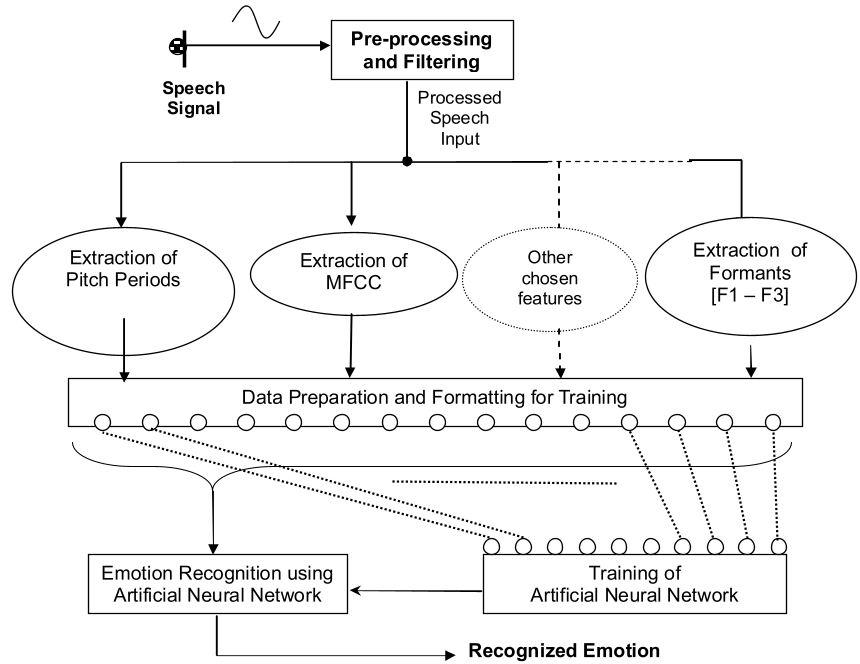 Figure 1: The overarching recognition workflow involving signal sampling, feature extraction, and neural classification.
Experiments & Results: Real-World vs. Lab
The study used two datasets: an online call center archive (real-world) and a laboratory dataset (primed/emulated).
Key Findings:
- Superior Accuracy: The GRBF network outperformed EFuNN consistently, especially on call center data.
- Error Metrics: With a complexity of 5 clusters, the system achieved a FAR of 0.055% and an FRR of 0.635%.
- The Validity Gap: A "Listening Comprehension Survey" revealed that 88% of people found "Sad" samples in training databases unrealistic, explaining high error rates for that specific emotion.
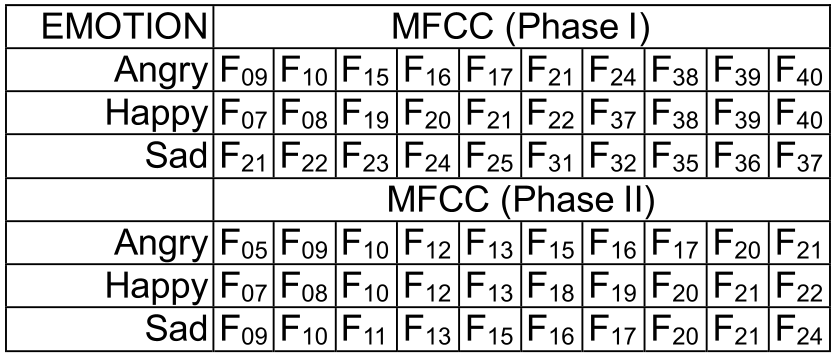 Table 1: Selected MFCC features for different emotional states across two phases.
Critical Analysis & Conclusion
Takeaway
The study proves that GRBF networks are highly capable of bi-state emotion recognition when fed with biologically relevant features (MFCC). It also highlights a critical methodological shift: real-life, unobtrusive data is far more valuable for training emotional AI than controlled laboratory environments.
Limitations & Future Work
While bi-state (Happy vs. Angry) performance is nearly SOTA, the model struggles with more subtle or "fake" emotions (like Sadness in the study). Future research should explore:
- Multi-modal Fusion: Combining voice with facial micro-expressions.
- Temporal Dynamics: Utilizing Recurrent architectures (like LSTMs or Transformers) to capture the "flow" of emotion over time, rather than static feature snapshots.
In the quest to make machines "feel," this research reinforces that the secret lies in mimicking how our own auditory cortex perceives the world.