
MT-A-DNN: Elevating Speech Emotion Recognition through Multi-Task Attention
Poster Abstract: Speech Emotion Recognition via Attention-based DNN from Multi-Task Learning
This paper introduces MT-A-DNN, a multi-task attention-based Deep Neural Network designed for high-accuracy Speech Emotion Recognition (SER). By utilizing a custom large-scale corpus of Chinese TV and movie clips, the model achieves a state-of-the-art accuracy of 60.02% across four primary emotional categories.
TL;DR
Understanding human emotion through speech is a cornerstone of next-generation Human-Computer Interaction (HCI). This paper presents MT-A-DNN, a robust framework that leverages a large-scale real-world audio database and a multi-task learning architecture enhanced by attention mechanisms. The model moves beyond simple classification by learning the underlying "valence" and "activation" of speech, achieving a superior 60.02% accuracy in wild scenarios.
Problem & Motivation: The Gap Between Lab and Life
Most existing speech emotion recognition (SER) systems suffer from two chronic issues:
- Data Artificiality: They rely on small datasets of actors performing emotions, which lack the nuances, noise, and intensity variations of real-life conversations.
- Structural Rigidity: Standard models often treat audio as a flat signal, failing to capture the high-order dependencies and the "salience vs. silence" nature of emotional speech.
The authors address these gaps by curating a massive dataset from 33 Chinese TV series and 20 movies, involving over 430 speakers, and designing a model that "listens" more intelligently to the features that actually matter.
Methodology: The Power of Multi-Tasking and Attention
The core innovation of MT-A-DNN lies in its hierarchical structure. Instead of focusing solely on the "Emotion" label, the network is forced to learn complementary tasks: Valence (how positive/negative) and Activation (the energy level).
1. Shared Feature Learning
The input consists of 68-dimensional acoustic features (including mean and variance of 34-dimensional features like MFCCs). These flow through a shared fully connected layer with SELU activations, which captures a universal representation of the audio.
2. Task-Specific Attention
Following the shared layer, the model splits into three branches. Each branch uses a weighted-pooling with attention layer. This allows the model to calculate attention weights () that highlight salient emotional cues while ignoring irrelevant silence or non-emotional noise.
 Note: The architecture highlights the flow from shared layers to specialized attention-based task heads.
Experiments & Results: Setting a New Benchmark
The researchers tested MT-A-DNN against traditional machine learning and standard deep learning baselines. The results validated that the combination of Multi-Task Learning (MTL) and Attention brings a significant "performance premium."
SOTA Comparison
As shown in the comparison table, MT-A-DNN consistently outperforms SVM, Random Forest, and a vanilla DNN:
| Model | Accuracy (%) | Improvement (vs. DNN) |
|---|---|---|
| SVM | 55.46 | - |
| Random Forest | 52.61 | - |
| Standard DNN | 57.79 | Baseline |
| MT-A-DNN | 60.02 | +2.23% |
Confusion Matrix Insights
The model is particularly skilled at identifying Happiness (67.73%), while Anger (52.03%) proves more difficult, often being confused with happiness—a common challenge in acoustic analysis where both emotions share high energy (activation) profiles.
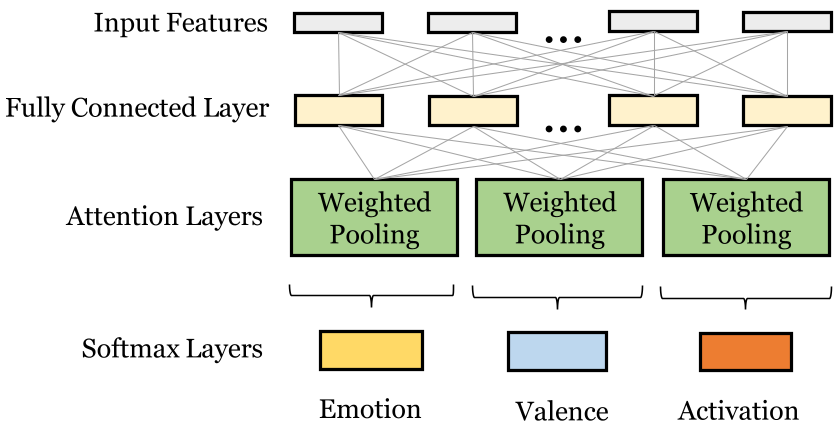 Table: The confusion matrix reveals the model's high precision in neutral and happy tones.
Critical Analysis & Conclusion
Why it Works
By including Valence and Activation as auxiliary tasks, the model develops a more nuanced internal representation of the "emotional space." The attention mechanism ensures that the model doesn't get "distracted" by the 85% of an audio clip that might be emotionally neutral or silent.
Limitations & Future Work
While 60% accuracy on a real-world, multi-speaker dataset is impressive, the model still struggles with the high-activation overlap between anger and joy. The authors' future roadmap includes utilizing transfer learning to apply these findings across different languages, potentially solving the data scarcity problem for non-Mandarin/English dialects.
Takeaway
MT-A-DNN proves that for complex human traits like emotion, architectural inductive bias (attention) and task diversity (multi-tasking) are just as important as the raw amount of data. This model is lightweight enough to be embedded in smart audio devices, bringing us one step closer to truly empathetic AI.