
Speech Emotion Recognition: Decoding Feelings in the Wild of Social Media
"Speech Emotion Recognition from Social Media Voice Messages Recorded in the Wild"
This paper presents a Speech Emotion Recognition (SER) study conducted on "in-the-wild" voice messages from WhatsApp. By developing a new ecological dataset of Spanish speakers, the authors utilize a Support Vector Machine (SVM) pipeline to achieve approximately 71% accuracy in classifying both arousal and valence dimensions.
TL;DR
Researchers have successfully developed a system to recognize emotions from real-world WhatsApp voice messages, moving away from simulated "lab" data. By analyzing 24 Spanish speakers' spontaneous audio, they achieved over 70% accuracy in predicting emotional intensity (arousal) and positivity/negativity (valence) using an optimized Support Vector Machine (SVM) approach.
Background & Positioning
Unlike traditional Speech Emotion Recognition (SER) models that rely on actors shouting "I'm angry!" in soundproof booths, this work targets "in-the-wild” scenarios. It sits at the intersection of Social Computing and Affective Computing, attempting to bridge the gap between controlled academic experiments and the messy reality of daily instant messaging.
The "In-the-Wild" Challenge
Prior work in SER often falls into the trap of oversimplification. Acted databases are stereotypical and exaggerated, while induced databases (where subjects watch videos to trigger mood) struggle with individual variations. Real-world social media audio presents a "nightmare" for signal processing:
- Environmental Noise: Traffic, wind, and background chatter.
- Unnaturalness: When subjects know they are being recorded for a study, they self-censor.
- Contextual Loss: Emotions in messaging are often responses to complex social historical contexts.
The authors solved this by requesting historical messages—audio sent before the study began—ensuring the emotions were 100% genuine and spontaneous.
Methodology: From Raw Waveforms to Emotional Insights
The pipeline follows a rigorous data-to-decision flow:
1. Feature Extraction
Using the pyAudioAnalysis library, the team extracted 50ms frames to capture:
- Time Domain: Zero crossing rate and entropy.
- Frequency Domain: MFCCs (Mel-Frequency Cepstral Coefficients) and Chroma vectors.
2. Feature Selection
To prevent "The Curse of Dimensionality" and overfitting, the authors used a Random Forest-based selection. This pruned hundreds of features down to the 5 or 6 most critical vocal cues.
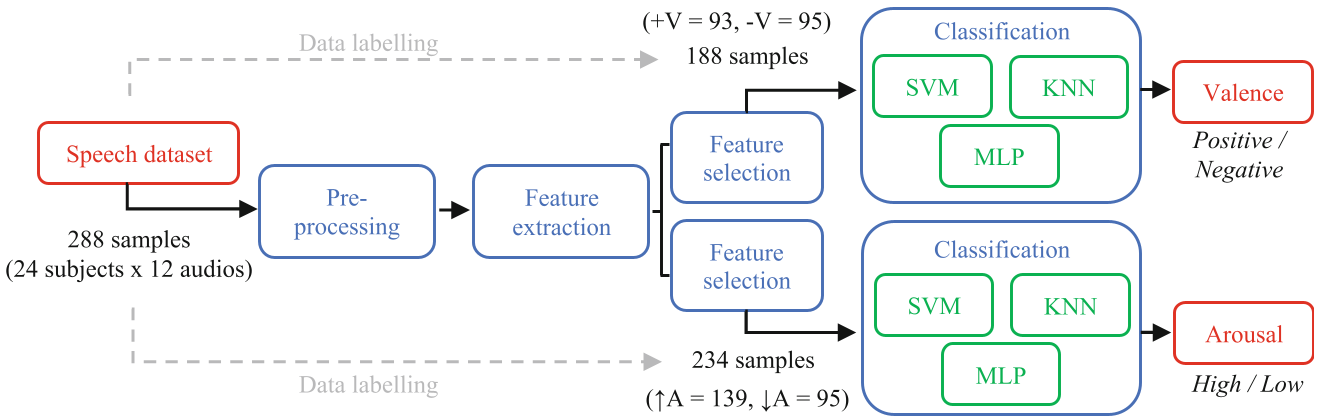 Figure 1: The data processing pipeline from normalization to classification.
Experiments and Results
The study compared three primary architectures: K-Nearest Neighbors (KNN), Multilayer Perceptron (MLP/Neural Networks), and Support Vector Machines (SVM).
The Winner: SVM
Surprisingly, the simplest model—the SVM with a small feature set—won the day. In the Valence dimension (Positive vs. Negative), it reached 70.73% accuracy. For Arousal (High vs. Low energy), it peaked at 71.37%.
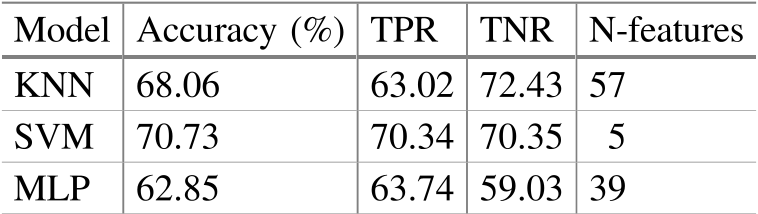 Table 1: Comparison of models for Valence classification. Note that SVM achieves the highest accuracy with the fewest features (only 5).
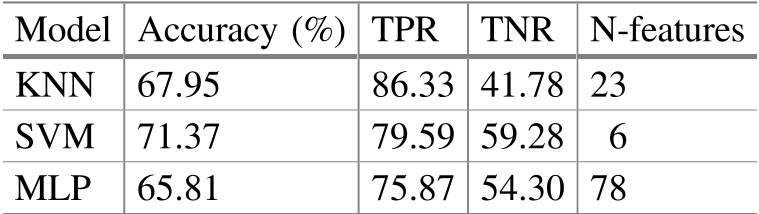 Table 2: Comparison of models for Arousal classification.
Critical Insights: Why does "Less is More" work?
The fact that SVM used only 5-6 features is highly significant. In noisy, "wild" environments, complex models like MLPs tend to memorize noise (overfitting). By using a sparse feature set, the SVM focuses on the most robust acoustic invariants—those that remain consistent even when recorded through a cheap smartphone microphone on a busy street.
Limitations & Future Outlook
While promising, the study faces hurdles:
- Noise Sensitivity: 20% of the original participants had to be dropped because their audio was too noisy for current algorithms.
- Dataset Balance: High-arousal messages are easier to find in WhatsApp than neutral ones, leading to some class imbalance.
- Gender Variation: Future work needs to disentangle how pitch and timber differences between genders affect the vocal features of emotion.
Conclusion
This work-in-progress is a strong step toward "Ubiquitous Affective Computing." If our devices can understand not just what we say but how we feel during a WhatsApp exchange, the future of digital social interaction will be vastly more empathetic and personalized.