
Boosting Emotion: How XGBoost and Attention-CNNs Revolutionize Audio Recognition
17512_Speech Emotion Recognition using XGBoost and CNN BLSTM with Attention.
This paper presents a robust framework for audio-based emotion recognition using an optimized feature selection strategy. By combining the XGBoost Variable Importance Measurement (VIM) with classical machine learning classifiers (CART, Random Forest) and Deep Learning modules (Attention-based CNN), the proposed method achieves a SOTA accuracy of 86.87%.
TL;DR
Recognizing human emotion from voice is notoriously difficult due to the "curse of dimensionality" in acoustic features. This research proposes a hybrid framework that uses XGBoost Variable Importance to prune redundant features and an Attention-augmented CNN to capture the nuance of speech. The result? A significant jump to 86.87% accuracy, setting a new benchmark over previous academic efforts.
Background & Motivation: The Noise in the Voice
Speech Emotion Recognition (SER) is not just about what is said, but how it's said. We use features like MFCCs (Mel-frequency cepstral coefficients) and Chroma features, yet a standard audio clip can yield hundreds of parameters. Most are noise. Traditional models fail because they drown in this high-dimensional space. The authors realized that the bottleneck wasn't just the classifier, but the feature selection process.
Methodology: Pruning the Feature Forest
The core innovation lies in a two-stage process:
1. XGBoost Variable Importance Measurement (VIM)
Instead of using all features, the authors used XGBoost to calculate the "Gain" for each feature—essentially measuring how much each feature improves the model's predictive power.
By ranking features through , they identified that the top 71 features provide the optimal balance between information and simplicity.
2. The Model Architecture
The system employs a heavy-duty CNN with 6 Convolutional layers, interleaved with Dropout to prevent overfitting.
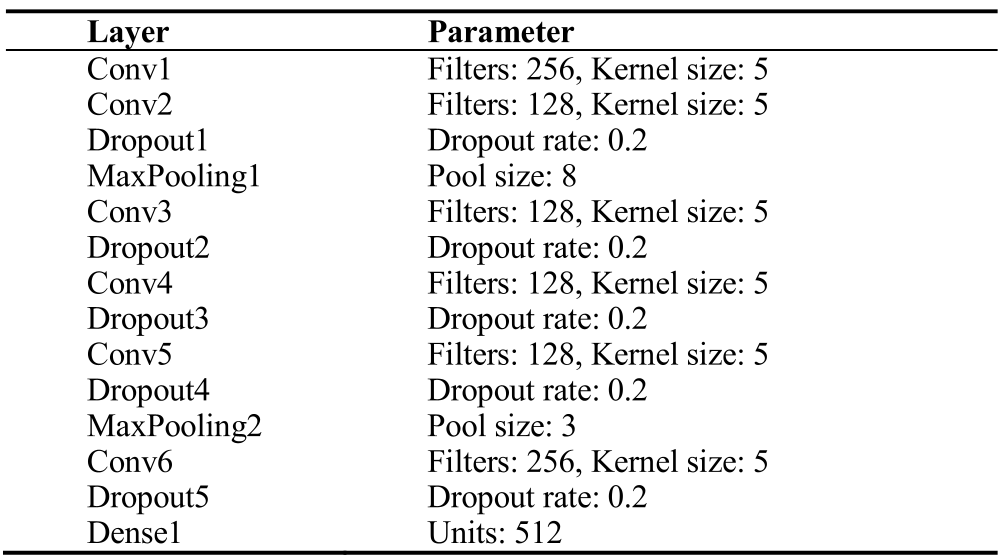 Table 1: The detailed CNN configuration featuring Dropout and MaxPooling steps.
Furthermore, an Attention Mechanism was added to the output of the temporal layers. By calculating (attention weights), the model "listens" more closely to certain parts of the audio—like an angry exclamation or a hesitant pause—rather than treating the entire clip with equal weight.
Experimental Results: The 71 Feature Sweet Spot
The researchers conducted extensive ablation studies comparing CART, Random Forest, and XGBoost across different feature counts.
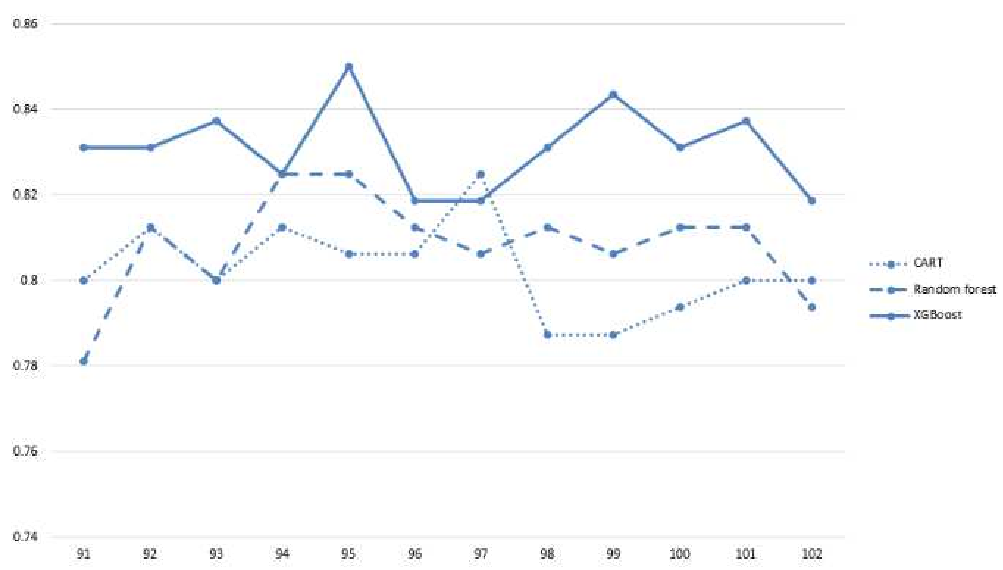 Visual comparison of accuracy across different model types.
Key findings include:
- Peak Performance: XGBoost with exactly 71 features hit 86.87%.
- Prior Work Comparison: The proposed system beat the nearest competitor (83.38%) by a clear margin of 3.49%.
- Robustness: The deep integration of 1D-CNN layers allowed the model to maintain high performance even when audio quality varied.
| Method | Accuracy |
|---|---|
| Alice D Souza et al. | 74.45% |
| Ranjana Dangol et al. | 83.38% |
| Proposed Framework (XGBoost Top 71) | 86.87% |
Deep Insight & Conclusion
This paper proves that Selective Attention (at both the feature level via XGBoost and the temporal level via the Attention layer) is the key to mastering audio data. By removing low-gain features, the model avoids the local minima that often plague deep learning in the SER domain.
Future Outlook: While the current results are impressive, the next frontier will be applying this XGBoost-Attention hybrid to real-world, "in-the-wild" datasets where background noise is more chaotic than the controlled environments used in current benchmarks.